

The entrance to the pool is a safety element, not an addition. European standard for equipment public swimming pool (EN 13451-2) requires that the height of the step be 230–300 mm and the same for all steps, ladder width 450–600 mm, handrail cross-section 25–50 mm, and the top step is flush with the edge of the pool. Everything that leads into the water must have the strictest anti-slip class — C.
Below is an elaboration that Croatian texts on this topic do not have: specific dimensions from the standard, the difference between the requirements for public and home pools, why A4 stainless steel is not a marketing designation but a number, and which anti-slip class applies to which surface. For a broader picture of the project, start with our a complete guide to building a swimming pool in Croatia.
What types of pool entrances are there?
In practice, there are three solutions: built-in stairs built into the shell itself (Roman, angular, straight), stainless steel ladder attached to the edge of the pool, and escalator for above-ground pools. All three do the same job, but differ in when they are decided upon, how much space they take up, and how much they cost to maintain.
This chapter is expert opinion of the Flusso team based on completed projects, not a quote from the norm. In the 800–1,000 pools we've tested, the pattern is consistent: people love built-in stairs for their looks and comfort, but underestimate how much floor space they take up. Corner and integrated versions save space because they sit in the corner of the shell and do not encroach on the swimming surface — in an 8 × 4 m pool, this is the difference between a swimming pool and a standing pool.
| Input type | Advantages | Disadvantages | When deciding |
|---|---|---|---|
| Built-in stairs in the shell (Roman, straight) | The most comfortable entrance, safe for children and the elderly, a place to sit in the water | They take away the swimming area, increase the cost of the coating (more curves and edges), an irreversible decision | Before concreting the shell |
| Corner / integrated stairs | They save space, do not encroach on the swimming surface, and retain the comfort of a built-in entrance. | Narrower entry space, more demanding corner cladding design | Before concreting the shell |
| Stainless steel ladders (installation in the edge) | They do not take anything away from the swimming area, can be added later, and can be dismantled in the winter. | Steeper entrance, less suitable for small children and less mobile, the quality of the stainless steel determines the lifespan | Can also be done after performing the shell |
| Escalator (above ground pools) | Without installation, removing the ladder prevents access to the pool | The least stable, they require a flat and solid surface, they are not a solution for an inground pool | Anytime |
We build concrete pools exclusively, so this article deals with reinforced concrete shell entrances. If you are still deciding on the type of pool, we have elaborated on the comparison in the article built-in or prefabricated pool.
What does the standard stipulate about stairs and ladders?
There is a Croatian standard that regulates this: HRN EN 13451-2:2020, “Swimming pool equipment — Part 2: Additional specific safety requirements and test methods for ladders, step ladders and handrails”. It was published on 31 July 2020 and is in force. It specifies the dimensional ranges that each swimming pool entrance should respect.

| Element | Requirement from EN 13451-2 | What does this mean in practice? |
|---|---|---|
| Stair height | 230–300 mm, and must be the same for all steps | The foot remembers the rhythm of the steps; every step that deviates is the place of a fall. |
| Tread alignment | Front edges vertically aligned, tolerance ± 10 mm | Stairs must not "run" in front of each other in the floor plan. |
| Ladder width | 450–600 mm | There is no more stable support for both legs than that. |
| Upper staircase | Level with the edge of the pool | Getting out of the water without a "hidden" half-step at the end |
| Handrail | At least one; for widths over 1,200 mm, another one, spaced at least 600 mm apart | Wide Roman steps require two handrails, not one in the middle |
| Catching section | 25–50 mm | A wet child's hand must grasp the tube; a thicker one cannot be grasped. |
Source: Croatian Standards Institute, HRN EN 13451-2:2020, dimensional requirements according to EN 13451-2:2015+A1:2020. The standard does not prescribe the number of stairs — that is determined by the depth of the pool and the chosen height of the stairs.
The most common mistake: uneven step height. In improvised built-in stairs, the last step is often "adjusted" to what is left at the bottom, so it turns out to be 180 or 350 mm. The standard explicitly prohibits this - the height must be the same for all steps. A person coming out of the water does not look at his feet but walks by memory of the rhythm, and it is precisely this one different step that causes a fall. It can only be corrected by demolishing and re-concreting.
Does this standard also apply to my backyard pool?
Not directly. EN 13451 is written for swimming pools for public use — hotels, campsites, sports facilities, public swimming pools. For home pools the second norm applies: EN 16582, of which Part 1 is general, Part 2 covers in-ground and Part 3 above-ground pools with a water depth greater than 400 mm.
This does not mean that there are no requirements for a private pool. Clause 5 of the EN 16582-1 standard is specifically dedicated to access to the swimming pool. ("means of access"): anti-slip properties, crushing and entrapment hazards, ladder dimensions and load capacity, lateral stability, submerged steps and handrails. Annex C prescribes test methods for entrapment of the head and neck, fingers, feet and hands — so exactly those scenarios that occur with children at the entrance to the pool.
The dimensions in EN 13451-2 are therefore not mandatory for your private pool, but they are the best available reference for good practice. When we design built-in stairs, we stick to these ranges because they are written for public pools, where the load is incomparably higher than on a home pool. For a private pool, it is a free choice — but a choice that costs nothing.
The same logic applies to the Croatian regulation. Regulation NN 59/2020 in Art. 9, paragraph 1, requires that the floors of swimming pools be anti-slip, but according to Art. 2. does not apply to swimming pools owned by citizens that are not intended for public useThere is no obligation; there is also no reason to behave differently from the profession.
How anti-slip does a staircase have to be?
For everything that leads to water, it is required anti-slip class C — barefoot class with an angle of inclination greater than 24°, the strictest that exists. Class C according to DGUV Information 207-006 look for ladders and steps leading into the water, sloping pool edges, and pool ramps with a slope of over 6 %.
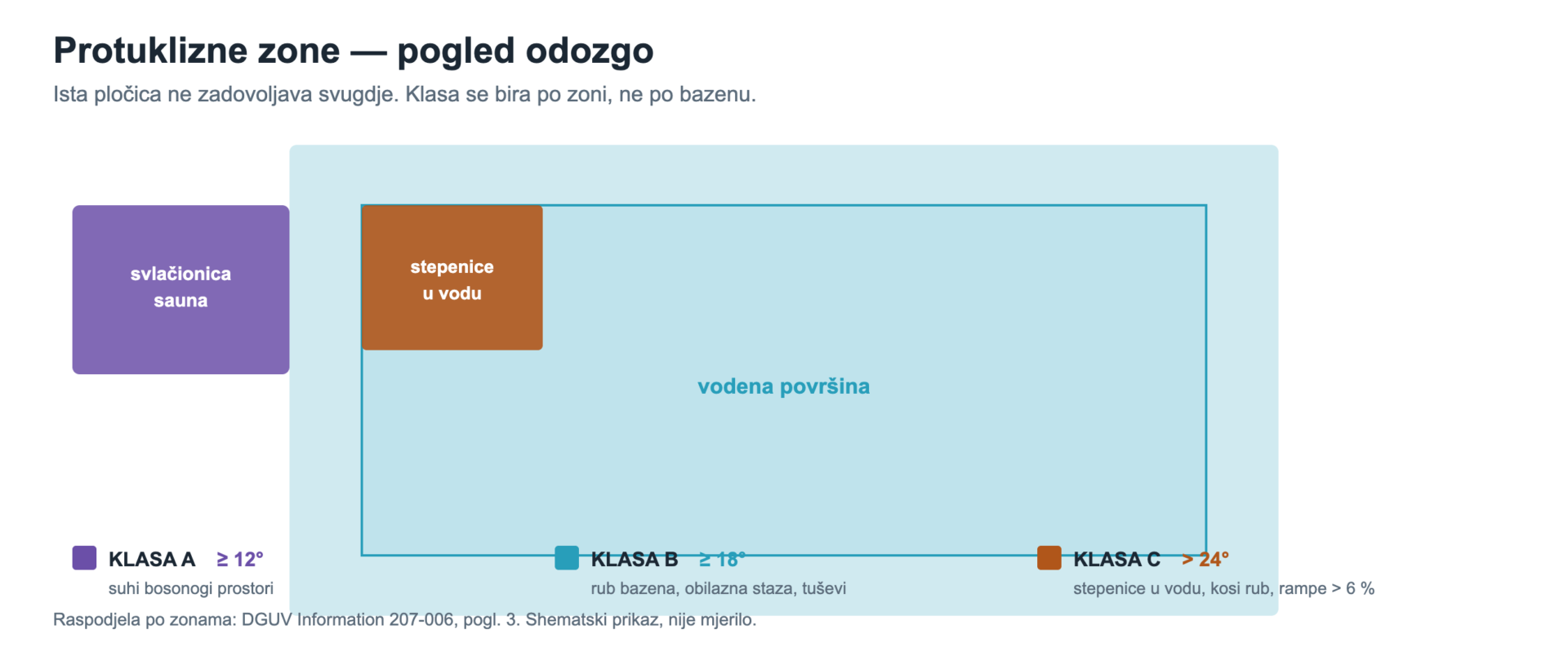
The edge of the pool and the surrounding path require a gentler class B (≥18°), which includes showers, overflow channel covers, and ladders and steps beyond pools. Dry barefoot areas — locker rooms, saunas — require class A (≥12°)The reason for the strictest class on the water ladder is simple: it is the only surface on which a person can stand barefoot and wet at the same time, transferring all their weight onto one leg and not seeing where they are standing.
Classes A/B/C are measured using the soap solution and barefoot tester method (DIN 51097, today EN 16165, Annex A). They are not the same thing as R-classes (R9–R13), which are measured with oil and in footwear, and they cannot transform into each otherIf someone offers you an "R11 stair tile", that is not the answer to the question about class C.
Pro tip: Anti-slip glass mosaic is available according to distributor price lists. about 50 % more expensive from the basic series. So don't put it everywhere — put it exactly where the German guideline DGUV 207-006 requires class C, that is, on the stair treads and the beveled edge, and cover the rest of the shell with the basic series. We have elaborated on this in detail in the text about tiles and ceramics for the poolThis is the only part of the pool where improvisation has a direct cost in injury.
A2 or A4 stainless steel — what to choose for a pool ladder?
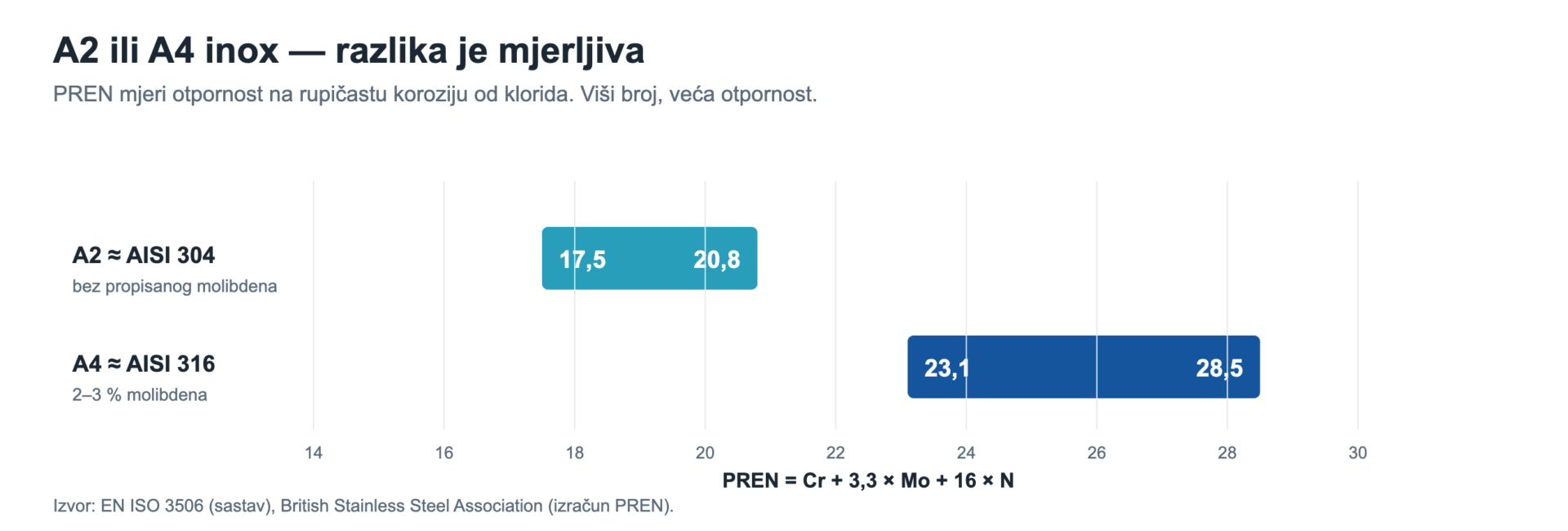
The difference is one element: molybdenumAccording to EN ISO 3506, A2 (approx. AISI 304) has 15–20 % chromium and 8–19 % nickel, but without prescribed molybdenum. A4 (approx. AISI 316) has 16–18.5 % chromium, 10–15 % nickel and 2–3 % molybdenumMolybdenum is what gives the material its resistance to chloride pitting corrosion.
| Label | Chromium | Molybdenum | Nickel | PREN |
|---|---|---|---|---|
| A2 (≈ AISI 304) | 15–20 % | not prescribed | 8–19 % | 17.5–20.8 |
| A4 (≈ AISI 316) | 16–18.5 % | 2–3 % | 10–15 % | 23.1–28.5 |
Information: PREN is calculated according to the formula PREN = Cr + 3.3 × Mo + 16 × N and measures the resistance to chloride pitting corrosion. A higher number means greater resistance. Therefore, A4 is not a marketing designation but a measurable difference in chemical composition. Source: British Stainless Steel Association.
A fair nuance, because it is never mentioned in sales texts: according to Australian Stainless Steel Association (ASSDA), for parts that are permanently immersed or regularly rinsed both 304 and 316 meet the requirements. The real risk is not water, but indoor pool atmosphere, where chlorides condense and deposit on parts that no one washes. So: the ladders on the outdoor pool that are constantly in the water will not disintegrate because they are A2.
So why do we still recommend the A4? Because of the chemistry of the water that we incorporate in practice. For swimming pools up to approximately 100 m³ We handle disinfection. by salt electrolysis — and the most popular size of 8 × 4 × 1.5 m has 48 m³ and falls neatly into that range. Salt electrolysis means permanently present chlorides in the water and on the sprayed edge of the pool. With the price difference, which is small on one set of ladders, and the difference in PREN, which is not, the A4 is simply a more rational choice.
As a reference value, the Astralpool "Easy Access" ladder is designed in AISI-316, with a handle diameter 43 mm and width 500 mm, in accordance with EN 13451-1 and EN 13451-2, in three- and four-step versions. The 43 mm handrail and 500 mm width fall exactly within the standard range — 25–50 mm and 450–600 mm, respectively. This is a good test when comparing offers: take a tape measure and check.
How to make a pool safe for children?
The entrance is the most important, but not the only point. According to World Health Organization, in the world, about die from drowning every year 300,000 people, almost quarter are children under five years old, and drowning is fourth leading cause of death in the age group of 1 to 4 years. Among the measures that WHO explicitly recommends is fencing off swimming pools.
Croatian data: according to Croatian Institute of Public Health, in the period 2014–2023, people died from drowning in Croatia 769 people, from that 47 children and young people under 19 years of age; only in 2023 68 peopleThe Croatian Institute of Public Health recommends that free access to swimming pools and water tanks be prevented.
Underestimated risk: The Croatian Institute of Public Health warns that small children can drown in just a few centimeters of water. This means that the shallow upper step is not a safe zone — it is the most exposed zone, because it is there that a child is most likely to find himself alone. The design of the entrance solves one part of the problem; the other part is that access to the pool is prevented when no one is supervising it.
Practically, from our perspective: built-in stairs with the same step height, handrail and class C give a child and an elderly person a controlled entry and exit. Ladders do not provide this — they require arm strength and turning your back to the water. If there are small children or a person with mobility difficulties in the household, built-in stairs are not an aesthetic choice but a functional one.
Built-in stairs or stainless steel ladders — how to decide?
Answer four questions and the decision will write itself.
- Who will enter most often? If they are children, parents with children, or elderly household members — built-in stairs. If they are adult swimmers — a ladder is completely sufficient.
- How much swimming surface do you have left? In pools 8 × 4 m and smaller, steps across the entire width take up a significant portion of the length; the angular design maintains comfort without eating up swimming length.
- What is the disinfection regime? Salt electrolysis means permanent chlorides — choose A4 on everything metal, including built-in stair handrails.
- What stage of the project are you in? This is a question with a deadline.
Deadlines that people miss: Built-in stairs are decided before the shell is concreting. They are not added after that — they are part of the reinforced concrete structure. Stainless steel ladders can be installed later. If you are not yet sure what kind of entrance you want, decide before the formwork goes to the site, because this is the only point where the decision costs nothing.
The impact on the price comes from the covering, not the structure: built-in stairs mean more edges, curves and cuts in the covering, plus anti-slip design on the treads. How this fits into the overall budget, we have explained using an example prices of swimming pools with dimensions of 8 × 4 mLadders and overflow grates are in the category pool environment in our offer.
Frequently asked questions
What are the dimensions of a pool ladder according to the standard?
According to EN 13451-2, the height of the step is 230–300 mm and must be the same for all steps, the front edges of the treads must be vertically aligned with a tolerance of ±10 mm, the width of the ladder is 450–600 mm, and the top step must be flush with the edge of the pool. The standard does not prescribe the number of steps or the depth of the treads — the number of steps is derived from the depth of the pool and the selected step height.
Does EN 13451 apply to a private backyard pool?
Not directly. EN 13451 is written for public use swimming pools, and for domestic swimming pools EN 16582 — Part 1 general, Part 2 for in-ground, Part 3 for above-ground with water depth over 400 mm applies. Clause 5 of EN 16582-1 is dedicated to access to the pool, and Annex C to testing for entrapment of the head, fingers and feet. The dimensions in EN 13451-2 remain a useful reference for good practice.
What anti-slip class should pool stairs have?
Class C, with an angle of inclination greater than 24° — the strictest barefoot class. According to DGUV Information 207-006, ladders and steps leading into the water, sloping pool edges and ramps with an inclination of more than 6 % require class C. The pool edge and bypass path require class B (≥18°), and dry barefoot areas such as changing rooms require class A (≥12°). The R-classes from DIN 51130 are measured by a different method and are not a substitute.
Are A4 pool ladders worth the price difference?
For a salt electrolysis pool — yes. A4 (≈ AISI 316) contains 2–3 % molybdenum and has a PREN of 23.1–28.5, compared to 17.5–20.8 for A2 (≈ AISI 304), which means greater resistance to chloride pitting. In fairness, ASSDA states that for permanently immersed or regularly rinsed parts, both 304 and 316 are satisfactory; the greatest risk is posed by the atmosphere of the enclosed pool.
Can I add a ladder to a pool that has already been built?
Yes. Stainless steel ladders are built into the edge of the pool and can be added after the shell is finished, and even dismantled over the winter. Built-in stairs are not — they are part of the reinforced concrete structure and are decided upon before concreting. This is the most common irreversible decision that owners fail to consider in time.
Next step
If you are in the design phase, solve the entrance before deciding on the layout of the formwork: the type of entrance, the height of the stairs within 230-300 mm, the position of the handrails and the anti-slip class on the treads. These are four decisions that cannot be changed without demolition. If you already have a pool and are considering a ladder, measure the width of the rim and the thickness of the handrail and compare to the standard ranges before ordering anything.
We work from Makarska to Zadar and we discuss the entrance to the pool during the project phase, not at the end of construction. Send us an inquiry with the dimensions of the pool and who will use it — we typically respond to inquiries within 24 hours.
 English
 Hrvatski
 Deutsch
 Español
 Русский
 Italiano
 Nederlands
 Svenska
 Dansk
 Čeština
 Українська
 Português
 العربية
 Suomi
 简体中文