

There are three types of pool liners to consider: glass mosaic, porcelain ceramics and PVC foil. Water absorption and slip resistance are decisive, not appearance. For a permanently immersed surface, absorption below 0,5 %, and for stairs leading into the water, anti-slip class C. Glass mosaic has 0 % absorption, foil lowest initial cost.
Below is an explanation that is almost non-existent in Croatian texts about pool tiles: which anti-slip class applies in which zone, why water absorption is a purchasing criterion, and why the adhesive and grout decide whether the covering will survive a decade. For a broader picture of the project, start with our a complete guide to building a swimming pool in Croatia.
What are the pool liner options?
There are actually three: glass mosaic, porcelain ceramic and PVC foil (liner). All three are made on a concrete shell, all three can function well, but they have a fundamentally different relationship between durability and initial price. At Fluss, we perform all three finishes, a we prefer glass mosaic — and for technical, not aesthetic reasons.
Mosaic is the only one of them that does not absorb water at all: glass has no open porosity, so there is no mechanism by which water would enter the material, freeze and destroy it. The foil does not deteriorate from moisture, but it is a consumable layer — it is replaced every 10–15 years, while ceramics last 20–30 years, and glass mosaic is declared by the manufacturer as a material with an unlimited life.
| Covering | Water absorption | Frost | Appearance and shape | Century |
|---|---|---|---|---|
| Glass mosaic | 0 % | Not susceptible to frost damage | Follows curves, steps and gradients; depth of color in water | The manufacturer states an unlimited lifespan for the material. |
| Porcelain ceramics (BIa) | ≤ 0.5 % | Low absorption significantly reduces risk; look for declared frost resistance | Large formats, flat surfaces; harder to follow curves | 20–30 years |
| PVC film (reinforced, ≥1.5 mm) | It is not porous, but it is a wear layer. | Not sensitive to frost | Welded fields, visible seams; quick installation | 10–15 years |
The lifespan of foil and ceramics according to publicly published data bazenirijeka.comReinforced foil is standardized as EN 15836-2 (min. 1.5 mm), homogeneous as EN 15836-1 (min. 0.75 mm) — check which one is on offer, because the "foil" is sold in both versions.
When foil makes sense: if the budget is tight, if a renovation is planned in ten years anyway, or if the pool needs to be put into operation quickly. Foil is cheaper (≈110 €/m² installed, mosaic ≈160 €/m²) and is installed in days, not weeks. It is not a worse solution — just a solution with a shorter horizon. We have explained the prices of the liner in the article about price of a swimming pool 8×4 m.
Why doesn't regular tile from the store go in a pool?
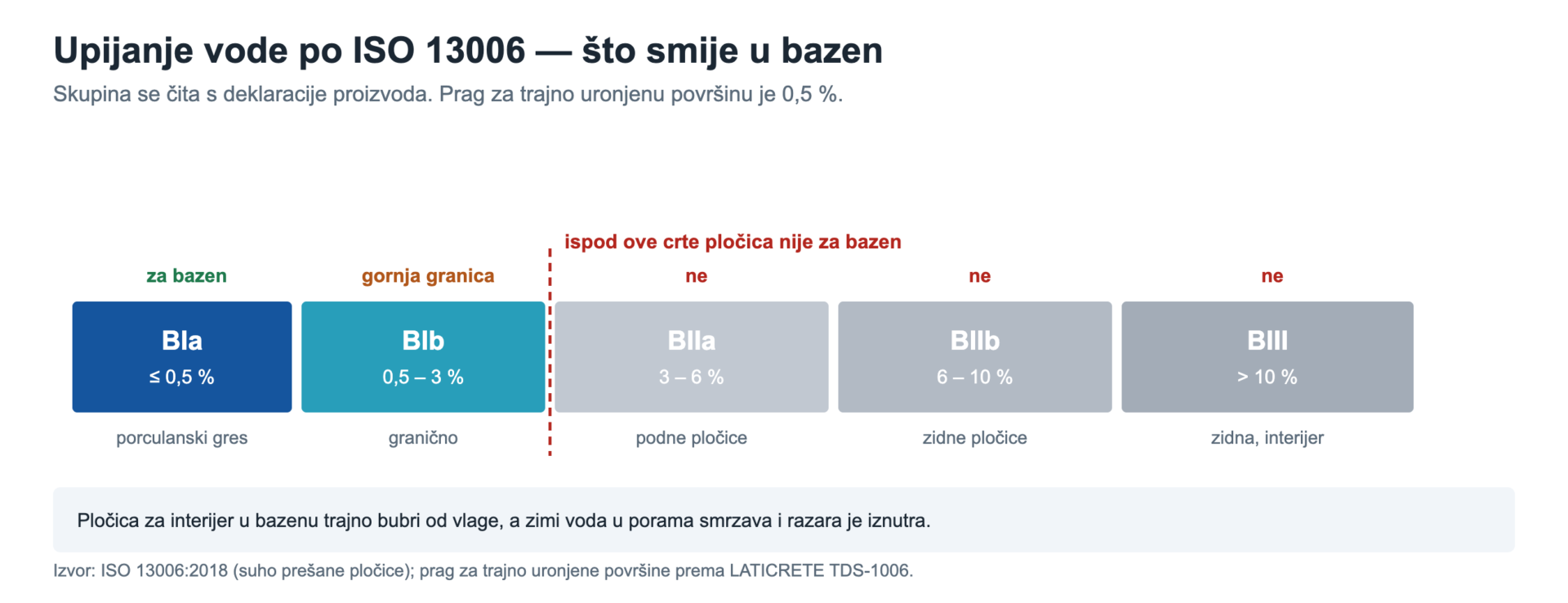
Because it absorbs water. Ceramics are ISO 13006:2018 classified by water absorption, and the difference between the groups is not cosmetic — it determines whether the tile will permanently swell and crack after the first winter. For a permanently submerged surface, absorption is required below 0.5 %, most under 3 %.
| Group (ISO 13006, dry pressed) | Water absorption | For the pool? |
|---|---|---|
| BIa — porcelain stoneware | ≤ 0.5 % | Yes — this is the target group |
| BIb | 0.5–3 % | Borderline, upper permissible limit |
| BILL | 3–6 % | Not |
| BIIb | 6–10 % | Not |
| BIII | > 10 % | No — it's an interior wall tile |
A threshold of 0.5 % recommends LATICRETE in the technical data sheet TDS-1006: a covering permanently immersed in water should be from a group with an absorption below 0.5 %, otherwise the tile will permanently swell from moisture. Floor and wall tiles for interior use regularly have an absorption above 3 % — perfectly good for the kitchen, completely wrong for the swimming pool. Check the class on the product declaration.
Hidden cost: A tile that absorbs 6 % of water in a pool is constantly saturated. When the edge strip freezes in winter, the water in the pores expands and destroys the tile from the inside — the edges along the grout crack first, then the glaze. Savings of a few hundred euros turn into breaking the entire edge strip, emptying the pool and re-grouting.
How anti-slip does a tile have to be — and where?
There is no single anti-slip class for the entire pool. There are three, and they differ by zone: the edge of the pool and the bypass path require class B, Stairs and ladders leading into the water require class C., and the dressing room and sauna class A. This is the most common mistake in selection — people buy one tile for everything and then have slippery stairs.
Slipperiness is measured by the angle of inclination on which the examiner can still safely walk. There are two completely different methods. Barefoot method (DIN 51097, now Annex A of the EN 16165:2021 standard) uses a soap solution and gives classes A, B and C. Method in footwear (DIN 51130, today Annex B) uses oil and provides R-classes, from R9 to R13.
| Pool area | Group | Tilt angle |
|---|---|---|
| Ladders and steps leading into the water | C — the strictest | > 24° |
| Sloping pool edges | C | > 24° |
| Pool ramps with slope > 6 % | C | > 24° |
| Pool edge and walkway | B | ≥ 18° |
| Ladders and stairs beyond swimming pool | B | ≥ 18° |
| Showers | B | ≥ 18° |
| Overflow channel covers | B | ≥ 18° |
| Locker room, sauna, mostly dry barefoot areas | AND | ≥ 12° |
The distribution by zones is taken from DGUV Information 207-006, Chapter 3 — the German guidelines for barefoot areas, which is still today the most concrete reference frame available for swimming pools.
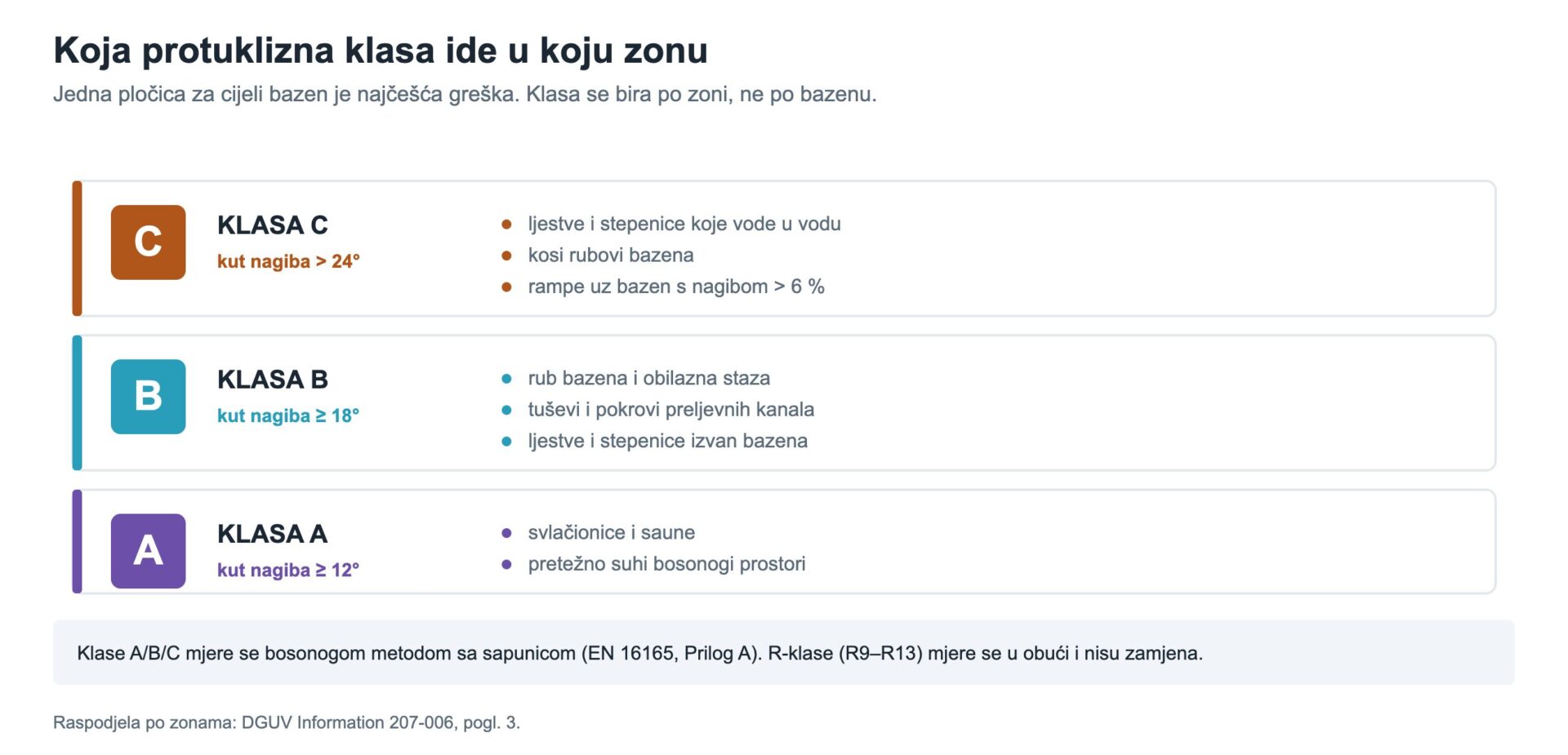
Key: R-class and A/B/C classes they are not convertible one into the other. These are two different methods, with different media (oil with shoes vs. soapy water barefoot) and different test conditions. A salesperson who tells you “R11 is the same as class B” is not telling the truth — he is just guessing. If the tile goes into the barefoot zone, ask for the barefoot method classification. Source: UK Slip Resistance Group.
Practical consequence: Look for the marking "class B according to DIN 51097 (now EN 16165, Annex A)" on the declaration. The DIN EN 16165:2021 standard has replaced both DIN 51097 and DIN 51130 at the European level, but the classes have been retained in the German national annex, so in practice both are still written. More about this change at BESCO GmbH.
What about the Croatian regulation? Regulation NN 59/2020 in Article 9, paragraph 1, for swimming pools, it requires that "floors must be non-slip" — but without specifying the class. Important: Art. 2 of the same Regulations explicitly states that does not apply to swimming pools owned by citizens that are not intended for public use. For your private pool, this is not a requirement. The physics of skating, however, does not know this difference.
Glass mosaic: what makes it good
The glass mosaic in the pool works because it has 0 % water absorption, is resistant to acids and alkalis and is not subject to frost damage. It's a material that doesn't age chemically — and pool water, between chlorine or electrolysis and pH correctors, is a pretty aggressive environment chemically.
According to official specifications of Vidrepur, whose mosaic we offer, the material has an unlimited lifespan. Physical properties: Mohs hardness 4, specific gravity 2.45–2.48 kg/dm³, softening point 730 °C.
Formats are standardized and this makes planning easier. Series Colors Sky comes in tablet format 25 × 25 mm in 22 shades; the sheet is approximately 315 × 315 mm, thickness 4 mm, mounted on gummed paper, on fiberglass with polyester or on dots. This small format is the reason why mosaic is the only one that neatly follows the rounded steps and overflow edge — a large tile has to be cut into strips there.
A Mohs hardness of 4 also represents a realistic limit: the mosaic is not indestructible against scratches. The sand that enters the pool from the bypass path is harder than glass, so regular vacuuming of the bottom protects the coating as well as the water.
How much do different mosaic series cost?
This is the part that people don't anticipate. The difference between the basic and anti-slip versions of the same series is about 50 % in material cost — and on stairs leading into the water, the industry demands anti-slip class C.
| Vidrepur series | Distributor price of materials |
|---|---|
| Colors (basic) | €22.50/m² |
| Colors+ | €31.50/m² |
| Colors anti-slip | €33.90/m² (≈ 50 % more than the basic one) |
| Nature | €43.90/m² |
Prices are distributor prices for the material (source: Matcarrelage distributor price list) and are not a binding offer. In our offer, glass mosaic as a material ranges from €30–250/m² depending on the series, while installation with the basic mosaic and everything included is indicative ≈160 €/m²Selecting a series can easily double the price of a panel, even though only one line in the offer has changed.
Pro tip: do not use anti-slip mosaic for the entire pool. The rougher the surface, the harder it is to clean and the more expensive it is. Use it where German guideline DGUV 207-006 requires it (good practice, not mandatory) — on the steps into the water, the sloping edge and the entrance zone — and cover the rest with the basic series. Safety remains the same, and the more expensive material is used for a small part of the surface. We write about designs and installation in the article about pool steps and ladders.
Glue and grout — the quiet half of the job
Pool liners almost always fail at the grout, not the tile. For permanently submerged surfaces, adhesives of class C2 S1 or C2 S2 according to EN 12004 — i.e. improved cementitious adhesives with proven deformability. For glass mosaic Mapei in the swimming pool waterproofing manual explicitly states the combination ADESILEX P10 + ISOLASTIC, described as "bright white color, specifically developed for installing mosaics". White is not marketing — through transparent glass you can see the layer underneath.
Mapei formulates more precisely than most contractors why a joint exists at all: "Joints are not just for decorative purposes; they are required to reduce the rigidity of the lining and make it more resistant to deformations." The joint is an expansion element. It absorbs thermal expansion of the cladding and micro-movements of the structure.
Risk: ordinary cement grout in a swimming pool is a mistake, not a saving. Mapei describes it as "porous material that can absorb water and stains" which requires regular sealing, and explicitly states that the finished cement joint "should not be used for water immersion installations such as pools"It is epoxy. "non-porous and highly resistant to water and stains"Source: Mapei Tech Talk.
Epoxy grouting becomes mandatory, not recommended, in pools where "sanitation treatments are carried out frequently with chlorinated water", in thermal pools and in pools with salt water. Since in practice we choose salt electrolysis for pools up to about 100 m³ of water, this means yes in most of our pools, epoxy grout is not an option but the default setting. Epoxy grout from Mapei's program is used for this purpose.
For ceramics, Keraflex Maxi S1, Kerabond + Isolastic and Ultralite S1 are also considered. The choice depends on the tile format and substrate, but class C2 S1 is the lower limit that we do not lower.
When can you fill the pool?
Not immediately. Depending on the type of grout, the pool may be filled after 48 hours, 10 days or 14 daysFailure to comply with this deadline is one of the most common ways to ruin an otherwise flawlessly executed coating — a joint that has not completed its setting under water remains permanently weaker and more permeable.
| Type of joint | Earliest filling | Source |
|---|---|---|
| Ultracolor Plus (CG2 FWA) | 48 hours | Maps |
| Epoxy grout | 10 days at 21 °C | LATICRETE |
| Cementitious, latex modified | at least 14 days at 21 °C | LATICRETE |
Pay attention to the addition "at 21 °C". At lower temperatures, setting takes longer, so the deadline is extended, not shortened — in Dalmatian practice, this mostly affects work in October and November.
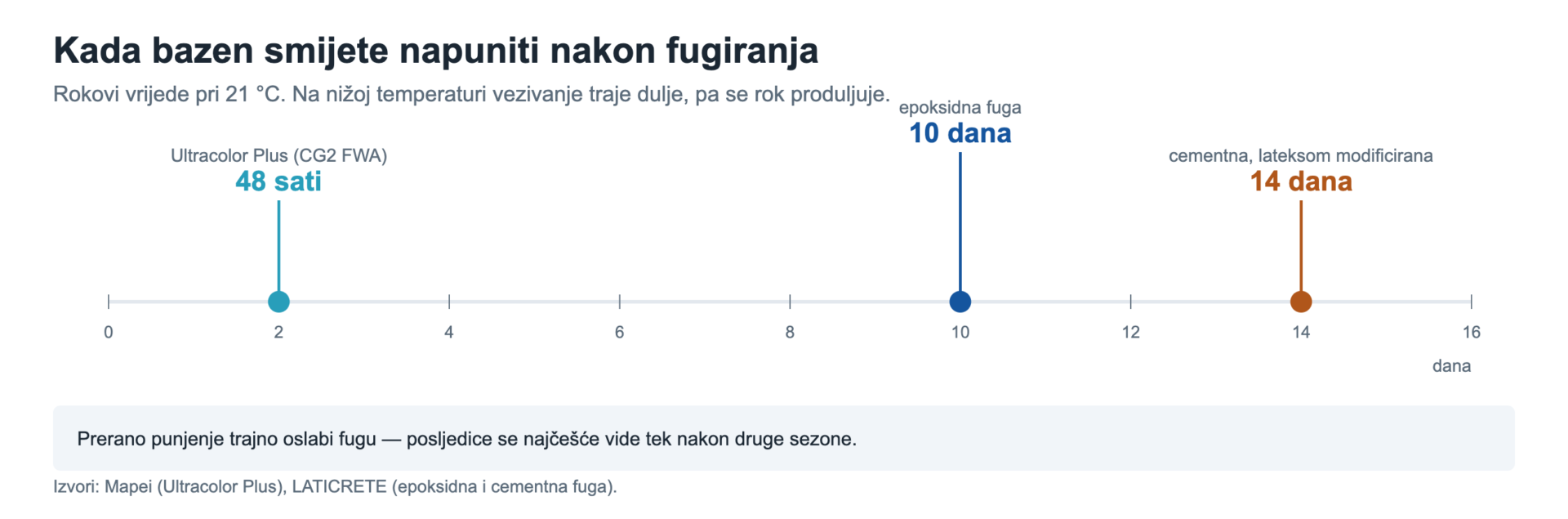
From practice: in 800 to 1,000 completed projects, the most expensive failure we find in other people's pools is not a bad tile — it's a pool filled too early, "because the guests arrived on Friday". That the joint has suffered is not seen immediately, but two seasons later, when he starts firing.
Salt water and wraps: what salt really attacks
Salt electrolysis does not corrode glass mosaic. What salt really attacks are cement joints, natural stone and metal partsThis is an important difference because it is often mixed up in offers — so the buyer is advised against electrolysis because of a coating that has no problems with it.
Glass has 0 % absorption, so there is no mechanism for salts to enter the material. Cement grout does. According to grout manufacturers (TEC / HB Fuller), salt can cause rust on many types of slate, discolor travertine, and in the case of chemical imbalances in water "corrode cementitious grouts" — corrode cement joints. Metal parts in the pool — ladders, handrails, fasteners — require appropriate quality stainless steel.
The design conclusion is simple: if salt electrolysis is used, then epoxy grout is also used, and natural stone as a coating for the submerged surface is discarded. In practice for pools up to about 100 m³ of water, we choose salt electrolysis, above that automatic for liquid chlorine and pH. The 8 x 4 x 1.5 m pool has 48 m³ — so electrolysis, so epoxy grout.
How much liner is needed for an 8 x 4 pool?
For a pool 8 × 4 × 1.5 m you need 68 m² of covering: 32 m² of floor and 36 m² of walls. The calculation is simple and worth doing before asking for a quote, as it immediately reveals whether someone has only calculated the floor in their quote.
- Bottom: 8 × 4 = 32 m²
- Longer walls: 2 × (8 × 1.5) = 24 m²
- Shorter walls: 2 × (4 × 1.5) = 12 m²
- Total walls: 36 m²
- Total: 68 m²
The perimeter edge, steps and cutting waste are added separately and depend on the geometry of the pool. In addition to installation with a basic mosaic at ≈160 €/m², the lining of that pool is indicative around €10,900The same area in foil costs ≈110 €/m² around €7,500 — the difference is approximately €3,400, or around €340 per year if the foil lasts ten years and the mosaic twenty. The ranges are indicative and are not a binding offer; a full breakdown of the costs can be found in the text about pool price by dimensions.
The mosaic material itself costs €30–250/m², which for 68 m² means a range of around €2,000 to €17,000 for the tiles alone. That's why when comparing offers, look for the series name, not just the word "mosaic". We've covered how the covering fits into the decision on the type of pool in our comparison. concrete, polyester and overflow pool.
Note on scope: we perform the pool shell, pool technology and pool lining — we do not do a “turnkey” landscaping. The bypass path is a separate job, but class B for that zone is equally valid, so coordinate your selection before ordering the patio stone. You can view the components in category of pool shells in our shop.
Frequently asked questions
What tiles are used for swimming pools?
For the pool, glass mosaic and porcelain ceramics from the BIa group with water absorption up to 0.5 % are used. Glass mosaic has 0 % absorption, is resistant to acids and alkalis and is not subject to frost damage, so it is the safest choice for a permanently immersed surface. Ceramics for the interior regularly have absorption above 3 %, so they are not suitable for a permanently immersed surface. Check the class on the declaration.
Can regular floor tiles be placed in a swimming pool?
No. The key criterion is water absorption according to ISO 13006, and interior tiles usually belong to group BIIa (3–6 %) or BIIb (6–10 %). Such tiles in a swimming pool permanently swell from moisture, and in winter the water in the pores freezes and destroys it from the inside. For a swimming pool, group BIa with absorption below 0.5 %, at most below 3 % is required.
What anti-slip class is required for pool steps?
Class C, the strictest barefoot class, with an angle of inclination greater than 24°. According to DGUV Information 207-006, class C is required for ladders and steps leading into water, sloping edges of pools and ramps with a slope over 6 %. The edge of the pool and the bypass require class B (≥18°), and the changing rooms and saunas require class A (≥12°).
Is R11 the same as anti-slip class B?
No, and the two designations are not interchangeable. The R-classes (R9–R13) are measured using the oil and footwear method according to DIN 51130, and classes A, B and C using the soapy water and barefoot method according to DIN 51097. These are different media and test conditions. For swimming pool areas, look for the barefoot method classification, currently EN 16165:2021, Annex A.
When can the pool be filled after grouting?
Depending on the joint: Ultracolor Plus allows immersion after 48 hours, epoxy joints require 10 days at 21 °C, and latex-modified cement joints require at least 14 days at 21 °C. At lower temperatures, the time limit is extended. Filling too early permanently weakens the joint, and the consequences are usually only visible after the second season.
Next step
You make the decision about the cladding before the shell is poured — it determines the thickness of the finishing layers, the design of the overflow edge, and the geometry of the steps. You need to choose three things: a material group, a series within your budget, and the zones where the anti-slip design will be applied.
Send us the dimensions of your pool and the desired look and we will get back to you with a breakdown of quantities and an approximate cost of the liner — we typically respond to inquiries within 24 hours. Request a quote here.
 English
  Hrvatski
  Deutsch
  Español
  Русский
  Italiano
  Nederlands
  Svenska
  Dansk
Dansk  Čeština
  Українська
  Português
  العربية
  Suomi
Suomi  简体中文
简体中文