Pool systems and equipment: how to put together a plant room
A pool plant room has four essential parts – the pump, filter, multiport valve and disinfection – and a few optional ones that are added as needed. The order is not a matter of taste.
A pool plant room has four essential parts – the pump, filter, multiport valve and disinfection – and a few optional ones that are added as needed. The order is not a matter of taste: the water always goes skimmer → pump → filter → disinfection → return to the pool. For an 8 × 4 × 1.5 m pool the basic equipment comes to about €1,900, and with automated disinfection and monitoring to €4,500–5,000.
This guide puts the whole plant room together in the order in which decisions are actually made, with figures instead of generalities: what flow each pool needs, why the filter is chosen before the pump, when salt electrolysis makes sense and when it does not, and how much space all of it actually takes up. If you are only starting to plan the build, begin with the complete guide to building a pool.
What makes up a pool plant room
The plant room is the space that houses everything that moves, cleans and treats the water. It divides into what the pool cannot work without and what is added depending on ambition and budget.
| Part | Role | Essential? |
|---|---|---|
| Pump | moves the water through the whole system | yes |
| Filter | retains mechanical dirt | yes |
| Multiport valve | sets the direction of the water – filtration, backwash, rinse | yes |
| Disinfection | destroys micro-organisms that the filter does not catch | yes |
| Monitoring and dosing | automatically maintains the pH and the disinfectant level | no, but it changes everyday life |
| Heating | extends the swimming season | no |
| UV sterilisation | reduces the amount of chemicals needed | no |
A definition that clears up half the misunderstandings: filtration and disinfection are not the same thing and do not replace each other. The filter catches what can be seen – sand, leaves, silt, particles down to 30–60 microns. Disinfection kills what cannot be seen – bacteria and algae. A pool with a flawless filter and no disinfection turns green within a few days, and a pool with chlorine and no filter stays cloudy. You need both.
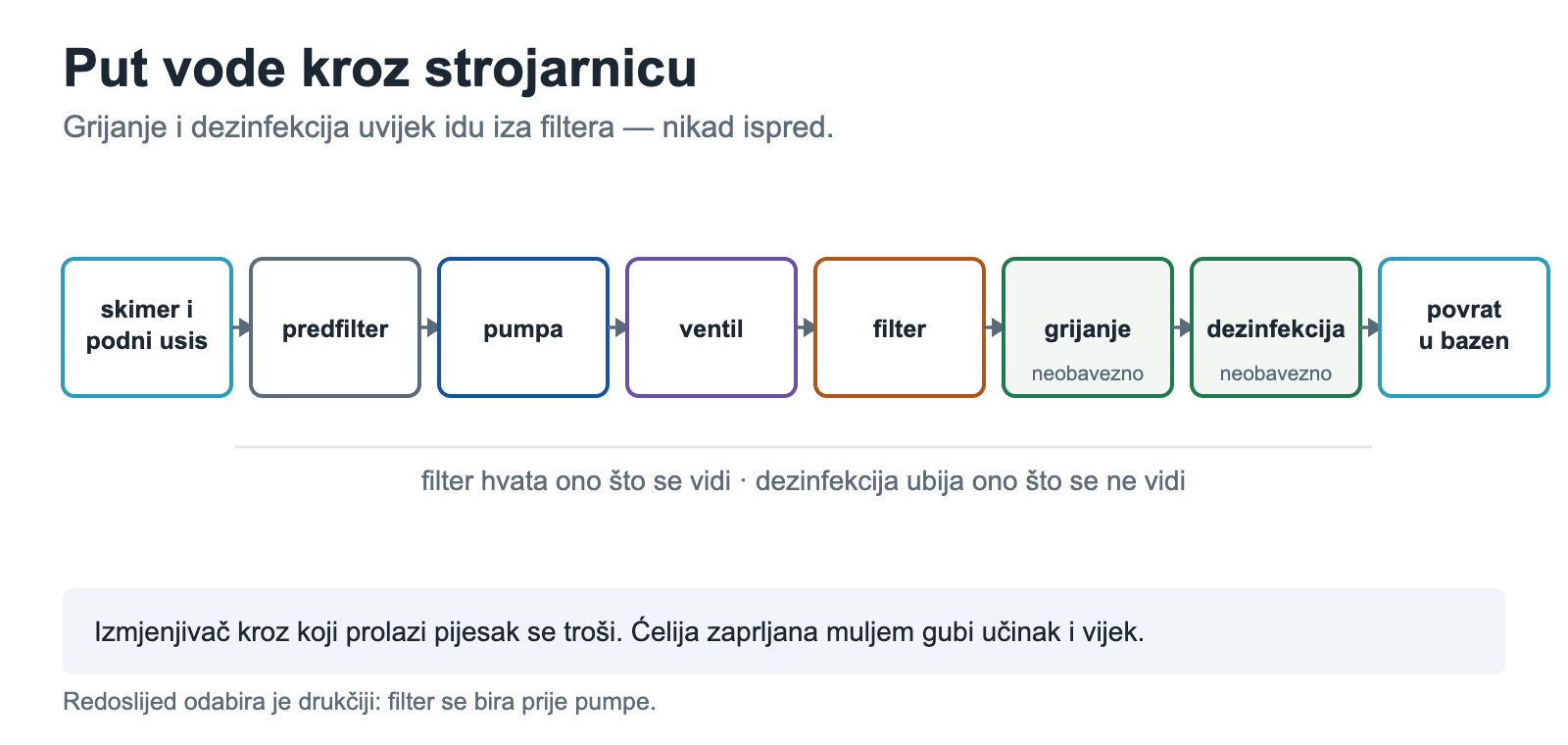
The order in which the water travels
The path of the water is always the same, and it is worth remembering because it explains why the equipment is arranged in exactly this order:
- Skimmer and bottom drain – the water leaves the pool. The skimmer takes it from the surface, the bottom drain from the floor.
- Pump strainer – the basket catches leaves and coarse debris before they reach the impeller.
- Pump – pushes the water onwards.
- Multiport valve – directs it to the filter or, when backwashing, in the opposite direction.
- Filter – the water passes through the media from top to bottom.
- Heating (if fitted) – always after the filter, so that no dirt passes through the heat exchanger.
- Disinfection – the electrolysis cell or dosing point, at the end of the line.
- Return to the pool through the return jets.
Two rules from this sequence always apply: heating and disinfection come after the filter, never before it. A heat exchanger that sand passes through wears out, and an electrolysis cell fouled with sludge loses efficiency and service life.
1. Pump – chosen by flow, not by motor power
The flow is calculated from the pool volume and the turnover time. The German practice for private pools is two turnovers in eight hours of operation, so the formula is (volume × 2) ÷ 8.
| Pool | Volume | Required flow | Minimum pipe diameter |
|---|---|---|---|
| 6 × 3 × 1.4 m | 25.2 m³ | 6.3 m³/h | d50 |
| 7 × 3.5 × 1.4 m | 34.3 m³ | 8.6 m³/h | d50 / d63 |
| 8 × 4 × 1.5 m | 48 m³ | 12.0 m³/h | d63 |
| 10 × 5 × 1.5 m | 75 m³ | 18.8 m³/h | d63 / d75 |
| 12 × 6 × 1.5 m | 108 m³ | 27.0 m³/h | d75 |
The pipe diameter is not a recommendation but a limit. According to an overview published by AQUA Magazine, the water velocity on the suction side should not exceed 1.83 m/s under the ANSI/PHTA/ICC-15 energy standard. At that velocity a d50 pipe carries about 10.6 m³/h – which is less than an 8 × 4 m pool needs. We cover the choice of models and the comparison of single-speed and variable-speed pumps in detail in the article on the pool pump. If you are building a smaller pool and thinking of a ready-made pump, filter and valve set, also look at the sand filter pump (monobloc) – where its limits lie and how much sand goes in.
2. Filter – actually chosen first
Although the water reaches it second, the filter is decided before the pump. The reason is that the filter has a rated flow that is an upper limit, not an operating point – so it sets a ceiling that the pump must not break through.
The measure is the filtration velocity in metres per hour. According to figures quoted by pool-magazin.com, the limit for private pools is 50 m/h, while DIN 19643 requires a maximum of 30 m/h for public freshwater pools. The quality of the filtrate falls as the velocity rises.
What is rarely said: manufacturers rate filters practically exactly at the private maximum. The Aster D500 is rated at 9 m³/h, which is 45.9 m/h; the D900 at 32 m³/h, which is 50.3 m/h. A filter labelled ‘9 m³/h’ therefore runs at the upper limit of what is permitted, with no margin. You will find the full table with the calculation, and a comparison of quartz sand and activated glass, in the article on the pool filter.
The practical consequence: choose a filter one diameter larger than the calculator says. The filter is the only item in the plant room where oversizing works in your favour – lower velocity, better water, less frequent backwashing, less resistance for the pump. With the pump, the opposite applies.
3. Disinfection – three routes and when to use each
The filter kills nothing. Disinfection is a separate system and is chosen according to the volume of water, not the surface area.
Salt electrolysis
The cell produces chlorine from salt dissolved in the water, and after doing its work the chlorine reverts to salt. There are no canisters and none of the smell of a chlorinated pool, and the water is softer on the skin. In practice we run pools of up to roughly 100 m³ on salt electrolysis – and the most popular size, 8 × 4 × 1.5 m, holds 48 m³ and falls neatly within that range.
From our range, by volume: Astralpool E-Next 12 g/h (€1,580), Hidrolife SAL16 for pools up to 65 m³ (€1,995), Hidrolife SAL22 up to 110 m³ (€2,250).
Automatic liquid chlorine and pH dosing
Above 100 m³ we move to dosing pumps with liquid products. The system measures the redox potential and the pH and doses exactly what is needed. From our range: a Zodiac Chlor Expert dosing pump (€1,150) and pH Expert (€850), plus pH and redox (Rx) sensors (€120 and €130) – all in the dosing equipment category.
Manual dosing with tablets
The cheapest and the most demanding. Tablets in the skimmer or a floating dispenser, measuring with test strips, correction by hand. It works perfectly well on smaller pools and with an owner who is regularly there. On a pool that is rented out or used at weekends, this is the model that most often ends in green water in August.
A figure worth knowing: equipment is sized by cubic metres of water, not by surface area. Two pools with the same 8 × 4 m surface area can have substantially different equipment if one is 1.2 m deep (38.4 m³) and the other 1.8 m (57.6 m³) – a difference of 19 m³, almost 50%. For an overflow pool, the contents of the balance tank and pipework must be added to that volume, as we described in the article on infinity and overflow pools.
4. Monitoring and dosing – what it actually changes
This part is not essential, but it does more than anything else to change how much attention the owner has to give the pool. The pH sensor and the redox sensor measure the water continuously, and the dosing pump corrects before the deviation is visible to the naked eye.
Why pH matters more than it sounds: at too high a pH, chlorine loses its disinfecting power, so you can have ‘enough chlorine’ according to the test and a green pool at the same time. Automatic pH correction often solves problems that the owner is trying to solve by adding even more chlorine.
For pools with salt electrolysis, pH control is almost essential because electrolysis in itself raises the pH.
Optional, but often requested
Heating
Three options, in order of rising installation cost and falling running cost:
- Heat pump – the most common choice for an outdoor pool. It takes heat from the air, so it is cheap to run. From our range: Astralpool Eco Elyo from €1,760, Zodiac Z250iQ from €2,000. The whole range is in the heat pumps category.
- Heat exchanger – connects to the existing boiler in the house. Cheap to buy (from €500), but it only makes sense if the boiler is running anyway.
- Electric heater – the cheapest to install, the most expensive to run. For an outdoor pool in season it rarely pays off.
Heating always goes after the filter, and a cover is almost essential with it – without a cover you are heating the surrounding air.
UV sterilisation
A UV-C lamp destroys micro-organisms as the water passes through the chamber, which reduces the amount of chemicals needed. It does not replace disinfection, because it has no residual effect in the pool itself – the water is disinfected only while it passes through the lamp. From our range: Lyriox UV-C from €465.
Cleaning
Robotic cleaners and vacuums are not part of the plant room – they work in the pool and put no load on the filtration. A robot draws 150–200 W and uses 0.4–0.5 kWh per cycle, whereas the main pump would need two extra hours of running to do the same job. You will find a comparison of models and prices in the article on the robotic cleaner or pool vacuum.
How much space the plant room needs
More than people expect. The basic pump and filter set for an 8 × 4 m pool takes up about one square metre of floor area, but it needs working space around it.
Practical minimums from installations:
- Access from at least two sides. The strainer lid is opened weekly, the valve is turned by hand, and the filter is emptied and refilled once in about ten years.
- Enough height to remove the media. With a D600 filter this means leaving room above the tank for a shovel and a sack.
- A floor drain. Backwashing the filter releases water, and seals will leak at some point. A plant room without a drain is a plant room that will flood one day.
- Ventilation. The pump motor is air-cooled, and a heat pump needs airflow as specified by the manufacturer.
- Proximity to the pool. Every metre of pipe and every elbow adds resistance.
- Height relative to the water level. Below the water level is always easier, because the water comes to the pump by itself.
If the plant room is not planned in the design, it ends up as a recess that the service technician can barely get into – and then servicing is put off until something breaks. This is one of the more common mistakes we come across, and we described it in the article on the garden pool as well.

What all this costs – an example for an 8 × 4 m pool
In concrete terms, for 48 m³ of water and the required flow of 12 m³/h, from our range:
| Level | What it includes | Indicative cost |
|---|---|---|
| Basic | Sena 75M pump (€610) · Aster D600 filter (€1,025) · 1½" multiport valve (€145) · quartz sand (from €16 per bag) | ≈ €1,900 |
| + salt electrolysis | basic + E-Next 12 g/h (€1,580) or Hidrolife SAL16 (€1,995) | ≈ €3,500–3,900 |
| + monitoring and pH | previous + pH Expert dosing pump (€850) + pH and Rx sensor (€250) | ≈ €4,600–5,000 |
| + heating | Eco Elyo heat pump from €1,760 or heat exchanger from €500 | + €500–2,600 |
| + automatic cleaning | robotic cleaner from €750 to €2,200 | + €750–2,200 |
The amounts are indicative, from our range, and do not include pipework, valves, installation or electrical work. They are not a binding quote. For comparison, our work on a pool of this size comes to roughly €35,000 (excluding the concrete shell), which we cover in detail in the article on the price of an 8 × 4 m pool – so the equipment is on the order of 10–15% of the total project.
The order of decisions
If we boil everything above down to a procedure, it goes like this:
- Calculate the volume – length × width × average depth.
- Calculate the required flow – (volume × 2) ÷ 8.
- Choose a filter whose rated flow is equal to or higher than that, preferably one diameter larger.
- Choose the pipe diameter that can handle that flow – and do it before the concrete is poured.
- Choose a pump that delivers the required flow without exceeding the rated flow of the filter.
- Choose disinfection according to the volume of water – salt electrolysis up to 100 m³, automatic dosing above that.
- Add monitoring and dosing if you want the pool to look after itself.
- Heating and cleaning last – these can be added at any time.
Next step
Before you ask for a quote for the equipment, calculate the pool volume and decide where the plant room will physically stand in relation to the pool and to the water level. Those two pieces of information determine the whole rest of the list – the flow, the filter, the pump, the pipe diameter, and whether the installation will be simple or a building job.
You can browse the complete plant room equipment in the Plant room category. We do the waterproofing, lining and equipment from Makarska to Zadar, and we give a contractual 5-year guarantee on the waterproofing. Send us the pool dimensions and a plan of the space for the plant room – we typically answer enquiries within 24 hours, and we will put together an equipment list with figures, including what you do not need.
Frequently asked questions
Four essential parts: a pump that moves the water, a filter that retains mechanical dirt, a multiport valve that sets the direction of the water, and disinfection that destroys micro-organisms. Optional additions are monitoring and automatic dosing of pH and disinfectant, heating and UV sterilisation. Robotic cleaners and vacuums are not part of the plant room because they work in the pool and do not pass through the filtration.
The water always goes skimmer and bottom drain → pump strainer → pump → multiport valve → filter → heating → disinfection → return to the pool. Two rules always apply: heating and disinfection come after the filter, never before it, because the heat exchanger and the electrolysis cell must not receive dirt. When selecting equipment the order is different – the filter is chosen first because its rated flow sets a limit that the pump must not exceed.
The pump and filter set alone for an 8 × 4 m pool takes up about one square metre, but a plant room needs considerably more: access from at least two sides, enough height to remove and refill the filter media, a floor drain, ventilation to cool the motor and, where possible, a position below the water level of the pool. The set may be installed at most 3 m below or 3 m above the water level; above it, a self-priming pump and non-return valves are needed.