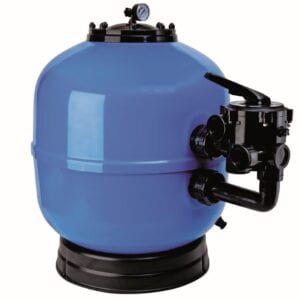
Sand filter pump for a pool: sizing and installation
The name is technically incorrect, but it has stuck, so we use it. The pump filters nothing – the tank of sand does. What is sold as a ‘sand filter pump’ is a set of three parts.
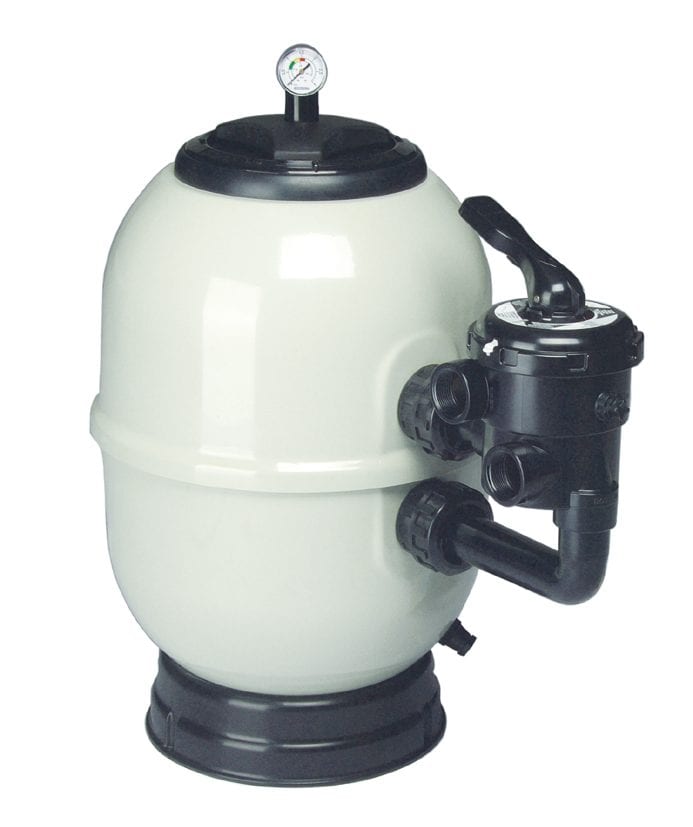
A ‘sand filter pump’ in practice means a monobloc – a pump, filter and multiport valve assembled on one base plate. The size is chosen not by motor power but by flow: a pool of 8 × 4 × 1.5 m (48 m³) needs about 12 m³/h. The quantity of sand is not a matter of estimation – the D400 takes 50 kg, the D500 about 90–100 kg, the D600 about 125 kg, and exceeding those figures forces sand back into the pool.
Below is the breakdown that the instructions supplied with the unit usually skip: where the monobloc may be installed in relation to the water level, in what order it is connected, what to do at first start-up and when a monobloc is not the right choice at all. If you are putting together a whole plant room, start with the guide to pool systems and equipment.
What a ‘sand filter pump’ actually is
The name is technically incorrect, but it has stuck, so we use it. The pump filters nothing – the tank of sand does. What is sold as a ‘sand filter pump’ is a set of three parts:
- A pump with a strainer (basket) that draws water from the pool.
- A filter tank with quartz sand or activated glass.
- A multiport valve that sets the direction of the water – filtration, backwash, rinse, recirculation, drain, closed.
Monobloc or separate components: a monobloc is the same system, only assembled at the factory and with fewer connections that someone can get wrong. The advantages are speed of installation and price. The drawback is that you are tied to the combination the manufacturer has chosen – if you need a larger filter later, you replace the whole unit, not just the tank. For a concrete pool with a separate plant room we generally install a separate pump and a separate filter precisely for that freedom.
Which size to choose
The same calculation as for any filtration: flow = pool volume ÷ time of one turnover. The German practice for private pools is two turnovers in eight hours of operation, so the formula is (volume × 2) ÷ 8.
| Pool | Volume | Required flow | Monobloc from our range | Price |
|---|---|---|---|---|
| 5 × 3 m | ≈ 20 m³ | 5.0 m³/h | Galactic D380 (5 m³/h) | €830 |
| 6 × 3 × 1.4 m | 25.2 m³ | 6.3 m³/h | Galactic D500 (10 m³/h) | €935 |
| 7 × 3.5 × 1.4 m | 34.3 m³ | 8.6 m³/h | Galactic D500 (10 m³/h) | €935 |
| 8 × 4 × 1.5 m | 48 m³ | 12.0 m³/h | above a monobloc – separate pump and filter | — |
This is a point worth saying out loud: a monobloc has an upper limit, and the most popular size, 8 × 4 m, is already above it. Our monoblocs cover up to 10 m³/h, and a pool of 48 m³ needs 12 m³/h. You can run it at 10 m³/h with longer hours of operation, but then you are choosing a compromise knowingly, not by accident.
How much sand goes in
This is the figure people most often guess by eye and most often get wrong. According to the instructions published by pooldoktor.at, the quantities by tank diameter are:
| Tank diameter | Sand quantity | Note |
|---|---|---|
| D400 | 50 kg | single grain size |
| D500 | 90–100 kg | single grain size |
| D600 | 125 kg | single grain size |
| D750 | 300 kg | in layers: 75 kg of coarse 2.0–3.0 mm + 225 kg of fine 0.7–1.2 mm |
In larger tanks the sand is added in layers: coarser at the bottom around the laterals, finer above it. That is why our range also includes coarser grain sizes – that is not worse sand but the bottom, supporting layer.
A quick win when filling: fill the tank halfway with water before you start pouring the sand, and cover the opening of the wide pipe with your hand or a plug. The water cushions the fall of the grains so that they do not break the laterals at the bottom, and the covered opening prevents sand from falling directly into the pipe. A broken lateral cannot be seen from the outside – you see it when sand trickles into your pool for months.

Where the monobloc may be installed
There are two hard limits and several practical rules.
Height difference relative to the water level. According to the same instructions, the unit may be installed at most 3 m below or 3 m above the water level in the pool. If it is above the water level, it needs a self-priming pump and non-return valves – otherwise the pump loses its water at every stop and next time draws air.
Below the water level is always easier. The water then comes to the pump by itself and there is no question of priming. That is why the plant room for in-ground pools is almost always built buried, next to the pool.
Practical rules from installations:
- Dry and ventilated. The pump motor is air-cooled. A closed recess without ventilation shortens its life.
- A floor drain. Backwashing the filter releases water, and seals will leak at some point. A plant room without a drain is a plant room that will flood one day.
- Access from all sides. The strainer lid is opened every week and the valve is turned by hand. If the service technician cannot reach it, neither will you.
- As close to the pool as possible. Every metre of pipe and every elbow adds resistance that the pump has to overcome.
- The electrical connection is carried out by an authorised electrician. A pool and a plant room are a space with prescribed protection zones – not a place for an extension cable.
In what order it is connected
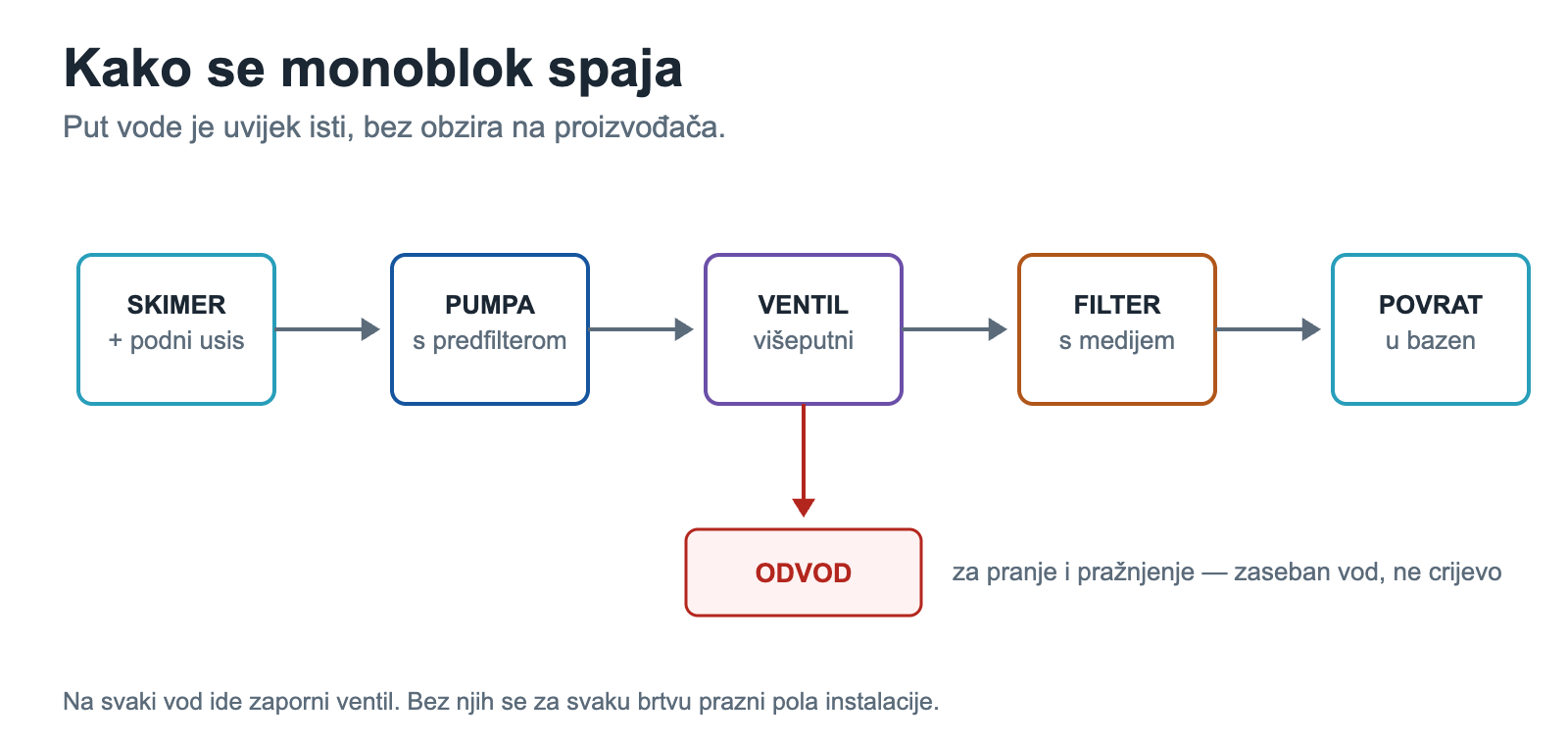
The path of the water is always the same, regardless of the manufacturer:
- Skimmer and bottom drain → suction line to the pump.
- Pump (with the strainer basket) → pressure line to the valve.
- Multiport valve → filter tank.
- From the filter → return to the jets in the pool.
- From the valve → a separate line to the drain (for backwashing and emptying).
The line to the drain is the one that is most often forgotten or improvised with a hose. Every filter backwash sends water through it – close to a tonne per backwash with medium-sized filters. Check the conditions for discharging pool water with the responsible water utility before you connect anything to the drains.
Every line gets an isolation valve. Without them, half the installation has to be emptied for every seal replacement or basket cleaning.
First start-up
A sequence that prevents the three most common beginner problems:
- Valve to ‘backwash’, then start the pump. New sand contains dust and fine particles that would otherwise go straight into the pool. Backwash until the water in the sight glass becomes clear.
- Then to ‘rinse’, for 20–30 seconds. This settles the media and flushes the cloudy water out of the laterals.
- Only then to ‘filtration’. Note the pressure that the gauge shows at that moment – it is your baseline with clean media, a reference for the next ten years or so.
Maintenance through the season
Backwashing the filter is triggered by the pressure gauge, not the calendar. The source states that backwashing is needed when the pressure reaches roughly 1.0 bar; in practice a more reliable indicator is a rise of 0.3–0.5 bar above your baseline, because the absolute value differs from system to system.
In addition, weekly:
- Empty the strainer basket. A full basket chokes the pump just as effectively as a clogged filter.
- Check the water level. Below the middle of the skimmer, the pump starts to draw air.
- Listen to the pump. A change in sound to a gravelly rattle means air in the system or cavitation – switch off and look for the cause before you carry on.
For winter: drain the water from the pump and filter, leave the valve in an intermediate position so that the seal is not pressed against the same spot all the time, and if the plant room is outdoors, dismantle the unit and store it. The sand does not need to be removed.
Next step
Before buying, calculate the required flow from the pool volume and check two things at the place where you plan to install the unit: the height difference relative to the water level and whether there is a drain. Those two items decide whether the installation will be an afternoon’s job or a building job.
You can browse monoblocs, separate pumps, filters and media in the Plant room category. If you are not sure whether a monobloc is enough for your pool, tell us the pool dimensions and where you plan the plant room – we typically answer enquiries within 24 hours, and we will tell you frankly when a monobloc is too small a choice for what you are building.
Frequently asked questions
By flow, not by power. Calculate the flow as (pool volume × 2) ÷ 8 if you are aiming for two turnovers in eight hours of operation. A 6 × 3 × 1.4 m pool (25.2 m³) needs 6.3 m³/h, and an 8 × 4 × 1.5 m pool (48 m³) needs 12 m³/h. The monoblocs in our range go up to 10 m³/h, so for an 8 × 4 m pool and larger you move to a separate pump and filter.
It depends on the tank diameter: the D400 takes 50 kg, the D500 about 90–100 kg, the D600 about 125 kg, and the D750 300 kg in total in two layers – 75 kg of coarse 2.0–3.0 mm at the bottom and 225 kg of fine 0.7–1.2 mm above. The exact quantity is written on the tank itself and must be respected; if you pour in more than prescribed, the sand washes out into the pool during backwashing.
The unit is installed no more than 3 m below or 3 m above the water level in the pool; if it is above the water level, a self-priming pump and non-return valves are needed. The location must be dry, ventilated, with a floor drain and access from all sides. The water goes skimmer → pump → multiport valve → filter → return to the pool, with a separate line from the valve to the drain for backwashing. The electrical connection is carried out by an authorised electrician.