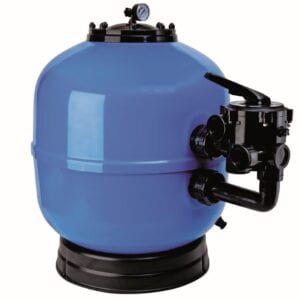
Sand vs quartz pool filter – which one filters better
‘Sand’ and ‘quartz’ filters are the same thing – the medium in a sand filter is quartz sand. The real decision lies elsewhere: quartz sand or activated glass as the filter medium.
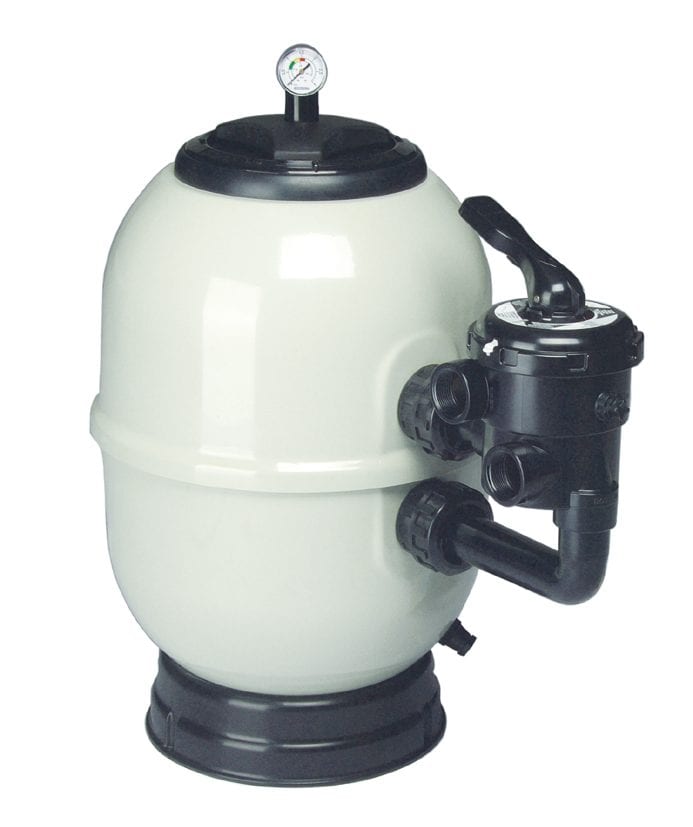
First, a correction that clears up half the confusion: ‘sand’ and ‘quartz’ filters are the same thing. The media in a sand filter is quartz sand – these are not two types of filter but two names for the same device. The real decision you make is a different one: quartz sand or activated glass as the media. Sand retains particles of 30–60 microns, glass, according to manufacturers’ declarations, down to 5 microns, and it lasts up to three times longer.
Below is a breakdown explaining why the rated flow on a filter is not an operating point but a maximum, how much media is actually needed, and when replacing sand with glass makes sense and when it is a waste of money. If you are putting together a whole plant room, start with the guide to pool systems and equipment.
Where the ‘sand vs quartz’ confusion comes from
The confusion comes from adverts. Sellers sometimes write ‘quartz filter’ to emphasise the quality of the media, which has created the impression that there is some third type of filter. There is not. For domestic pools, practically two designs are used:
- Sand filter – a tank with media through which the water passes from top to bottom. The media is quartz sand or activated glass. It is cleaned by reversing the flow (backwashing).
- Cartridge filter – a cartridge of pleated material that is removed and rinsed or replaced. It filters more finely but is not backwashed.
In plant rooms we install sand filters, so this article is about them. That is not because the cartridge is bad, but because a sand filter is cleaned with one turn of the valve, without removing and hand-rinsing anything, which, over a season, makes a considerable difference to how much time the owner actually spends on the pool.
The key difference: the media does not change the type of filter. Activated glass poured into a sand filter is still a sand filter – the same tank, the same valve, the same way of backwashing. Only the fineness of filtration and the life of the media change. Anyone who sells you a ‘glass filter’ as a separate device is selling you a sand filter with different media.
The rated flow of a filter is a maximum, not an operating point
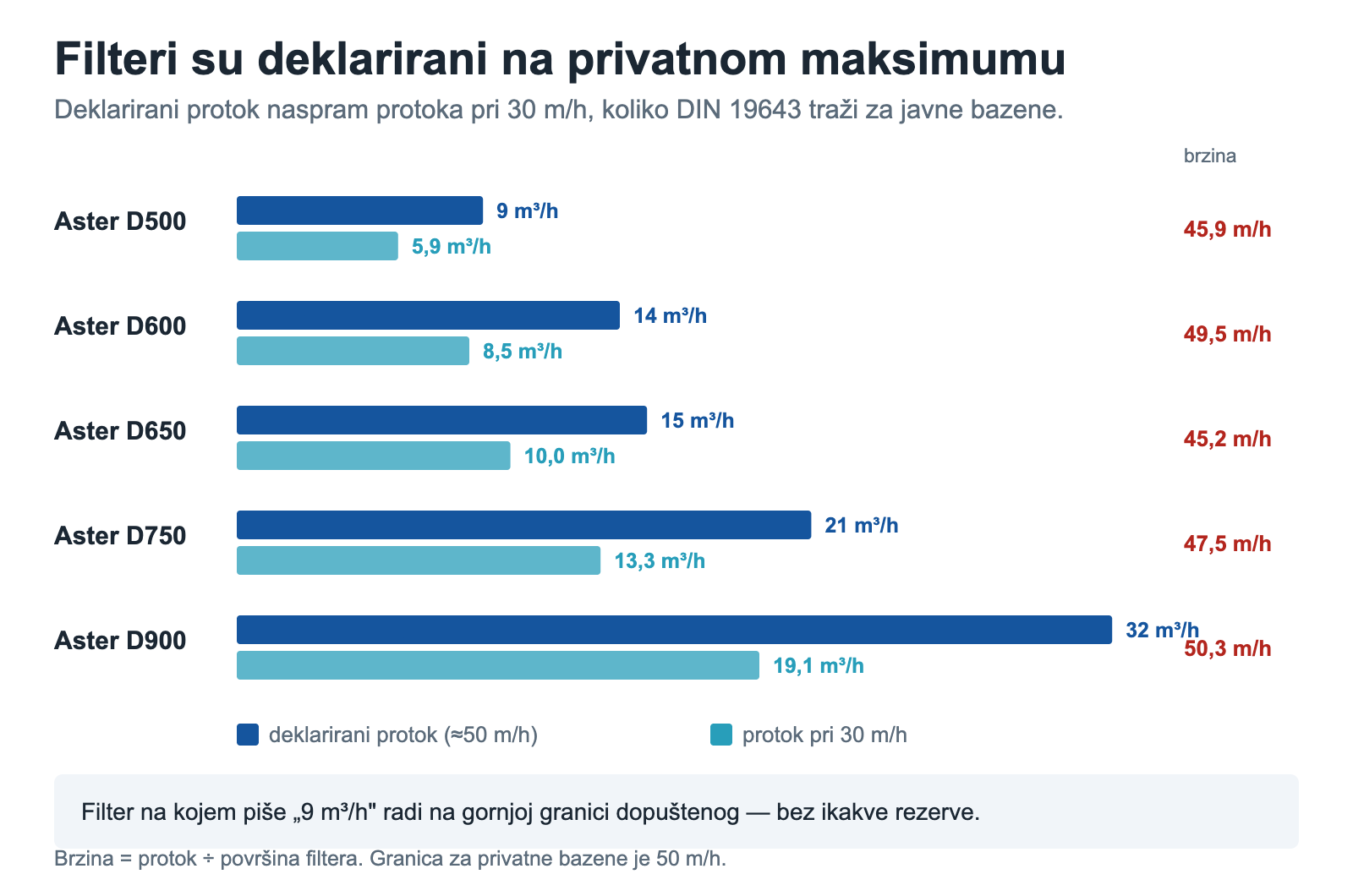
This is the most important figure in the whole article, and it is hardly explained anywhere. Filtration velocity is measured in metres per hour and is obtained by dividing the flow by the filter area. According to figures quoted by pool-magazin.com, the limits are:
- private pools: at most 50 m/h
- public freshwater pools (DIN 19643): at most 30 m/h
- public pools with sea or salt water: at most 20 m/h
The same source states explicitly that the quality of the filtrate falls as the velocity rises. And now look at what manufacturers actually declare:
| Filter | Rated flow | Area | Velocity at rated flow | Flow at 30 m/h |
|---|---|---|---|---|
| Aster D500 | 9 m³/h | 0.196 m² | 45.9 m/h | 5.9 m³/h |
| Aster D600 | 14 m³/h | 0.283 m² | 49.5 m/h | 8.5 m³/h |
| Aster D650 | 15 m³/h | 0.332 m² | 45.2 m/h | 10.0 m³/h |
| Aster D750 | 21 m³/h | 0.442 m² | 47.5 m/h | 13.3 m³/h |
| Aster D900 | 32 m³/h | 0.636 m² | 50.3 m/h | 19.1 m³/h |
Each of them is rated practically exactly at the private maximum of 50 m/h. That is not deception – that is how filters are rated across the whole industry. But it means that a filter labelled ‘9 m³/h’ is running at the upper limit of what is permitted, with no margin at all. If you want the filtrate quality that the regulations require for public pools, you may run that same filter at 5.9 m³/h.
Calculation: area = π × (diameter ÷ 2)². For the D500 that is π × 0.25² = 0.196 m². Velocity = 9 ÷ 0.196 = 45.9 m/h.
Quartz sand or activated glass?
This is the real choice. Both options go into the same filter and are replaced in the same way.
| Feature | Quartz sand | Activated glass |
|---|---|---|
| Fineness of filtration | 30–60 microns | down to 5 microns (manufacturer’s declaration) |
| Media life | shorter | up to 3× longer |
| Quantity per fill | more by weight | less by weight |
| Backwashing | more often and longer | less often and shorter, less water used |
| Price in our range | €16 per bag | €35 per bag |
The arithmetic is fairer than it looks at first glance. Glass is 2.2 times more expensive per bag, but lasts up to three times longer and less of it is needed by weight. Over the life of the media it comes out at roughly the same or slightly cheaper – and you get finer filtration and less water used on backwashing. Read the number of bags per filter from the manufacturer’s instructions, as it depends on the diameter of the tank.
An honest caveat: the 5-micron figure comes from the glass manufacturers’ declarations, not from an independent measurement on your pool. Independent sources also warn of something more important: glass poured into a sand filter still works in a sand filter, which is structurally a less efficient design than a cartridge filter. Glass is an upgrade to an existing system, not a move into a different league of filtration. Do not expect a change of media to fix an oversized pump or an undersized filter.
Which grain size and how much media
According to DIN EN 12904, two grain sizes are used in practice: 0.4–0.8 mm and 0.7–1.2 mm. The finer one retains smaller particles; the coarser one gives less resistance and is easier to backwash.
In larger filters the media is laid in layers – a coarser layer at the bottom around the laterals, a finer one above it. That is why our range also includes coarser grain sizes such as 1.0–3.0 mm and 3.0–5.0 mm: they are not ‘worse sand’ but the bottom, supporting layer. For the bed depth the source gives an indicative 80 cm, but take the actual depth and layer distribution from your filter’s instructions.
Do not improvise with building sand. Filter media is washed, graded and declared by grain size – building sand has ungraded particles that either pass through the laterals or compact into an impermeable crust.
What size of filter for which pool
You choose the filter according to the pump flow, and the pump according to the pool volume. The order matters: first calculate the required flow, then choose a filter that can handle it with a margin, and only then the pump that will not exceed it.
| Pool | Volume | Required flow | Filter | Price |
|---|---|---|---|---|
| 6 × 3 m | 25 m³ | 6.3 m³/h | Aster D500 (9 m³/h) | €855 |
| 8 × 4 m | 48 m³ | 12.0 m³/h | Aster D600 (14 m³/h) | €1,025 |
| 10 × 5 m | 75 m³ | 18.8 m³/h | Aster D750 (21 m³/h) | €1,460 |
| 12 × 6 m | 108 m³ | 27.0 m³/h | Aster D900 (32 m³/h) | €2,080 |
The prices are from our range and subject to change. For the 8 × 4 m pool we deliberately skipped the D500, even though its rated flow of 9 m³/h is not far from the 12 required – because the filter would run above its rating. The whole range is in the Plant room ▸ Filters category.
Backwashing the filter: when, for how long and how much water it uses
The filter is backwashed by reverse flow – the water goes in the opposite direction, lifts the media and carries the accumulated dirt to the drain. According to the source, the backwash velocity is 45–50 m/h, the usual frequency is once a week, and it lasts 3–5 minutes, or until the water in the sight glass becomes clear.
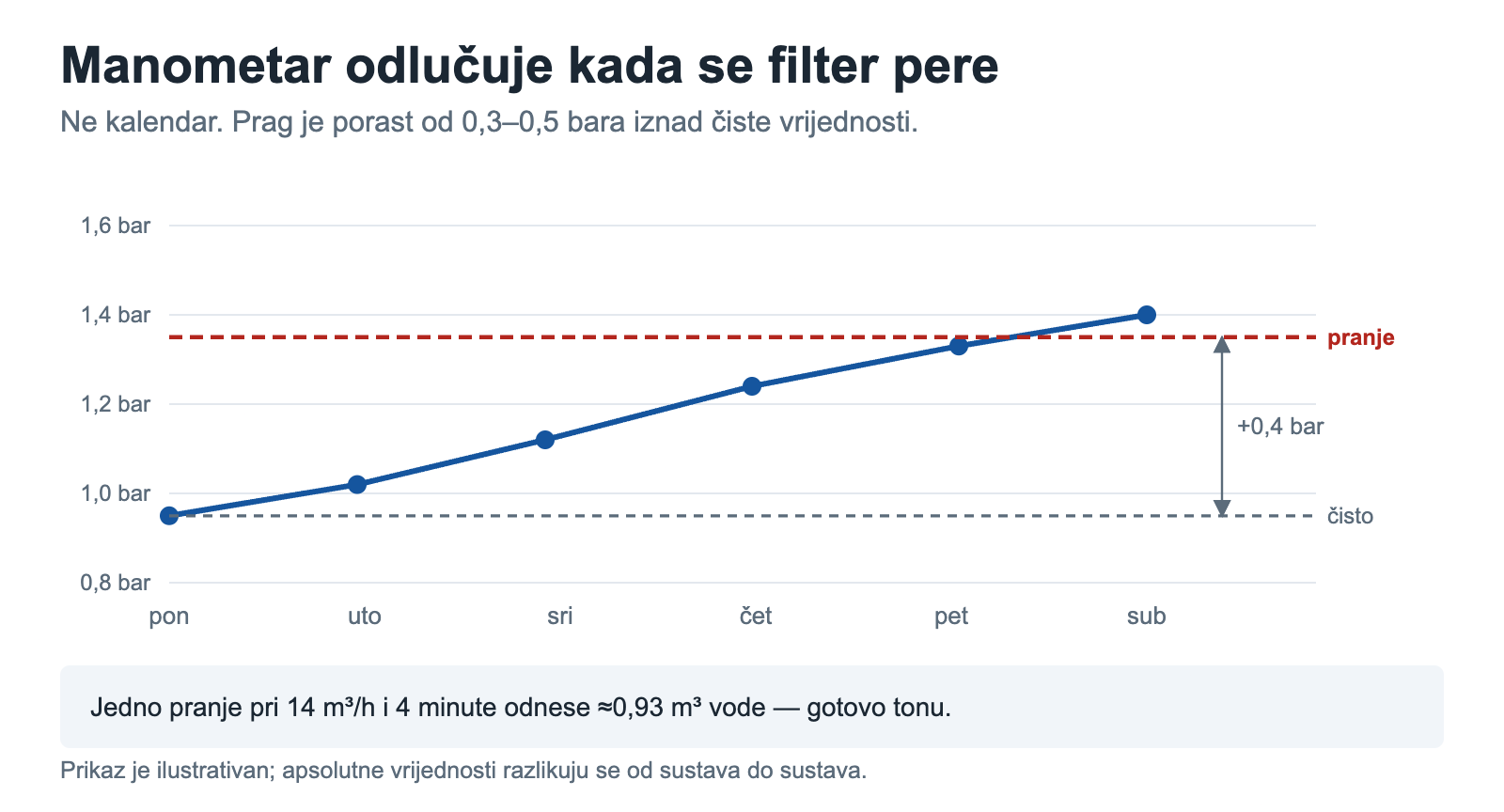
But the calendar is not the best indicator – the pressure gauge is. When the pressure rises by about 0.3–0.5 bar above the value the filter shows with clean media, it is time to backwash. Record that clean value immediately after the first backwash; without it you do not know whether 1.4 bar is normal for your system or a sign of a problem.
How much water one backwash uses: at a flow of 14 m³/h and a duration of four minutes it is roughly 0.93 m³ – almost a tonne of water per backwash. With weekly backwashing over a five-month season that comes to about 20 m³, which is more than a third of the volume of an 8 × 4 m pool. This is our calculation from flow and duration, not a measurement. In a year when the water utilities are calling for savings, that is a reason to watch the pressure gauge instead of the calendar – and one more argument for glass, which needs less frequent backwashing. We cover water consumption in detail in the article on the garden pool.
After backwashing, a short rinse of 20–30 seconds is essential before returning to filtration. Without it, cloudy water from the laterals goes straight back into the pool and the owner concludes that the backwash made things worse.
Next step
Measure two things before you order anything: the pool volume and the diameter of your existing filter. The volume gives you the required flow, the diameter the filtration velocity at which your system is currently running. If that velocity exceeds 50 m/h, the problem is not the media but the sizing – and replacing sand with glass will not help there.
You can browse filters, quartz sand and activated glass in the Plant room ▸ Filters category. If you are not sure what suits you, tell us the filter diameter, the pump flow and the pool volume – we typically answer enquiries within 24 hours, and we will also tell you when the answer is that your existing system works perfectly well.
Frequently asked questions
The question is really which media purifies better, because the filter is the same. Quartz sand retains particles of 30–60 microns, and activated glass, according to manufacturers’ declarations, down to 5 microns. Glass therefore filters more finely, lasts up to three times longer and needs less frequent backwashing. A caveat: the 5-micron figure is the manufacturer’s declaration, and glass poured into a sand filter still works in that structurally less efficient design.
It makes sense when the sand is near the end of its life anyway, when the filter is backwashed more often than before or when you struggle to keep the water clear despite proper treatment. It does not make sense as a first remedy if the problem lies elsewhere – an oversized pump, an undersized filter or weak disinfection are not fixed by changing the media. In price terms glass is about 2.2 times more expensive per bag, but over its service life it comes out at roughly the same.
Roughly once a week, for 3–5 minutes, or until the water in the sight glass becomes clear. A more accurate indicator than the calendar is the pressure gauge: backwash when the pressure rises by 0.3–0.5 bar above the value with clean media. After backwashing, allow a rinse of 20–30 seconds before returning to filtration.