Pool pump: how to choose the right one (filter pump)
A pool pump is chosen by flow, not by motor power. The real upper limit is not set by the pool – it is set by the filter and the pipe diameter.

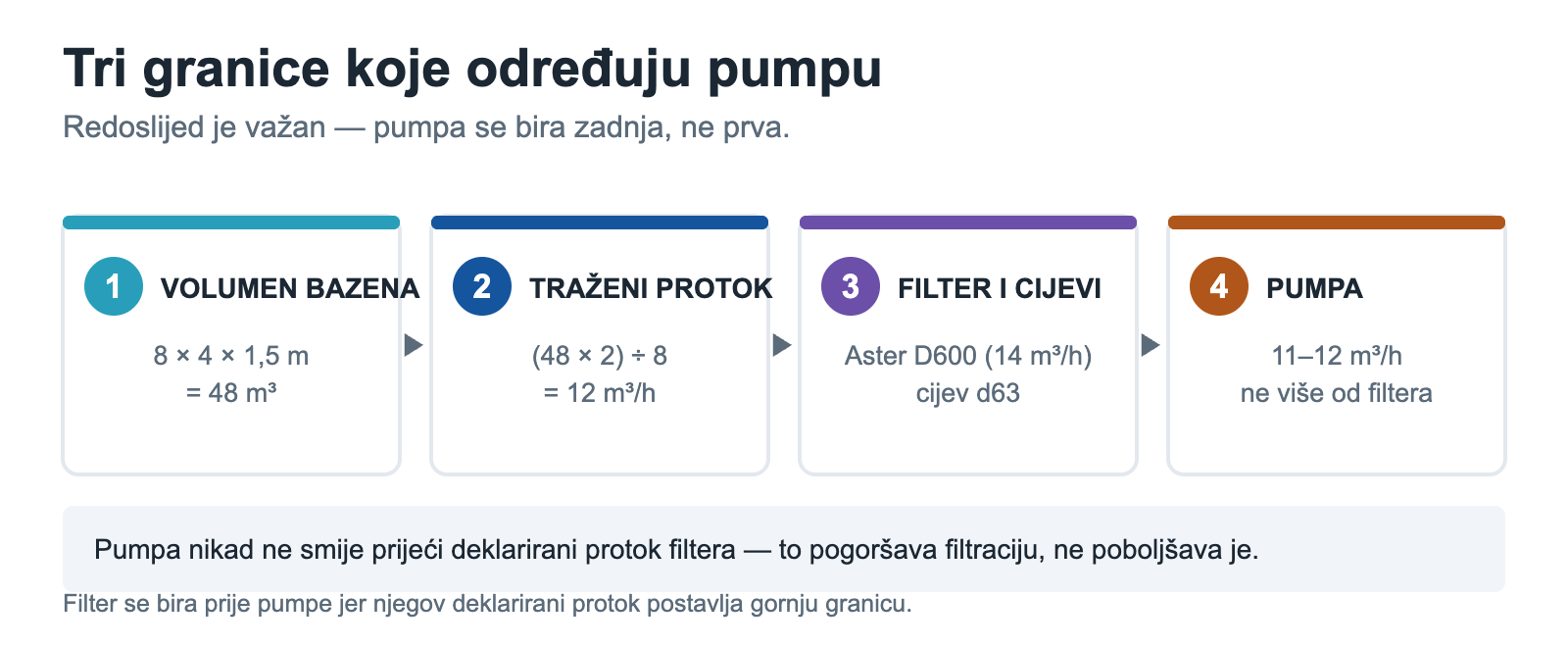
A pool pump is chosen by flow, not by motor power. For an 8 × 4 × 1.5 m pool (48 m³) you need a pump of about 12 m³/h if the water passes through the filtration twice in eight hours of operation. But the real upper limit is not set by the pool – it is set by the filter and the pipe diameter. A pump that is too strong for a filter that is too small means worse filtration, not better water.
Below is the breakdown that Croatian articles on pool pumps skip: how flow is actually calculated, why the rated flow on a filter is a maximum, not an operating point, how much a d50 pipe actually lets you pass, and whether a variable-speed pump pays off in a season lasting five months. For the bigger picture of the plant room, start with the guide to pool systems and equipment.
What flow does your pool need?
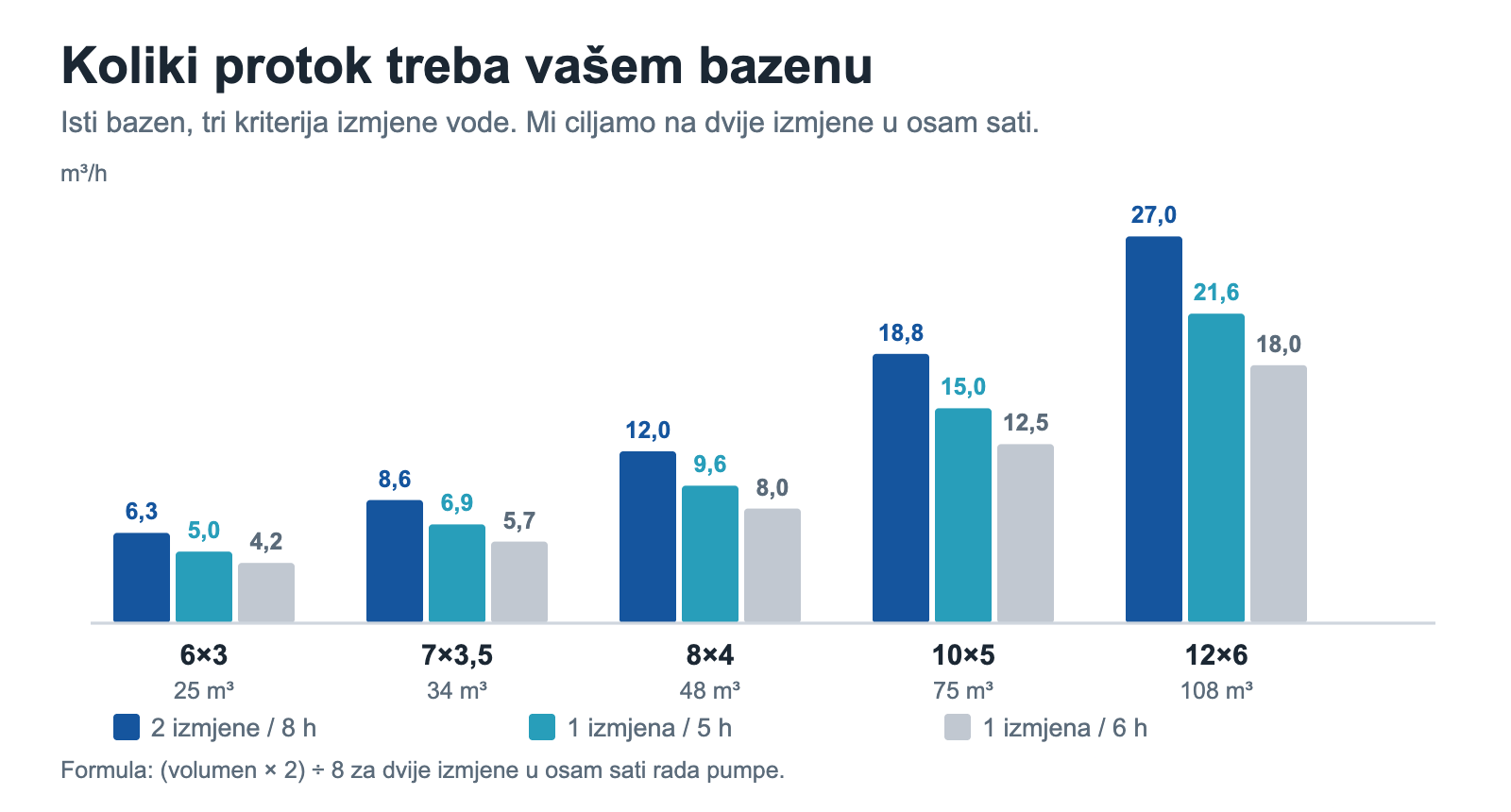
The formula is simple: flow = pool volume ÷ time of one turnover. The difference lies in which turnover time you take, and the sources differ here because they refer to different kinds of pools.
- German practice for private pools: the water is turned over roughly twice in eight hours of pump operation. The formula quoted by Apoolco is (volume × 2) ÷ 8.
- Common design practice: one turnover in 5 hours.
- American federal energy regulation: at most 6 hours for one turnover; the new PHTA-5 standard allows up to 12 hours.
| Pool | Volume | 2 turnovers / 8 h | 1 turnover / 5 h | 1 turnover / 6 h |
|---|---|---|---|---|
| 6 × 3 × 1.4 m | 25.2 m³ | 6.3 m³/h | 5.0 m³/h | 4.2 m³/h |
| 7 × 3.5 × 1.4 m | 34.3 m³ | 8.6 m³/h | 6.9 m³/h | 5.7 m³/h |
| 8 × 4 × 1.5 m | 48 m³ | 12.0 m³/h | 9.6 m³/h | 8.0 m³/h |
| 10 × 5 × 1.5 m | 75 m³ | 18.8 m³/h | 15.0 m³/h | 12.5 m³/h |
| 12 × 6 × 1.5 m | 108 m³ | 27.0 m³/h | 21.6 m³/h | 18.0 m³/h |
In practice we aim for the ‘2 turnovers / 8 h’ column because it gives a reserve for days when the pool is full of people, and the pump still does not have to run 24 hours. The volume is calculated as length × width × average depth – if the pool has a sloping floor, take the average, not the maximum depth.
Key point: a ‘turnover’ does not mean that all the water has been purified. The water in the pool mixes, so after one turnover about 63% of the volume has passed through the filter, not 100%. That is why two turnovers a day are required in practice instead of one – that is the reason, not exaggeration.
The pump is chosen to suit the filter, not the pool
This is the part that is most often skipped. The filter has a rated flow, and that flow is an upper limit, not a recommended operating point. If the pump pushes more than that, the water passes through the sand too fast and filtration deteriorates.
The measure is the filtration velocity in metres per hour. According to figures quoted by pool-magazin.com, the limit for private pools is 50 m/h, while DIN 19643 requires at most 30 m/h for public freshwater pools, and 20 m/h for sea or salt water. The quality of the filtrate falls as the velocity rises.
Now look at what that means for the filters in our range. Divide the rated flow by the filter area and you get the velocity:
| Filter | Rated flow | Area | Velocity at rated flow | Flow at 30 m/h |
|---|---|---|---|---|
| Aster D500 | 9 m³/h | 0.196 m² | 45.9 m/h | 5.9 m³/h |
| Aster D600 | 14 m³/h | 0.283 m² | 49.5 m/h | 8.5 m³/h |
| Aster D650 | 15 m³/h | 0.332 m² | 45.2 m/h | 10.0 m³/h |
| Aster D750 | 21 m³/h | 0.442 m² | 47.5 m/h | 13.3 m³/h |
| Aster D900 | 32 m³/h | 0.636 m² | 50.3 m/h | 19.1 m³/h |
The pattern is clear: manufacturers rate the flow exactly at the private maximum of 50 m/h. That is not a product defect but the way filters are rated across the whole industry. But it means that a filter with ‘9 m³/h’ on the box runs at the upper limit, not with a margin.
Velocity calculation: area = π × (diameter ÷ 2)², velocity = flow ÷ area. For the D500: π × 0.25² = 0.196 m², so 9 ÷ 0.196 = 45.9 m/h.
The pipes set an upper limit you cannot get around
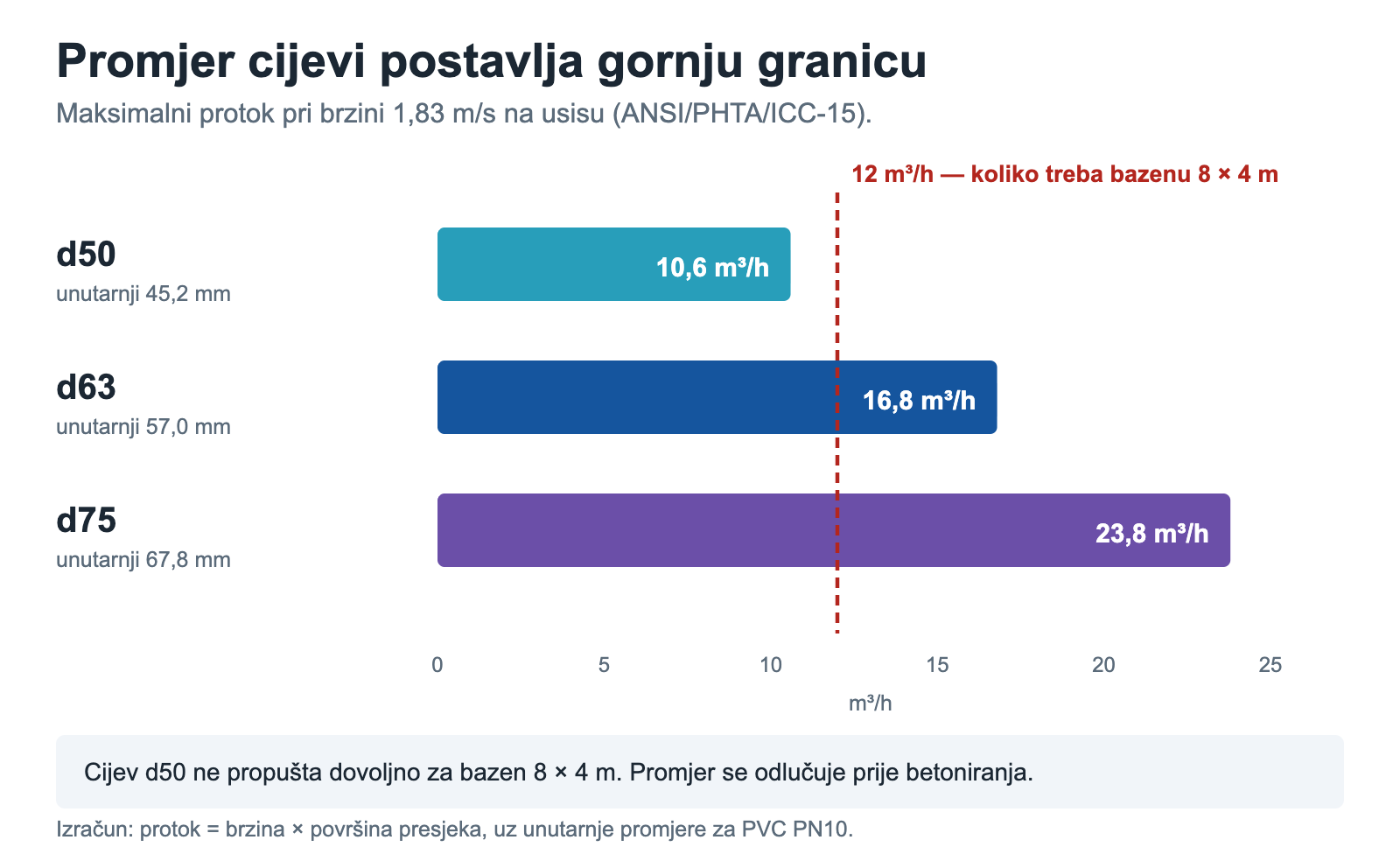
Even when the pump and filter are matched, the pipe diameter can be a bottleneck. The water velocity in a pipe must not exceed a certain limit, because above it friction losses, noise and suction hazard increase.
According to an overview published by AQUA Magazine, the limits on the suction side are: 6 feet per second (≈1.83 m/s) under the ANSI/PHTA/ICC-15 energy standard, 8 ft/s (≈2.44 m/s) under the ISPSC safety standard, while the GENESIS design guideline recommends 5 ft/s (≈1.52 m/s). On the pressure side the standards allow 8 ft/s.
| Pipe (PVC, PN10) | Internal diameter | Max. flow at 1.83 m/s | Conservative, at 1.52 m/s |
|---|---|---|---|
| d50 | ≈ 45.2 mm | ≈ 10.6 m³/h | ≈ 8.8 m³/h |
| d63 | ≈ 57.0 mm | ≈ 16.8 m³/h | ≈ 14.0 m³/h |
| d75 | ≈ 67.8 mm | ≈ 23.8 m³/h | ≈ 19.8 m³/h |
This is a calculation, not a quotation: flow = velocity × cross-sectional area, using internal diameters typical for PVC PN10. Check the actual wall thickness of your pipes, because it varies with the pressure class.
Which pump for which pool – in concrete terms
When the three limits are combined – the required flow, the filter’s rated flow and the capacity of the pipes – the choice narrows by itself. From our range:
| Pool | Required flow | Pump | Pump flow | Price |
|---|---|---|---|---|
| 6 × 3 m | 6.3 m³/h | Sena 50M | 7.5 m³/h | €595 |
| 7 × 3.5 m | 8.6 m³/h | Victoria Plus Silent 50M | 10.0 m³/h · 0.43 kW | €805 |
| 8 × 4 m | 12.0 m³/h | Sena 75M or Victoria Plus Silent 75M | 11.2 m³/h · 11.0 m³/h at 0.61 kW | €610 · €810 |
| 10 × 5 m | 18.8 m³/h | Victoria Plus Silent 150M | 21.5 m³/h · 1.10 kW | €975 |
| 12 × 6 m | 27.0 m³/h | Victoria Plus Silent 200M with d75 | 26.0 m³/h · 1.46 kW | €1,001 |
The prices are from our range and subject to change; the rated flows are the manufacturer’s. For the 8 × 4 m size we deliberately gave two options – the Sena 75M is cheaper, the Victoria Plus Silent quieter and with a declared power consumption, which matters if the plant room is close to the terrace. The whole range is in the pumps category.
The designation M or T – single-phase or three-phase
The letter after the model designation tells you about the power supply: M is a single-phase version at 230 V, T a three-phase one at 400 V. Three-phase motors are generally more durable and have better starting torque, but they require a three-phase connection in the plant room – which households on the coast often do not have.
Interestingly, the price difference goes in both directions: the Sena 75T (€636) is more expensive than the 75M (€610), while the Victoria Plus Silent 50T (€780) is cheaper than the 50M (€805). So there is no rule that the three-phase version is more expensive – check model by model.
Does a variable-speed pump pay off?
The answer for a Dalmatian private pool is more honest than you might expect from someone who sells these pumps: it depends on how long your season lasts, and for five months of operation the payback is long.
Physics favours variable speed. According to the affinity laws explained by Pentair, flow rises linearly with speed, pressure with the square, and power with the cube. If you halve the speed, the pump uses about 87% less energy.
How it was calculated: this is our calculation from the affinity laws and declared data, not a measured figure. The Victoria Plus Silent 100M delivers 16 m³/h at 0.78 kW. To pass two turnovers through an 8 × 4 m pool (48 m³), 96 m³ has to be moved – at 16 m³/h that is 6 hours, or 4.68 kWh a day. At half speed the pump delivers 8 m³/h at 0.0975 kW, so it needs 12 hours – or 1.17 kWh a day. The saving is 3.51 kWh a day. Over a 180-day season that is 632 kWh. The actual saving is somewhat smaller because the affinity laws do not account for the motor efficiency curve at low speeds.
Now compare the prices. The Victoria Plus Silent 100M costs €850, and the variable-speed Victoria Plus Silent VS 100 costs €2,120. The difference is €1,270. With a saving of 632 kWh per season, the payback depends on your tariff:
| Electricity price | Saving per season | Payback of the €1,270 difference |
|---|---|---|
| €0.13/kWh | ≈ €82 | ≈ 15 seasons |
| €0.18/kWh | ≈ €114 | ≈ 11 seasons |
| €0.25/kWh | ≈ €158 | ≈ 8 seasons |
The tariffs are illustrative – the tariff items of Croatia’s national electricity company (HEP) change and consist of several components, so use the figure from your own bill. The point is not the exact number but the order of magnitude: the payback is measured in years, not months.
Does that mean variable speed makes no sense? No. It makes sense in three cases: when the plant room is close to bedrooms or the terrace, so that quiet is valuable in itself; when the pool runs all year round because it is covered or heated; and when you are buying a pump anyway, so the cost difference is spread over the whole project instead of being a separate expense. For a seasonal outdoor pool with five months of operation, a well-sized single-speed pump is the more rational choice.
How many hours a day should the pump run?
Long enough to achieve the required number of turnovers – not by guesswork. If the pump is sized for two turnovers in eight hours, then eight hours is the answer, not twelve or four.
Practical rules we use:
- Split the running time into two cycles instead of one long one – for example four hours in the morning and four in the afternoon. The water mixes more evenly than when the pump stops at noon and stands idle until morning.
- Cover the swimming period. Skimmers work only while the pump is running; when the pump is off, dirt from the surface sinks to the bottom and stays there.
- With salt electrolysis, the pump dictates disinfection. The cell produces chlorine only while water flows through it, so shortening the pump’s running time directly reduces the amount of disinfectant.
- Extend in summer, do not shorten. At higher water temperatures disinfectant consumption and algae growth accelerate – this is the period when saving on hours takes its revenge fastest.
For pools of up to about 100 m³ of water we handle disinfection with salt electrolysis, and an 8 × 4 × 1.5 m pool holds 48 m³ and falls neatly within that range – so matching the pump’s running time to the cell is part of the same calculation.
Three mistakes we come across most often
First: a pump chosen by kilowatts. Motor power is not a measure of performance. The Victoria Plus Silent 100M delivers 16 m³/h at 0.78 kW, and the Sena 125M the same 16 m³/h – different motors, the same result. Look at m³/h, and at kilowatts only when you are comparing two pumps of the same flow.
Second: a pump stronger than the filter. If the filter is rated at 14 m³/h and the pump pushes 21 m³/h, the filtration velocity exceeds 50 m/h and the water passes through the sand too fast. You get cloudier water and a bigger bill – a combination nobody asks for.
Third: a forgotten pressure gauge. A rise in filter pressure of about 0.3–0.5 bar above the clean value is a sign that it is time to backwash. Without a pressure gauge you backwash by the calendar, which means either too rarely or too often – and every backwash uses water that is not easy to replace in August.
Next step
Before you order a pump, check three figures: the pool volume, the rated flow of the filter you already have or are planning, and the pipe diameter in the installation. If those three do not match, the pump will not fix the gap – it will only make it louder. For a new build, decide the pipe diameter before the concrete is poured, because it is the only one of the three figures that cannot be changed later.
You can browse the pumps in our range in the Plant room ▸ Pumps category, and if you are not sure what suits your system, send us the pool dimensions, the filter model and the pipe diameter – we typically answer enquiries within 24 hours, and we will also tell you when the answer is that your current pump is working perfectly well.
Frequently asked questions
Do not choose by power but by flow. Power in kilowatts tells you how much the pump consumes, not how much water it moves – two pumps with the same flow of 16 m³/h can have different motors. Determine the required flow from the pool volume and the turnover time, check that the filter and pipes can handle it, and only then compare kilowatts between pumps of the same flow.
The flow is the pool volume divided by the time of one turnover. The volume is length × width × average depth. If you aim for two turnovers in eight hours of operation, the formula is (volume × 2) ÷ 8. For an 8 × 4 × 1.5 m pool that is (48 × 2) ÷ 8 = 12 m³/h. With one turnover in five hours it comes to 9.6 m³/h, and with six hours 8 m³/h.
As long as is needed to achieve the planned number of turnovers – for a pump sized for two turnovers in eight hours, that is eight hours. It is better to split the running time into two cycles, morning and afternoon, than to run one long one. In summer the running time is extended, not shortened, because in warmer water algae grow faster and disinfectant is used up faster. With salt electrolysis, chlorine is produced only while the pump is running, so shortening it directly reduces disinfection.