A pool in the garden: from decision to first swim
A garden pool measuring 8 × 4 × 1.5 m holds 48 m³ of water. This article covers what the guides do not mention: how much water a pool really uses, how to restrict access to the water when there are small children in the house, and how to plan the order of works.
A garden pool measuring 8 × 4 × 1.5 m holds 48 m³ of water. The first fill at the ViK Split tariff (€2.01/m³) costs about €96, and in summer evaporation takes away roughly 307 litres a day – close to 19% of the pool’s own volume each month. A cover reduces that loss by more than 93%. Building a concrete shell takes 6–12 weeks.
This article covers what Croatian pool guides leave out: how much water a pool really uses, in actual figures, what the water utilities’ calls to save water in summer 2026 mean, how to restrict access to the water when there are small children in the house, and how to plan the order of works so that the pool level does not end up at odds with the house. For the bigger picture of the whole project, start with our complete guide to building a pool in Croatia.
Will a pool fit in your garden?
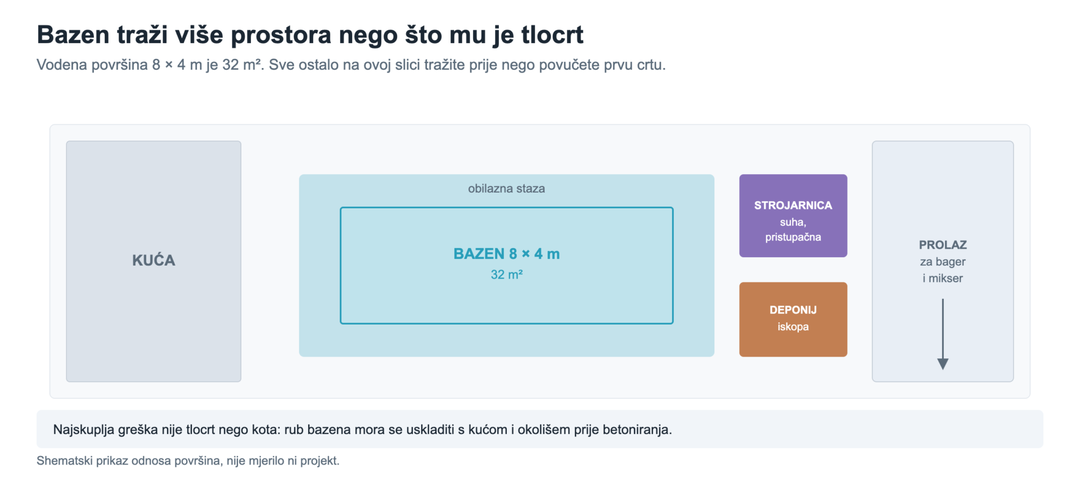
The space a pool needs is more than the footprint of the pool itself. Besides the water surface, you need to allow for a walkway around it, space for the plant room, access for machinery during excavation and somewhere to put the excavated material. The water surface of an 8 × 4 m pool takes up 32 m², but with the surround, the plant room and manoeuvring space the actual footprint is several times larger – and the question is whether any garden will be left.
Three things are decided before the first line is drawn:
- Site access. The excavator, the concrete mixers and the lorry that takes the spoil away all need a way in. In Dalmatian gardens with a narrow entrance, retaining walls or a neighbour’s house right against the boundary, access can dictate both the position of the pool and the cost of excavation.
- Pool level relative to the house and surroundings. This is the most common mistake we come across on other people’s pools: the pool ends up at a height that does not match the house and the landscaping. The edge is either too high, so you reach it by steps coming from nowhere, or too low, so the ground around it has to be built up.
- Plant room. The filter, pump and heating need a dry, ventilated and accessible space. If it is not planned in good time, it ends up as an improvised recess that a service technician can barely squeeze into.
Do you need a permit for a garden pool?
A pool with a footprint of up to 100 m², sunk into the ground, on the building plot of an existing building and serving that building, does not need a building permit – but it does need a main design (permit design), and the start of construction must be notified under Art. 4, point 1(c), and Art. 6, para. 3 of the Ordinance on Simple and Other Structures and Works (Pravilnik o jednostavnim i drugim građevinama i radovima). All typical house-pool sizes, from 6 × 3 to 12 × 6 m, stay below that threshold.
The key pitfall is not the area but the spatial plan: the structures covered by the Ordinance may not be built if this is contrary to the spatial plan (Art. 1, para. 2). The whole legal side, with citations and the difference from a garden pool up to 1 m deep under Art. 3, is covered in the pool construction guide; the original text of the regulation is available at zakon.hr.
Which type of pool for a garden?
Three groups come into consideration for a garden: in-ground concrete pools, fibreglass shells and above-ground garden pools (metal, wooden, inflatable). The decision comes down to how long the pool needs to last, how much freedom of shape you need, and how accessible the garden is for delivering a ready-made shell.
We should be upfront here: Flusso builds concrete pools only. The concrete shell is built by the client's building contractor to our design (we are happy to recommend a trusted one). We do not install fibreglass shells or above-ground pools. If your budget or timescale makes an above-ground pool the more sensible choice, that is a legitimate decision, and there is no reason for someone who builds in concrete to belittle it. An above-ground pool goes up in a single day, needs no excavation and can be removed; it cannot be shaped freely and is not a permanent part of the property.
We cover the detailed comparison in two separate articles: in-ground or above-ground pool – what to choose and why and a comparison of concrete, fibreglass and overflow pools. A note on fibreglass: the finished shell has to arrive by lorry and be lifted into place by crane, so narrow access in the old parts of Split or Trogir can rule out this type before the price is even discussed.
How much water does a garden pool use?
Part of the consumption also goes on backwashing the filter – exactly how much, and how to reduce it, is explained in the article on the pool filter.
A pool uses water in two ways: through a one-off fill and through constant evaporation. Filling an 8 × 4 × 1.5 m pool takes 48 m³, which at the ViK Split tariff for a household connected to the water supply and sewerage (€2.01/m³) comes to about €96. Evaporation is less visible, but over a season it adds up to a considerably larger volume.
| Dimensions | Surface area | Volume | First fill (€2.01/m³) | Evaporation at 30 °C, no wind |
|---|---|---|---|---|
| 6 × 3 × 1.4 m | 18 m² | 25.2 m³ | ≈ €51 | ≈ 173 l/day · 5.2 m³/month |
| 7 × 3.5 × 1.4 m | 24.5 m² | 34.3 m³ | ≈ €69 | ≈ 235 l/day · 7.1 m³/month |
| 8 × 4 × 1.5 m | 32 m² | 48 m³ | ≈ €96 | ≈ 307 l/day · 9.2 m³/month |
| 10 × 5 × 1.5 m | 50 m² | 75 m³ | ≈ €151 | ≈ 480 l/day · 14.4 m³/month |
| 12 × 6 × 1.5 m | 72 m² | 108 m³ | ≈ €217 | ≈ 691 l/day · 20.7 m³/month |
For an 8 × 4 m pool, this means that over a month of high summer about 9.2 m³ of water evaporates, close to 19% of the total volume. In money terms that is about €18.50 a month in top-up water, which is not dramatic – but in a year when the water utilities are calling for savings, the quantity matters more than the amount.
How it was calculated: the figures are an estimate based on published evaporation coefficients (euro-matic), not a measurement from your pool. The water surface area (m²) is multiplied by the coefficient for the given temperature and wind (l/m²·h) and by the number of hours. For an outdoor pool in operation, the German DGfdB gives a seasonal average of ≈145 g/m²·h, or about 3.5 l/m² a day, which for 8 × 4 m works out at ≈112 l/day – that is an average over the whole season, whereas 307 l/day is the figure for the peak of summer. Bathers also carry out 4–5 litres per person on their bodies and towels. Source: DGfdB.
Wind triples evaporation
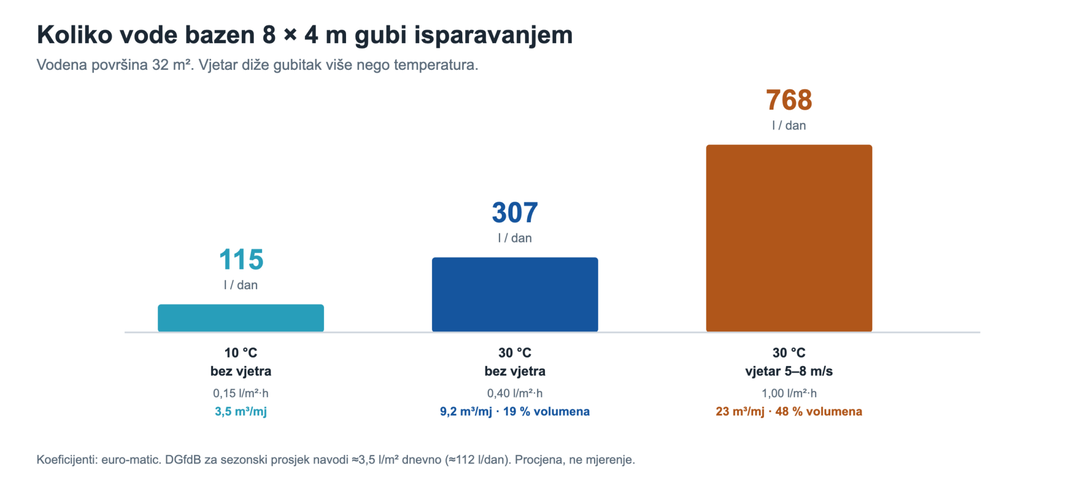
Temperature is not the main culprit – wind is. At the same water temperature of 30 °C, evaporation rises from 0.40 to 1.00 l/m²·h as soon as a wind of 5–8 m/s appears. For an 8 × 4 m pool, that is a jump from 307 to 768 litres a day. On an open plot above the sea, where the maestral sea breeze blows every afternoon, this is not an edge case but the rule.
| Conditions | Evaporation | 8 × 4 m pool (32 m²) | Monthly |
|---|---|---|---|
| 10 °C, no wind | 0.15 l/m²·h | ≈ 115 l/day | ≈ 3.5 m³ |
| 30 °C, no wind | 0.40 l/m²·h | ≈ 307 l/day | ≈ 9.2 m³ (19% of volume) |
| 30 °C, wind 5–8 m/s | 1.00 l/m²·h | ≈ 768 l/day | ≈ 23 m³ (48% of volume) |
Source of the coefficients: euro-matic. The practical consequence: shelter from the wind – a hedge, a wall, a pergola, siting the pool next to the house – is not just a matter of comfort but a water-saving measure.
A cover is the only measure that really works
A peer-reviewed measurement on 12 identical pools (Muleta, Cal Poly, for the National Plasterers Council) showed that a cover reduces evaporation by 93.9% (solid), 94.9% (air-bubble) and 95.9% (foam). Solar discs stop 50.1% of it, while liquid suppressants stop only 14.4–16.7%. The authors note that these are maximum efficiencies, achieved with the cover on the pool all the time.
| Solution | Evaporation reduction | Remaining loss for 8 × 4 m (30 °C, no wind) | Indicative price |
|---|---|---|---|
| Foam cover | 95.9 % | ≈ 0.4 m³/month | — |
| Air-bubble (solar) cover | 94.9 % | ≈ 0.5 m³/month | ≈ €1,000 |
| Solid cover on guide rails | 93.9 % | ≈ 0.6 m³/month | ≈ €1,500 |
| Roller cover (motorised) | depends on the cover design | — | €8,000–20,000 |
| Solar discs | 50.1 % | ≈ 4.6 m³/month | — |
| Liquid suppressants | 14.4–16.7 % | ≈ 7.7–7.9 m³/month | — |
Prices are indicative ranges, not a binding quote. The full measurement is available in the NPC report.
Are you even allowed to fill a pool from the mains?
In principle yes, but in summer 2026 it is no longer just a technical question. Two Croatian water supply companies publicly called on residents not to fill pools: Vodovod Zadar on 2 August 2026 introduced emergency water-saving measures and urged people to avoid frequent filling of pools, and ViK Rijeka on 14 August 2026 asked that water not be used to fill pools. These are appeals, not bans – but they show which way things are heading.
Sources: Vodovod Zadar, ViK Rijeka.
Three practical rules follow from this. First, do not drain a pool without a reason – well-managed water chemistry means the same water stays in the pool for years, and only the evaporated quantity is topped up. Second, a cover stops being an option; it is the difference between 9.2 and 0.5 m³ a month. Third, check the conditions for discharging pool water with the relevant water utility (for the Split area, ViK Split) before you release anything into the drains or the environment.
How do you secure a pool if you have children?
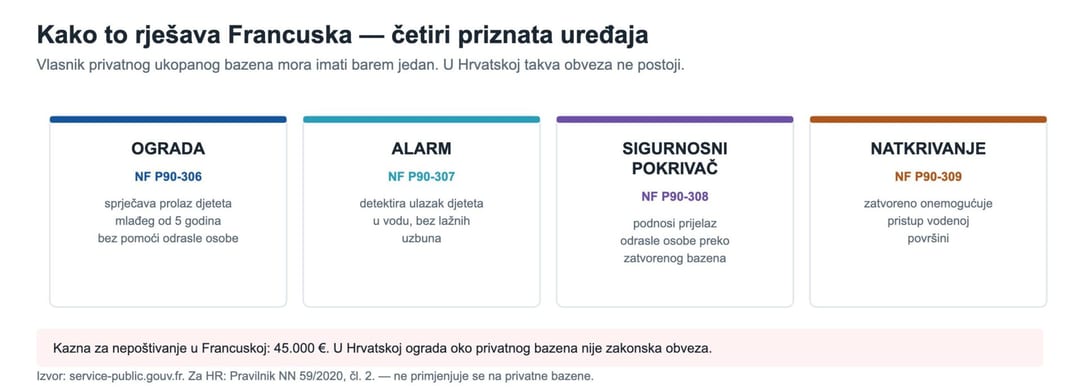
To be clear from the outset: in Croatia there is no legal obligation to have a fence or cover around a private pool. Under Art. 2, the Ordinance on swimming pool facilities (Official Gazette, NN 59/2020) expressly does not apply to pools owned by private individuals that are not intended for public use. The decision about a barrier is yours – which does not mean it is unimportant.
The figures are unambiguous. The World Health Organization reports about 300,000 drowning deaths a year, of which almost a quarter are children under five; drowning is the fourth leading cause of death among children aged 1–4, and fencing off pools is expressly listed among the recommended measures. The Croatian Institute of Public Health (HZJZ) reports that between 2014 and 2023, 769 people died from drowning in Croatia, of whom 47 were children and young people up to the age of 19, and 68 in 2023 alone. The recommendation is explicit: free access to pools and water tanks should be prevented. The HZJZ also warns that younger children can drown in just a few centimetres of water.
How this is handled where a regulation exists: France requires the owner of a private in-ground outdoor pool to have at least one of four devices – a fence (NF P90-306) that must prevent a child under five from getting through without the help of an adult, an alarm (NF P90-307) that detects a child entering the pool without false alarms, a safety cover (NF P90-308) that can bear an adult crossing it, or a pool enclosure (NF P90-309) that blocks access when closed. The penalty for non-compliance is €45,000. Source: service-public.gouv.fr.
Besides the barrier, there is the entry into the pool itself. The European standard for domestic swimming pools, EN 16582, devotes an entire clause 5 to access (means of access) – slip resistance, crushing and entrapment hazards, ladders, submerged steps and handrails. Annex C specifies test methods for entrapment of the head and neck, fingers, and feet and hands. These are the details that are easiest to overlook in garden pools, and they are covered in the article on pool steps and ladders.
How long does it take from decision to first swim?
Building the concrete pool itself takes 6–12 weeks, depending on size and complexity. To that you need to add the preparation before work starts – producing the main design with an authorised designer, collecting quotes and the construction start notification – as well as landscaping once the pool is finished, because these are separate works with their own timescale.
The sequence that makes sense in Dalmatian conditions works backwards from the swimming calendar. According to the climate normals of the Croatian Meteorological and Hydrological Service (DHMZ) for the Split-Marjan station, the mean air temperature in May is 19.2 °C, in June 23.4 °C, in July 26.2 °C, and in September it returns to 21.6 °C, with 247 hours of sunshine. If you want your first swim in June, work needs to start in March or earlier, and the design and permits before that. Winter and early spring are also the period when pressure on the water supply is lowest, so filling is easier to arrange as well.
We should also be clear: Flusso does not do ‘turnkey’ projects. We do the waterproofing, the lining and the pool equipment (the concrete shell is built by the client's own building contractor to our design), we help with the main design and permits and work with the authorised designer, but landscaping is not part of our scope – plan it with a landscaping contractor in parallel, precisely so that the levels are coordinated. We give a 5-year guarantee on the waterproofing. You can read more about the scope of works and prices in the article on how much pool construction costs, and in the more detailed breakdown of the price of an 8 × 4 m pool, and you can request a quote through the contact page – we typically answer enquiries within 24 hours.
Next step
Before you ask for a quote, measure two things: the available plan area, including the walkway around the pool and the space for the plant room, and the height difference between the ground and the threshold of the house. With those two figures, the conversation about the pool stops being theoretical. If the plot is exposed to wind, include a cover in the budget straight away – not as an add-on, but as part of the system.
We work on site from Makarska to Zadar, with a focus on Split, Kaštela, Trogir, Marina, Omiš and Podstrana. Send the dimensions and a photograph of your garden via the pool construction and maintenance page and we will get back to you with an indicative price range and a realistic timeframe for the works.
Frequently asked questions
An 8 × 4 × 1.5 m pool is filled with 48 m³ and then loses water through evaporation. According to published evaporation coefficients, at 30 °C with no wind this is about 307 litres per day, or 9.2 m³ per month; for the seasonal average of an outdoor pool, the DGfdB gives ≈3.5 l/m² per day, which works out at about 112 l/day. With a cover that reduces evaporation by more than 93%, the annual top-up comes down to small quantities.
A pool with a footprint of up to 100 m², sunk into the ground, on the building plot of an existing building and serving that building, does not need a building permit, but a main design is required and notification of the start of construction is mandatory (Art. 4, point 1(c) and Art. 6, para. 3 of the Ordinance on Simple and Other Structures and Works). The construction must not be contrary to the spatial plan.
No. There is no Croatian regulation that requires a private owner to have a fence or cover, and the Ordinance on swimming pool facilities (Official Gazette, NN 59/2020) expressly does not apply to pools owned by private individuals that are not intended for public use. Recommendations do exist, however: the WHO lists fencing off pools among its recommended measures, and the Croatian Institute of Public Health (HZJZ) recommends that free access to pools be prevented.
For a limited budget and a temporary solution, yes – they go up quickly, need no excavation and can be removed. They do not offer freedom of shape, do not last like a concrete shell and do not solve the question of permanent integration with the surroundings. Flusso does not build above-ground pools; we build concrete pools only. We cover the comparison with in-ground pools in a separate article.
There is no ban, but in August 2026 both Vodovod Zadar and ViK Rijeka publicly called on residents to avoid filling pools. Plan the filling outside the peak of the season, check the current measures with your local water utility, and bear in mind that a cover, which keeps the loss below 0.5 m³ a month, will be decisive for the rest of the season.