Infinity and overflow pools: how they really work
An overflow pool is a pool in which the water level is flush with the edge, so the water constantly spills into a perimeter channel. Infinity is not a separate type – it is a version of the overflow pool that spills over one edge.

An overflow pool is a pool in which the water level is flush with the edge, so the water constantly spills into a perimeter channel, runs off into the balance tank and returns through the filtration. An infinity pool is not a separate type – it is a version of the overflow pool in which water spills over only one edge, usually the one facing the view. The technical argument for an overflow pool is a single, measurable one: it draws 80% of the circulation from the surface, a skimmer pool only 20%.
Below is the breakdown that Croatian articles on this subject lack: the path of the water through the system, why the contamination collects in the top 150 mm, how to size the balance tank in litres, and which mistakes from practice turn an infinity edge into a pump that sucks air. If you are still choosing the type of pool, start with the complete guide to building a pool in Croatia.
How does an overflow pool work?
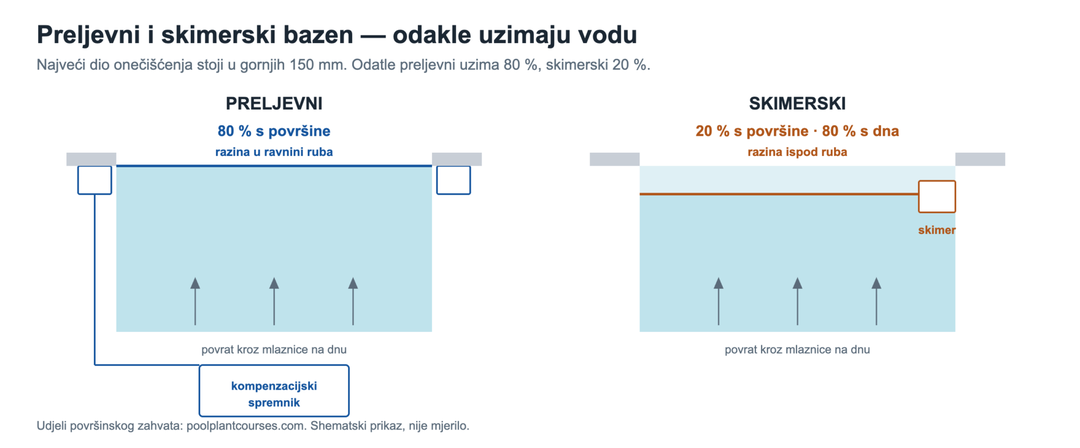
The water in an overflow pool travels in a closed circuit: edge → overflow channel → balance tank → pump → filtration (and heating/disinfection) → return jets in the floor → back towards the surface. The water level is held exactly at the edge level, so every wave, every bather getting in and every extra millimetre goes over the edge into the channel.
With a skimmer pool the logic is reversed. The water level stands a few centimetres below the edge, and the water is drawn through skimmers built into the wall and returned through jets below the surface. As a result the edge stays dry and the surface is cleaned only locally, around the skimmer intake.
The practical difference that people notice first is not technical but visual: an overflow pool looks like a bowl filled to the brim, and a skimmer pool like a bath in which the level drops a little. But the difference you feel in maintenance is in where the system takes the water from.
There is also a third consequence that is rarely mentioned. In a skimmer pool the water level has to stay within a narrow range for the skimmer to work at all – if it drops too far, it sucks air; if it rises, it skips the dirt. An overflow pool does not have this problem because the surplus always has somewhere to go, so the level stays constant regardless of how many people are in the water. That is why overflow pools cope better with groups of bathers, while skimmer pools are more predictable when the pool is used rarely and by few people.
Why does an overflow pool clean better?
Because the contamination is where an overflow pool takes its water from. Most of the dirt in a pool – grease, sun cream, dust, pollen, leaves, biofilm – is found in the top 150 mm of depth. An overflow system draws 80% of the circulation from the surface and 20% from the bottom; a skimmer system does the opposite, 20% from the surface and 80% from the bottom.
That is the only argument for an overflow pool that is not a matter of taste. Everything else – looks, the impression of full water, an edge without an edge – can be defended or disputed; this ratio cannot. Source: Pool Plant Courses, independently confirmed in the States of Guernsey guidelines (section 6.12).
| Feature | Overflow pool | Skimmer pool |
|---|---|---|
| Circulation from the surface | 80 % | 20 % |
| Water level | flush with the edge | a few cm below the edge |
| Where the purified water returns | jets in the floor | jets in the wall, below the surface |
| Balance tank | required | not needed |
| Space in the plant room | larger (tank + additional equipment) | smaller |
| Behaviour with more bathers | surplus water goes into the channel, the level does not change | the level rises, the skimmers lose efficiency |
| Price (Flusso, 8 × 4 m) | ≈ 30% more expensive | ≈ €35,000 (indicative, excluding the concrete shell) |
What is a balance tank and how big must it be?
How to choose the rest of the plant room equipment is covered in the guide to pool systems and equipment.
A balance tank is a closed reservoir in the plant room (or buried next to the pool) that receives all the water that spills over the edge and from which the pump draws water towards the filter. Without it an overflow pool does not work: the pump would draw directly from the channel and run out of water within seconds. Its volume must accommodate the water in transit (the water that is in the channel and pipes), the displacement by bathers and a reserve for waves.
The sources differ in method but give a comparable order of magnitude:
| Source / method | Requirement | For an 8 × 4 m pool (32 m², 48 m³) |
|---|---|---|
| DIN 19643 | ≈ 30 l per m² of water surface + 75 l per bather (displacement; American practice uses ≈70 l) | ≈ 960 l + 75 l per bather → with 4 bathers ≈ 1.26 m³ |
| California Building Code §3136B.2 | min. 40.75 l/m² of water surface | ≈ 1.3 m³ |
| Design practice | 5–10% of pool volume | ≈ 2.4–4.8 m³ |
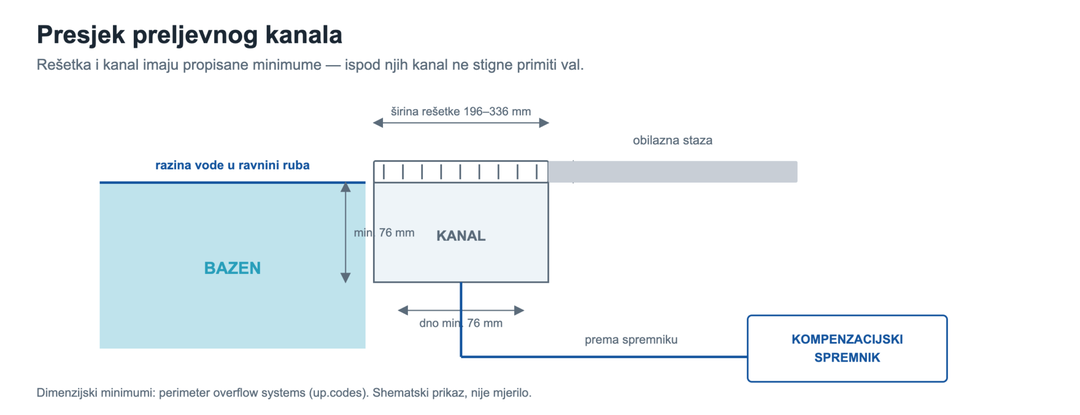
The same sources also give the channel geometry – both are regulations for public pools outside Croatia, so we take them here as a reference for good practice. DIN 19643 specifies a minimum overflow of 1.0 m³/h per metre of overflow channel, and the California Building Code a channel that is at least 76 mm deep with a 76 mm wide bottom, on condition that the water returns to skimming within 10 minutes. Sources: DIN 19643 formulae, CBC §3136B.2, Morana Water Design.
How does an infinity pool differ?
An infinity (vanishing edge) pool spills over only one edge – the one facing the view – while the other three edges are built as a conventional edge or a skimmer edge. Below the spill edge there is a catch basin that collects the water and passes it on to the balance tank.
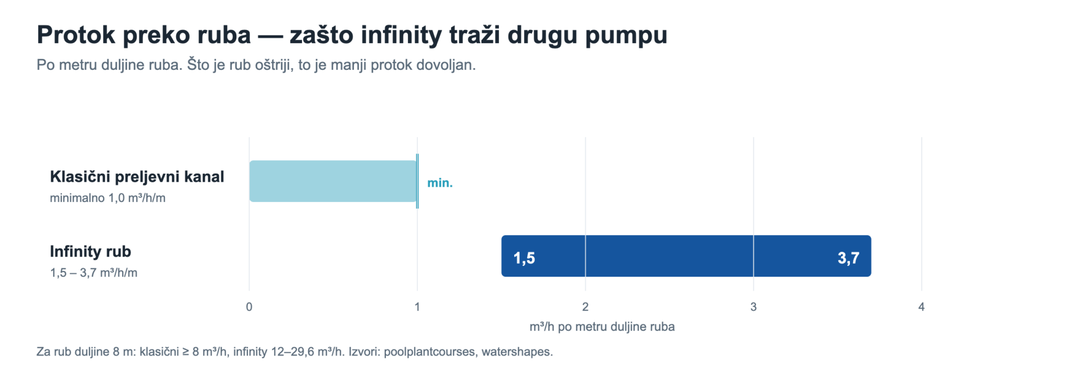
The technical requirement is substantially greater than with a conventional overflow. The recommended flow for an infinity edge ranges from 1.5 m³/h per metre (for a slot overflow) to ≈3.7 m³/h per metre, against the minimum of 1.0 m³/h/m for a conventional overflow channel. The geometry of the edge decides: the sharper the edge, the lower the flow needed for the water film not to break. That is why an infinity design as a rule needs two pumps: one for filtration and a separate one for the edge effect.
For an edge 8 m long, that means a need of 12–29.6 m³/h for the effect alone, regardless of the filtration pump. Source: WaterShapes.
Three mistakes from practice that cost the most
- A catch basin that is too small. A classic example from the professional literature is a catch basin with a 30 × 45 cm cross-section: the system empties it before enough water has spilled over the edge, so the effect flickers instead of flowing.
- Tiles set too short. The spill-edge zone is alternately wetted and dried, so the lining in the catch basin is taken down ≈45 cm, not the usual 15 cm.
- Wind ignored. Wind carries the water film horizontally, out of the catch basin. On a plot above the sea, where it blows every afternoon, the catch basin must be wide enough to catch that water – otherwise it is lost from the system. Together with the water in transit and the displacement by bathers (≈70 l per person), this is the third item in the balance that is most often skipped.
Source: AQUA Magazine.
How much more expensive is an overflow pool?
In our projects, a concrete overflow pool is about 30% more expensive than a skimmer pool of the same size. For the most popular size, 8 × 4 × 1.5 m, where the skimmer version is indicatively ≈€35,000 (excluding the concrete shell), that means a difference of around ten thousand euros. The difference does not go into a ‘nicer edge’ but into the balance tank, the additional pipework, the larger plant room and more precisely executed edge details.
A conclusion, not a measurement: we have no measurement of electricity consumption comparing an overflow and a skimmer pool, so we will not invent one. What can be concluded from the figures is this: a conventional overflow needs a minimum of 1.0 m³/h per metre of channel, and an infinity edge 1.5–3.7 m³/h per metre, with a separate pump for the effect. A higher flow and a second pump logically mean higher consumption – this is a conclusion derived from design flows, not a measured figure. Calculate the actual consumption from the power of the chosen pumps and the hours of operation, and multiply it by your tariff.
Prices are indicative ranges, never a binding quote – the final amount depends on the design, because equipment is sized by cubic metres of water, not by surface area. A breakdown of costs by type and size is in the article on how much pool construction costs, and for the most common size in the price of an 8 × 4 m pool. We covered the comparison of shell types in the article on concrete, fibreglass or overflow pools.
When does an overflow pool make sense, and when not?
The answer depends on where the plot stands. Our recommendation after 800–1,000 completed projects from Makarska to Zadar is simple: if the plot is elevated with a view of the sea, go for an overflow or infinity pool. An edge that visually joins the pool and the sea is the only situation in which an infinity design pays back what is invested – because you are paying for the view, not the technology.
In an urban area, where there is no view, we recommend a skimmer pool or, if you go for an overflow, an overflow on all sides. An infinity edge facing the neighbour’s fence is a cost without effect: it carries all the complexity of the build and lacks the one reason it exists.
There are two situations in which we responsibly answer ‘no’ to an overflow pool: when there is no room for a balance tank in the plant room, and when the pool is used rarely, so the difference in surface water quality does not justify a 30% larger outlay. Concrete is not always the right choice, and an overflow certainly is not always the right choice.
One practical note on disinfection that goes with an overflow system. We size equipment by cubic metres of water, not by surface area – the volume determines which filter and which pump are used, and for an overflow pool the contents of the balance tank and pipework must be added to that volume. Up to about 100 m³ of water we choose salt electrolysis in practice, above that automatic liquid chlorine and pH dosing. For an overflow pool this is a decision made together with the size of the tank, because the disinfectant is dosed into the same loop through which all the overflow water passes.
Overflow gratings: what the contractor actually chooses
The overflow channel is covered with a grating that has to withstand sun, chlorine and bare feet. Standard gratings are made of PVC with anti-UV additives, free of cadmium and lead. The usual heights are 22, 25, 30 and 35 mm, and on the Croatian market widths of 196, 246, 296 and 336 mm are stocked as standard, typically at a height of 35 mm.
| Parameter | Value |
|---|---|
| Material | PVC with anti-UV additives, free of cadmium and lead |
| Heights | 22 / 25 / 30 / 35 mm |
| Standard widths (Croatian market) | 196 / 246 / 296 / 336 mm |
| Slip resistance | certified to DIN 51097 (now EN 16165, Annex A) |
As regards slip resistance, the German guideline DGUV Information 207-006 places overflow channel covers in class B (≥18°), together with the pool edge and the surround. That is not a Croatian regulation for private pools, but it is the most useful good-practice reference that exists. We wrote in detail about the classes and which lining goes on which surface in the article on ceramics and tiles for pools. Sources: Depatech, Vagner Pool HR, DGUV 207-006.
Next step
If you are considering an overflow or infinity pool, the first check is not aesthetic but spatial: does the plant room have room for a balance tank of a few cubic metres, and how much fall is available towards the catch basin. Those two things decide whether an infinity design is feasible before the edge is even drawn.
We build overflow and infinity pools, with a gallery of completed projects in Trogir and Okrug Donji, and you choose plant room equipment from our plant room range. Send a plan of the plot and a photograph of the view via the contact page and we will tell you honestly whether infinity at your location is worth the difference in price or not.
Frequently asked questions
Infinity is not a separate type of pool but a version of the overflow pool. In a conventional overflow pool the water spills into a channel around the whole perimeter or on several sides, while in an infinity design it spills over only one edge, usually the one facing the view, into a catch basin below. Everything else – the balance tank, filtration, return through jets in the floor – works the same.
Because most of the contamination sits in the top 150 mm of depth, and an overflow system takes 80% of the water it sends to filtration from there. A skimmer pool draws only 20% from the surface and 80% from the bottom. With a larger number of bathers the difference is more pronounced, because grease and creams collect precisely in the surface layer.
Depending on the method, between roughly 1.3 and 4.8 m³. According to DIN 19643 (30 l/m² plus 75 l per bather) it comes to about 1.26 m³ with four bathers, according to the California Building Code (40.75 l/m²) about 1.3 m³, and according to design practice of 5–10% of the pool volume 2.4–4.8 m³. The final figure depends on the length of the channel, the volume of the pipework and the expected number of bathers.
As a rule, yes. One pump runs the filtration, the other maintains the water film over the edge, because an infinity edge needs 1.5–3.7 m³/h per metre of length against the minimum of 1.0 m³/h/m of a conventional overflow channel. The geometry of the edge changes the flow requirement: the sharper the edge, the lower the flow that is sufficient.
In our projects about 30% for the same size. The difference covers the balance tank, the additional pipework, the larger plant room and a more precise execution of the edge detail. The amounts are indicative and depend on the design – equipment is sized by cubic metres of water, so two pools with the same surface area can have a different cost of equipment.
Not in any sensible way. An overflow pool needs a different edge level, a perimeter channel, a separate balance tank and a different pipework layout – these are elements of the structure, not equipment that can be added. The decision on an overflow is made before the shell is concreted, together with the decision on the edge level and the position of the plant room.