Ceramics and tiles for pools: which to choose
Three linings are worth considering for a pool: glass mosaic, porcelain ceramic and PVC liner. Water absorption and slip resistance decide, not appearance.

Three linings are worth considering for a pool: glass mosaic, porcelain ceramic and PVC liner. Water absorption and slip resistance decide, not appearance. For a permanently submerged surface, absorption below 0.5% is required, and for steps leading into the water slip-resistance class C. Glass mosaic has 0% absorption; the liner has the lowest initial cost.
Below is a breakdown that hardly exists in Croatian articles about pool tiles: which slip-resistance class applies in which zone, why water absorption is a purchasing criterion, and why the adhesive and grout decide whether the lining survives a decade. For the bigger picture of the project, start with our complete guide to building a pool in Croatia.
What are the lining options for a pool?
Realistically there are three: glass mosaic, porcelain ceramic and PVC liner. All three are applied to a concrete shell, all three can work well, but they have very different trade-offs between durability and initial price. At Flusso we carry out all three finishes, and we prefer glass mosaic – for technical, not aesthetic reasons.
Mosaic is the only one of them that does not absorb water at all: glass has no open porosity, so there is no mechanism by which water could enter the material, freeze and destroy it. The liner is not damaged by moisture, but it is a consumable layer – it is replaced every 10–15 years, while ceramic lasts 20–30 years, and the manufacturer declares glass mosaic to be a material of unlimited life.
| Lining | Water absorption | Frost | Appearance and shape | Lifespan |
|---|---|---|---|---|
| Glass mosaic | 0 % | Not susceptible to frost damage | Follows curves, steps and the overflow edge; depth of colour in the water | The manufacturer states unlimited material life |
| Porcelain ceramic (BIa) | ≤ 0.5 % | Low absorption greatly reduces the risk; look for a declared frost resistance | Large formats, flat surfaces; harder to follow curves | 20–30 years |
| PVC liner (reinforced, ≥1.5 mm) | Not porous, but a consumable layer | Not sensitive to frost | Welded sheets, visible seams; quick installation | 10–15 years |
The lifespan of the liner and ceramic is based on publicly available data from bazenirijeka.com. Reinforced liner is standardised as EN 15836-2 (min. 1.5 mm), homogeneous as EN 15836-1 (min. 0.75 mm) – check which one is in the quote, because a ‘liner’ is sold in both versions.
When a liner makes sense: if the budget is tight, if a refurbishment is planned in about ten years anyway, or if the pool needs to be put into service quickly. A liner is cheaper (≈€110/m² installed, mosaic ≈€160/m²) and is installed in days, not weeks. It is not a worse solution – just one with a shorter horizon. We broke down the lining prices in the article on the price of an 8×4 m pool.
Why does an ordinary tile from a shop not belong in a pool?
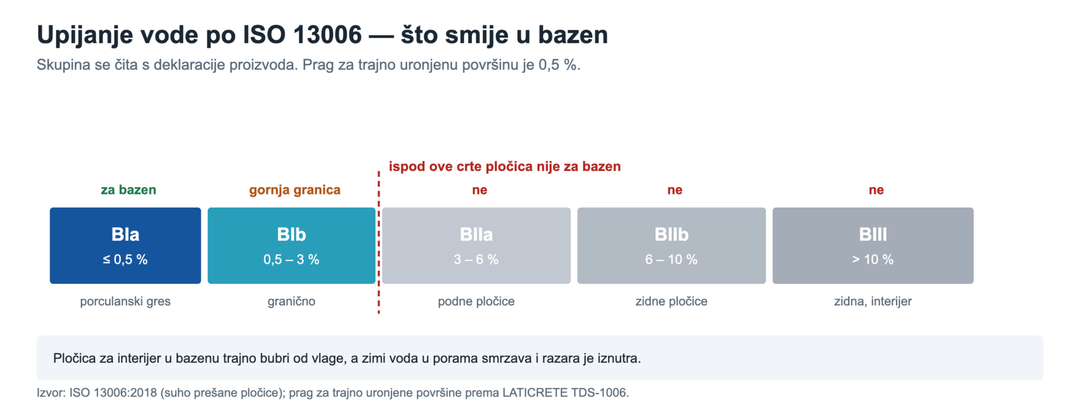
Because it absorbs water. Under ISO 13006:2018, ceramics are classified by water absorption, and the difference between the groups is not cosmetic – it determines whether the tile will swell permanently and whether it will crack after the first winter. For a permanently submerged surface, absorption below 0.5% is required, and at the very most below 3%.
| Group (ISO 13006, dry-pressed) | Water absorption | For a pool? |
|---|---|---|
| BIa – porcelain stoneware | ≤ 0.5 % | Yes – this is the target group |
| BIb | 0.5–3 % | Borderline, the upper permitted limit |
| BIIa | 3–6 % | No |
| BIIb | 6–10 % | No |
| BIII | > 10 % | No – this is an interior wall tile |
The 0.5% threshold is recommended by LATICRETE in technical data sheet TDS-1006: a lining permanently immersed in water should come from a group with absorption below 0.5%, otherwise the tile permanently swells from moisture. Floor and wall tiles for interiors regularly have absorption above 3% – perfectly good for a kitchen, completely wrong for a pool. Check the class on the product declaration.
How slip-resistant must the tile be – and where?
There is no single slip-resistance class for the entire pool. There are three, and they differ by zone: the pool edge and surround require class B, steps and ladders leading into the water require class C, and the changing room and sauna class A. This is the most common mistake in selection – people buy one tile for everything and then have slippery steps.
Slipperiness is measured by the angle of inclination at which the test person can still walk safely. There are two completely different methods. The barefoot method (DIN 51097, now Annex A of EN 16165:2021) uses a soap solution and gives classes A, B and C. The footwear method (DIN 51130, now Annex B) uses oil and gives R-ratings from R9 to R13.
| Pool zone | Class | Angle of inclination |
|---|---|---|
| Ladders and steps leading into the water | C – strictest | > 24° |
| Sloping pool edges | C | > 24° |
| Ramps beside the pool with a slope > 6% | C | > 24° |
| Pool edge and surround | B | ≥ 18° |
| Ladders and steps outside the pool | B | ≥ 18° |
| Showers | B | ≥ 18° |
| Overflow channel covers | B | ≥ 18° |
| Changing room, sauna, predominantly dry barefoot areas | A | ≥ 12° |
The distribution by zone is taken from DGUV Information 207-006, chapter 3 – a German guideline for barefoot areas, which is still the most concrete reference framework available for pools.
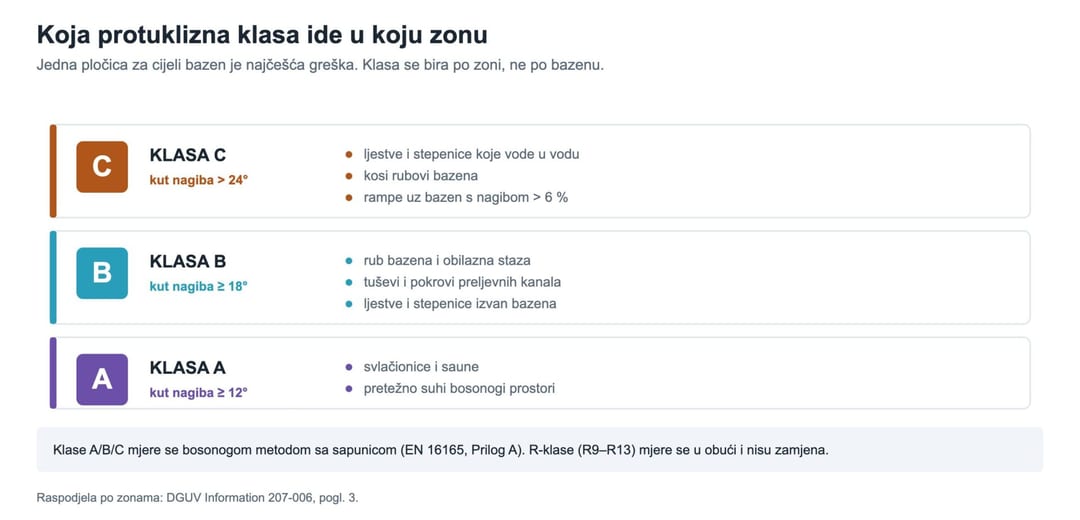
Key point: R-ratings and A/B/C classes cannot be converted into one another. They are two different methods, with different media (oil with footwear versus soap solution barefoot) and different test conditions. A seller who tells you ‘R11 is the same as class B’ is not telling the truth – they are only guessing. If the tile is going into a barefoot zone, ask for the classification by the barefoot method. Source: UK Slip Resistance Group.
The practical consequence: on the declaration, look for the designation ‘class B according to DIN 51097 (now EN 16165, Annex A)’. The standard DIN EN 16165:2021 replaced both DIN 51097 and DIN 51130 at European level, but the classes have been kept in the German national annex, so in practice both are still written. More about this change at BESCO GmbH.
What about Croatian regulation? Ordinance NN 59/2020, Art. 9, para. 1, requires for swimming pool facilities that ‘floors must be slip-resistant’ – but without stating a class. Important: Art. 2 of the same Ordinance expressly says that it does not apply to pools owned by private individuals that are not intended for public use. For your private pool it is not an obligation. The physics of slipping, however, does not know that distinction.
Glass mosaic: what makes it good
Glass mosaic works in a pool because it has 0% water absorption, is resistant to acids and alkalis and is not susceptible to frost damage. It is a material that does not age chemically – and pool water, between chlorine or electrolysis and pH-correcting agents, is a chemically fairly aggressive environment.
According to the official specifications of Vidrepur, whose mosaic we have in our range, the material has an unlimited service life. Physical properties: Mohs hardness 4, density 2.45–2.48 kg/dm³, softening point 730 °C.
The formats are standardised, which makes planning easier. The Colors Nieblas range comes in a tile format of 25 × 25 mm in 22 shades; a sheet is approximately 315 × 315 mm, 4 mm thick, mounted on gummed paper, on glass fibre with polyester, or on dots. That small format is the reason why mosaic is the only lining that neatly follows rounded steps and an overflow edge – a large tile has to be cut into strips there.
A Mohs hardness of 4 also means a real limit: mosaic is not indestructible against scratches. Sand carried into the pool from the surround is harder than glass, so regular vacuuming of the floor protects the lining, not just the water.
How much do the different mosaic ranges cost?
This is the part that people do not foresee. The difference between the basic and the slip-resistant version of the same range is about 50% in material price – and on steps leading into the water the profession requires exactly slip-resistance class C.
| Vidrepur range | Distributor price of material |
|---|---|
| Colors (basic) | €22.50/m² |
| Colors+ | €31.50/m² |
| Colors slip-resistant | €33.90/m² (≈ 50% more than basic) |
| Nature | €43.90/m² |
The prices are distributor prices for the material (source: the price list of the distributor Matcarrelage) and are not a binding quote. In our range, glass mosaic as a material runs at €30–250/m² depending on the range, while installation with a basic mosaic, everything included, is indicatively ≈€160/m². The choice of range can easily double the price of the lining while only one line of the quote has changed.
We write about the designs and installation in the article on pool steps and ladders.
Adhesive and grout – the quiet half of the job
A pool lining fails almost always at the grout, not the tile. For permanently submerged surfaces, adhesives of class C2 S1 or C2 S2 under EN 12004 are required – that is, improved cement adhesives with proven deformability. For glass mosaic, Mapei in its pool waterproofing manual expressly names the combination ADESILEX P10 + ISOLASTIC, described as an adhesive ‘bright white in colour, developed specially for laying mosaics’. The white colour is not marketing – through the transparent glass you can see the layer underneath.
Mapei explains why grout exists at all more precisely than most contractors: grout joints are not just decoration – they are needed to reduce the stiffness of the lining and make it more resistant to deformation. Grout is a movement element. It absorbs the thermal expansion of the lining and the micro-movements of the structure.
Source: Mapei Tech Talk.
Epoxy grout becomes mandatory, not merely recommended, in pools where frequent sanitation is carried out with chlorinated water, in thermal pools and in saltwater pools. Since in practice we choose salt electrolysis for pools up to about 100 m³ of water, this means that for most of our pools epoxy grout is not an option but the default. For this purpose, an epoxy grout from the Mapei range is used.
For ceramics, Keraflex Maxi S1, Kerabond + Isolastic and Ultralite S1 are also worth considering. The choice depends on the tile format and the substrate, but class C2 S1 is the lower limit that we do not go below.
When may the pool be filled?
Not straight away. Depending on the type of grout, the pool may be filled after 48 hours, 10 days or 14 days. Ignoring that period is one of the most common ways in which an otherwise flawlessly executed lining is ruined – grout that has not finished curing under water stays permanently weaker and more permeable.
| Type of grout | Earliest filling | Source |
|---|---|---|
| Ultracolor Plus (CG2 FWA) | 48 hours | Mapei |
| Epoxy grout | 10 days at 21 °C | LATICRETE |
| Cement, latex-modified | at least 14 days at 21 °C | LATICRETE |
Note the qualifier ‘at 21 °C’. At lower temperatures curing takes longer, so the period is extended, not shortened – in Dalmatian practice this affects work in October and November the most.
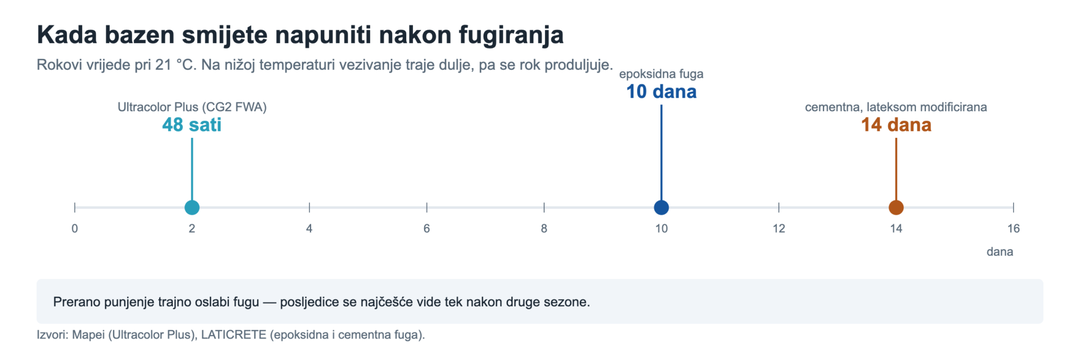
From experience: across 800 to 1,000 completed projects, the most expensive omission we come across on other people’s pools is not a poor tile – it is a pool filled too early, ‘because the guests arrived on Friday’. That the grout has suffered is not visible immediately but two seasons later, when it starts to come away.
Salt water and lining: what salt actually attacks
Salt electrolysis does not corrode glass mosaic. What salt actually attacks is cement grout, natural stone and metal parts. This is an important distinction because it is often muddled in quotes – so the customer is talked out of electrolysis because of a lining that has no problem with it.
Glass has 0% absorption, so there is no mechanism by which salts could get into the material. Cement grout has one. According to data from grout manufacturers (TEC / H.B. Fuller), salt can cause rust staining on many types of slate, change the colour of travertine and, with a chemical imbalance in the water, attack cement grout. Metal parts in the pool – ladders, handrails, fixings – require an appropriate grade of stainless steel.
The conclusion for design is simple: if salt electrolysis is going in, epoxy grout goes in too, and natural stone as a lining for a submerged surface drops out. In practice for pools up to about 100 m³ of water we choose salt electrolysis, and above that automatic liquid chlorine and pH dosing. A pool of 8 × 4 × 1.5 m holds 48 m³ – so electrolysis, so epoxy grout.
How much lining does an 8 × 4 pool need?
An 8 × 4 × 1.5 m pool needs 68 m² of lining: 32 m² of floor and 36 m² of walls. The calculation is simple and worth doing before you ask for a quote, because it immediately reveals whether someone has only priced the floor.
- Floor: 8 × 4 = 32 m²
- Long walls: 2 × (8 × 1.5) = 24 m²
- Short walls: 2 × (4 × 1.5) = 12 m²
- Walls in total: 36 m²
- Total: 68 m²
The perimeter edge, steps and cutting waste are added separately and depend on the geometry of the pool. With installation using basic mosaic at ≈€160/m², the lining of this pool comes to roughly €10,900. The same area in liner at ≈€110/m² comes to about €7,500 – a difference of roughly €3,400, or about €340 per year if the liner lasts ten years and the mosaic twenty. The ranges are indicative and are not a binding quote; you can find a complete cost breakdown in the article on the price of a pool by dimensions.
The mosaic material alone ranges from €30–250/m², which for 68 m² means a range of approximately €2,000 to €17,000 for the tiles alone. So when comparing quotes, ask for the name of the range, not just the word ‘mosaic’. How the lining fits into the decision on the type of pool is covered in the comparison of concrete, fibreglass and overflow pools.
A note on scope: we do the waterproofing, equipment and lining – we do not do ‘turnkey’ projects with landscaping. The pool surround is a separate job, but class B for that zone applies just the same, so coordinate the choice before you order stone for the terrace. You can view the components in the pool shell category in our shop.
Next step
Make the decision on the lining before the shell is poured – the thickness of the finishing layers, the construction of the overflow edge and the geometry of the steps depend on it. You need to choose three things: the group of material, the range within the budget and the zones where the slip-resistant version goes.
Send us the pool dimensions and the look you want, and we will come back with a breakdown of quantities and an indicative lining cost – we typically answer enquiries within 24 hours. Request a quote here.
Frequently asked questions
Glass mosaic and porcelain ceramic from group BIa with water absorption of up to 0.5% are used for pools. Glass mosaic has 0% absorption, is resistant to acids and alkalis and is not susceptible to frost damage, so it is the safest choice for a permanently submerged surface. Interior ceramics regularly have absorption above 3%, so they are not suitable for a permanently submerged surface. Check the class on the declaration.
No. The key criterion is water absorption under ISO 13006, and interior tiles regularly belong to group BIIa (3–6%) or BIIb (6–10%). Such a tile in a pool swells permanently from moisture, and in winter the water in the pores freezes and destroys it from within. For a pool, group BIa with absorption below 0.5% is required, at the very most below 3%.
Class C, the strictest barefoot class, with an angle of inclination greater than 24°. According to DGUV Information 207-006, class C is required for ladders and steps leading into the water, sloping pool edges and ramps with a slope above 6%. The pool edge and surround require class B (≥18°), and changing rooms and saunas class A (≥12°).
No, and the two designations cannot be converted into one another. R-ratings (R9–R13) are measured with the oil method and a person wearing footwear under DIN 51130, while classes A, B and C are measured with the soap solution method and a barefoot tester under DIN 51097. These are different media and test conditions. For pool zones, ask for the classification by the barefoot method, now EN 16165:2021, Annex A.
It depends on the grout: Ultracolor Plus allows immersion after 48 hours, epoxy grouts require 10 days at 21 °C, and latex-modified cement grouts at least 14 days at 21 °C. At lower temperatures the period is extended. Filling too early permanently weakens the grout, and the consequences are most often seen only after the second season.