Concrete, fibreglass or overflow pool: what to choose in Dalmatia
Concrete and fibreglass are materials; overflow is the way the water drains away. A comparison of prices and linings – and what really decides in Dalmatia: site access and excavation in rock.
Short answer: you choose a concrete pool when you want freedom of shape, an overflow design and a lining of your choice. You choose fibreglass when speed and a predictable cost are the key things and the plot is accessible to a lorry and a crane. An overflow pool is not a third material – it is the way the water drains away, not what the structure is made of.
Buyers almost always mix up these three terms, and in Dalmatia the decision rarely turns on the material – it turns on whether the shell can reach your plot at all and what lies beneath the topsoil.
Concrete, fibreglass, overflow – what is what?
Concrete and fibreglass are construction materials. Skimmer, overflow and infinity are ways in which the water overflows and drains. These are two independent questions: the first determines what the pool shell is made of, the second determines where the water level sits and where the water goes. When you see ‘overflow pool’ in a quote, it tells you nothing about the material.
The difference matters because the answers do not coincide. The material decides the shape, depth, finish and construction time. The overflow method decides how the edge looks and the price – because an overflow design needs an overflow channel, a balance tank and different hydraulics. In practice the combinations look like this: concrete skimmer, concrete overflow, concrete infinity, fibreglass skimmer.
Concrete pool: advantages and drawbacks
A concrete pool is a reinforced-concrete shell cast on site, waterproofed and finished with liner, ceramic tiles or glass mosaic. Its main advantage is that there is no catalogue: the shape, depth, steps, loungers, width of the edge and type of overflow are drawn to suit the plot, not the plot adapted to the pool.
The second advantage is the lining: the same concrete shell can get a PVC liner today and a mosaic in ten years, because the load-bearing structure stays. The third is repairability – damage to the liner or to individual tiles is repaired locally, without work on the structure. At Flusso we give a 5-year guarantee on the waterproofing.
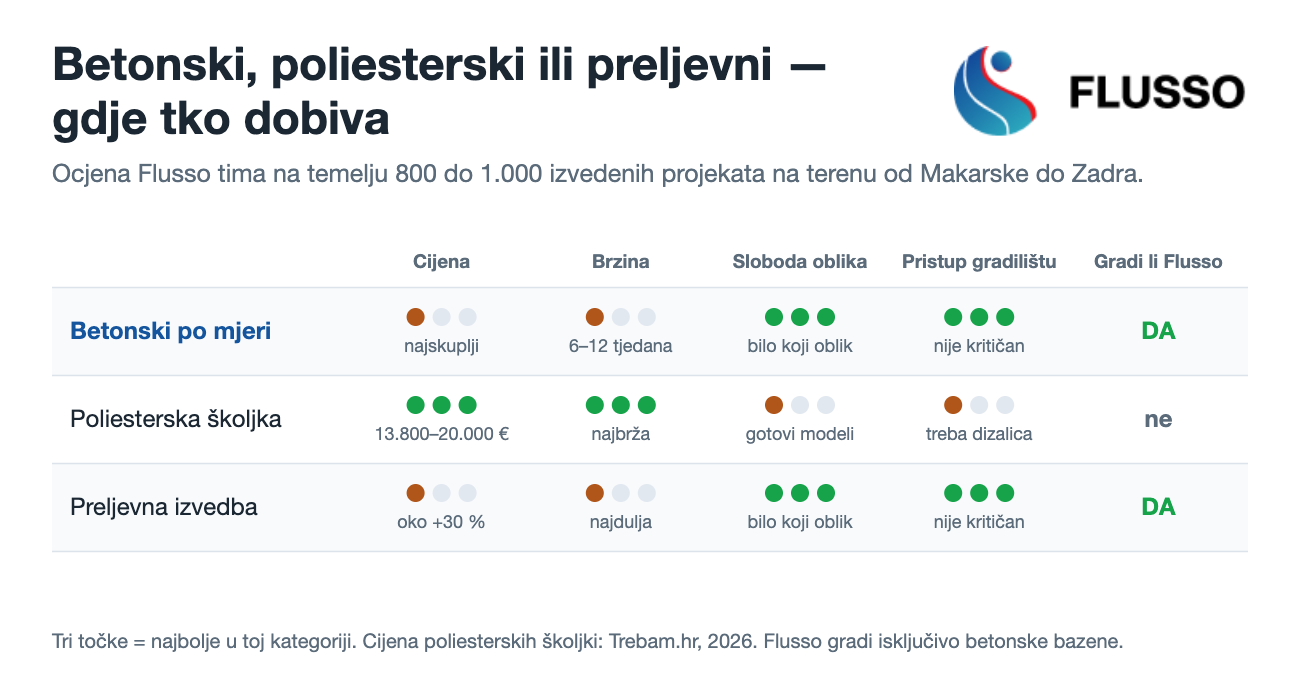
The drawbacks are real, and it is worth hearing them from a contractor who builds exactly this kind of pool. Concrete takes longer – with us 6 to 12 weeks, depending on size and complexity. For all that time the plot is a building site: excavation, reinforcement, formwork, concreting, waterproofing, lining, and only then the surroundings. If your garden and terrace are already finished, that is a lot of dirty work around a finished house. And one more thing: we do not do ‘turnkey’ – we install the pool equipment and lining, not the landscaping.
Fibreglass pool: advantages and drawbacks, and what it costs
A fibreglass shell is a finished factory product that is lowered into a prepared excavation, backfilled and connected. Its advantages are speed, fewer stages on the plot and a more predictable cost – the shell is a single item with a known price. For an investor who wants water before the season and the least possible building site around the house, this is objectively a stronger side than concrete.
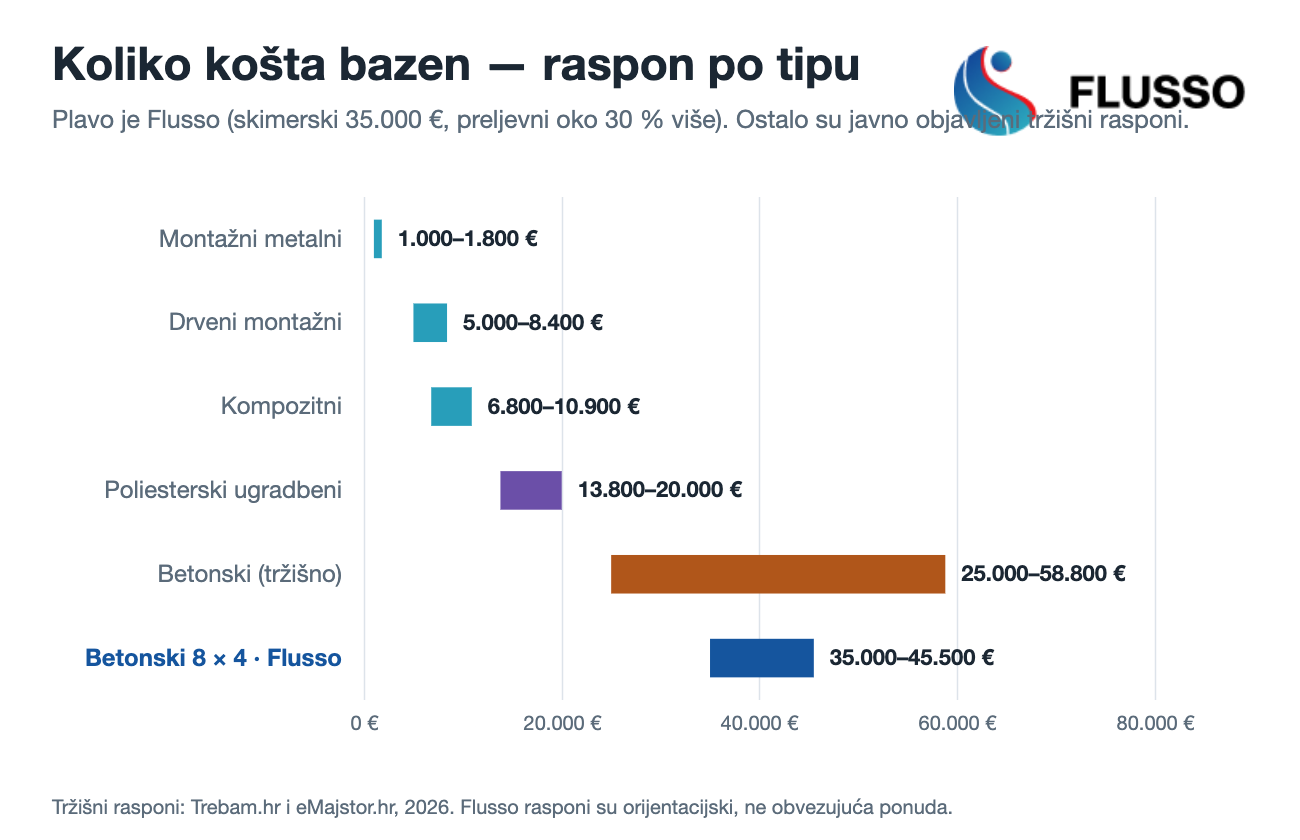
According to the market ranges published by the portal Trebam.hr, in-ground fibreglass pools run at €13,800–20,000, while concrete ones run at €25,000–58,800. The portal eMajstor.hr gives €780–1,080/m² with excavation for fibreglass and €900–1,250/m² for concrete. A more detailed breakdown of prices by type and size is in the article on how much it costs to build a pool.
There are three drawbacks. First: the shape and depth are fixed – you choose from a catalogue and adapt the plot to the shell. Second: transport and access, covered in detail below, because in Dalmatia this is the most common reason for dropping the idea. Third: repair. Damage to the gelcoat or the laminate layer is not work that every local tradesman does, whereas a liner and a mosaic are repaired locally.
Skimmer or overflow pool – what is the difference?
In a skimmer pool the water level is a few centimetres below the edge, and the water is drawn off through skimmers built into the wall. In an overflow pool the water level is level with the edge; the water spills over the whole edge into an overflow channel and goes to a balance tank, from which the filtration returns it. An infinity pool is an overflow pool in which the water spills over one edge, which visually merges with the horizon.
The price difference is not small: with us, an overflow design is roughly 30% more expensive than a skimmer pool of the same size. A concrete skimmer pool of 8 × 4 m costs roughly €35,000 (excluding the concrete shell) with us, and that is also our most requested size. The difference is not made by ‘luxury’ but by the additional construction and hydraulic work: the channel, the tank, higher flow, precise levelling of the edge.
Our recommendation after 800 to 1,000 completed projects is simple. If the plot is elevated with a sea view, go for overflow or infinity – the point of such a plot is the line of water merging with the sea, and a skimmer pool interrupts that line. If the plot is in an urban area, a skimmer pool or an overflow on all sides is the way to go, depending on whether you want an edge without a visible ‘step’ towards the terrace.
How the filter and pump are chosen by volume is explained in the guide to pool systems and equipment.
Comparison table: concrete, fibreglass and overflow
The table compares two materials and the overflow design as a third column, because that is how the decision is made in practice. Prices are indicative and are not a binding quote.
| Criterion | Concrete (skimmer) | Fibreglass (shell) | Overflow design |
|---|---|---|---|
| Price (market range) | €25,000–58,800 (Trebam.hr); €900–1,250/m² (eMajstor.hr) | €13,800–20,000 (Trebam.hr); €780–1,080/m² with excavation (eMajstor.hr) | With us ≈ 30% more than a skimmer design of the same size |
| Build time | 6–12 weeks, depending on size and complexity | Shorter – the shell is ready-made; excavation, placing and connections remain on site | Longer than skimmer – channel, balance tank, levelling of the edge |
| Freedom of shape and depth | Complete – drawn to suit the plot | Limited to catalogue models | Needs a precise edge and space for the tank |
| Lining | PVC liner, ceramic tiles or glass mosaic – your choice, and replaceable | Factory finish of the shell, no choice | All linings, plus finishing of the overflow channel |
| Site access | Material arrives in parts – feasible even on narrow and steep plots | Critical – needs a passage for a lorry and room for a crane | Same as the chosen material |
| Repairability | Local repair of the liner, grout or tiles without work on the structure | Gelcoat repair needs a specialist contractor | In addition: the channel and tank need regular inspection |
| Who it suits | A permanent solution next to the house, an atypical plot, a wish for mosaic or an infinity design | A flat, accessible plot; speed and a fixed budget are the priority | A plot with a view, where the line of the water is the main effect |
What really decides in Dalmatia?
In our practice from Makarska to Zadar, the choice of material is in many cases made not by the investor but by the plot. Three things – access, rock and climate – decide before anyone looks at a catalogue. This is the part that online comparisons almost never mention, because it is seen only by someone who goes out to site.
1. Site access and transport of the shell
An eight-metre fibreglass shell is a single piece. It has to reach the plot by lorry, and from the lorry it is lowered into the excavation by a crane – which must have somewhere to stand and enough room to work. That means a passable approach, a sufficient turning radius, room for the outriggers and a clear air corridor free of low wires, branches and the eaves of a neighbouring house.
In Dalmatian reality that often does not exist. Old town centres with narrow streets and archways, a terraced plot with retaining walls reached only by a staircase, a house reached through a neighbour’s yard, an island with ferry-only access – in all these cases the shell does not arrive, or arrives at a cost and risk that cancel out its advantage. That is reason number one why concrete is built here, not some special love of concrete. Concrete arrives in parts: reinforcement, formwork, the mix – everything that can be carried in, brought by a smaller machine or pumped.
2. Excavation in rock
Dalmatian terrain is not a plain. Beneath a thin layer of soil there is very often solid rock, and excavation then stops being digging and becomes breaking – a different machine, a different pace, a different cost. The same pool on two plots a hundred metres apart can have a significantly different excavation cost, and that is why a serious quote cannot be produced without a visit to the plot.
Rock has another side: once it has been broken through, it gives excellent bearing capacity. With a concrete pool that is an advantage, because the structure is cast in an already stable excavation. With a shell it is essential that the excavation has exact dimensions – in rock this takes more precision than in soil.
3. Salt, the bora and climate
By the sea everything metal and outdoors suffers from salt: handrails, screws, light housings, equipment in the plant room. That is why we choose components designed for such an environment and keep the plant room closed and ventilated. The bora brings a different problem – it blows leaves, dust and small debris into the water, so on exposed plots it pays to count on a cover. A solar cover costs ≈ €1,000 with us, a winter cover ≈ €1,500, and a roller cover €8,000–20,000 depending on the model.
The climate, in turn, is the reason it pays in Dalmatia to plan for a season and not just July and August. According to the climate normals of the Croatian Meteorological and Hydrological Service (DHMZ) for the Split-Marjan station (1948–2024), May and September have considerably more sunshine than is assumed:
| Month | Mean air temperature | Hours of sunshine |
|---|---|---|
| May | 19.2 °C | 271.4 |
| June | 23.4 °C | 309.0 |
| July | 26.2 °C | 353.3 |
| August | 25.9 °C | 328.0 |
| September | 21.6 °C | 247.1 |
May and September together bring more than 500 hours of sunshine, but air temperatures of 19.2 and 21.6 °C do not by themselves warm the water to a comfortable level. That is why a heat pump and a cover turn that difference into a season. An Astralpool heat pump for an 8 × 4 pool costs ≈ €3,000 with us, and for a 10 × 4 pool ≈ €4,000.
4. Preparing for the season
Whatever the material, plan so that the pool is finished before the season, not during it. A build of 6 to 12 weeks means that a project for June is agreed in winter, not in April. With a shell the lead time is shorter, but it depends on the availability of the model and the crane slot.
Which lining goes with which type of pool?
You choose the lining only with a concrete pool – a fibreglass shell comes with a factory finish and there is no choice. With concrete there are three options: PVC liner, ceramic tiles and glass mosaic. We prefer glass mosaic, because in Dalmatian light it gives a depth of colour that a liner does not achieve, and it performs best on atypical shapes and curves.
| Lining | Price with us (indicative) | Service life (market source) |
|---|---|---|
| Renolit PVC liner | ≈ €110/m² (we also offer Duraston kulir) | 10–15 years according to bazenirijeka.com |
| Ceramic tiles | Available, priced per project | 20–30 years according to bazenirijeka.com |
| Glass mosaic (Vidrepur) | Material €30–250/m²; installation with a basic mosaic, all included, ≈ €160/m² | — |
With an overflow design the lining continues into the overflow channel as well, so the quantity of material is greater than for a skimmer pool of the same footprint – one of the reasons the price difference is not just down to the extra concrete.
Does any of them need a permit?
The legal status does not depend on the material. It depends on whether the pool is sunk into the ground and how large it is. Under the Ordinance on Simple and Other Structures and Works (Pravilnik o jednostavnim i drugim građevinama i radovima), Art. 4, point 1(c), ‘a pool with a footprint of up to 100 m² sunk into the ground’ can be built without a building permit, but in accordance with a main design – on the building plot of an existing building and for the needs of that building. In addition, Art. 6, para. 3 provides that ‘the investor is obliged to notify the start of construction of the structures referred to in Article 4 of this Ordinance’.
A lighter regime exists for a garden pool: Art. 3, point 4 permits ‘a garden pool or pond up to 1 m deep measured from the level of the surrounding ground’ without a building permit and without a main design.
One thing always applies: Art. 1, para. 2 provides that these structures ‘must not be designed, built or carried out if this is prohibited by the spatial plan or is otherwise contrary to the spatial plan’. The spatial plan overrides everything above, so check it with the competent planning department before you order anything. The whole procedure is set out in our complete guide to pool construction. We help with the main design and work with an authorised designer.
How to decide in three questions
If you skip the catalogues and ask three questions in this order, the decision usually makes itself.
- Can a lorry and a crane reach the pool location? If not, the answer is concrete, and the discussion ends there. If they can, you stay in the game with both materials.
- Is a shape from the catalogue good enough for your plot? If the plot is regular and a model suits you, fibreglass brings speed and a predictable cost. If the plot has retaining walls, a slope, an atypical layout, or you want a specific depth and steps – concrete.
- Is the sea view the main reason you are building? If it is, go for an overflow or infinity design, at ≈ 30% more than a skimmer pool. If not, a skimmer pool does the same job for less money.
Next step
The decision between concrete and fibreglass is not made at a desk but on the plot – access, terrain and position relative to the sea settle it faster than any table. If you are not sure where you stand, also compare an in-ground and an above-ground pool, then get in touch with us with the address and a photo of the approach. We come out to site from Makarska to Zadar, typically reply to enquiries within 24 hours, and you can see exactly what we do on the pool construction and maintenance page.
Frequently asked questions
According to the market ranges of the portal Trebam.hr, in-ground fibreglass pools cost €13,800–20,000 and concrete ones €25,000–58,800. eMajstor.hr gives €780–1,080/m² with excavation for fibreglass and €900–1,250/m² for concrete. Our concrete skimmer pool of 8 × 4 costs roughly €35,000 (excluding the concrete shell). The amounts are indicative and are not a binding quote.
No. We work only on concrete pools, in skimmer, overflow and infinity designs, with a contractual 5-year guarantee on the waterproofing; the concrete shell is built by the client's own building contractor to our design. We do not install fibreglass shells, so if your plot is accessible and you are looking above all for speed, we will tell you openly that this route is a good choice too.
Not necessarily, but an overflow design needs an overflow channel, a balance tank and precise levelling of the edge – and that is much easier to achieve in a structure that is shaped on site. With a fibreglass shell it all depends on whether the manufacturer offers such a model, because the shell is not modified on site.
Because of site access and terrain. A fibreglass shell is a single piece that needs a lorry, a crane and free room to work, which old town centres, narrow streets, terraced plots and islands often lack. Concrete arrives in parts, so it is feasible even where a shell cannot get in.