
In-ground or above-ground pool? A comparison that settles the dilemma
A comparison of prices, permits and the main design, heating and the cost over five years – and when an above-ground pool is a sensible choice.
Short answer: an above-ground pool is for someone who needs water this summer, has a limited budget or is not sure whether they will stay at that location. An in-ground concrete pool is for someone who is building a permanent solution next to the house, wants heating and a season longer than two months, and accepts a main design and a higher initial investment.
Before comparing, the terms need to be cleared up, because the market mixes them up. There are three products with similar names: the above-ground pool, the prefabricated in-ground pool (shell) and the in-ground concrete pool. They differ in whether they require a main design, whether they can be heated and what happens to them in winter.
What is an in-ground pool and what is an above-ground pool?
An in-ground pool is sunk into the ground – either as a ready-made shell lowered into an excavation, or as a reinforced-concrete structure cast on site. A prefabricated pool is an above-ground pool assembled on a prepared base, without excavation. The problem is that the word ‘prefabricated’ is used in sales offers for both.
1. Prefabricated above-ground pool
A structure of metal walls, wooden panels or composite with a liner lining, set on a level base, with no work in the ground. The water is usually drained at the end of the season, and with simpler models the pool itself is dismantled and stored. According to the portal Trebam.hr, prefabricated metal pools on the market run from €1,000 to €1,800, wooden ones from €5,000 to €8,400 and composite ones from €6,800 to €10,900.
2. Prefabricated in-ground pool – shell
A ready-made fibreglass or steel shell manufactured in a factory and lowered into a prepared excavation. It is called ‘prefabricated’ because it is not built on site, but the result is an in-ground pool – with excavation, a foundation slab, backfilling and connections. According to Trebam.hr, in-ground fibreglass pools cost €13,800–20,000, and eMajstor.hr gives €780–1,080/m² with excavation.
3. In-ground concrete pool
A reinforced-concrete shell cast on site, waterproofed and finished with PVC liner, ceramic tiles or glass mosaic. There is no limit on shape, depth or type – skimmer, overflow or infinity. This is the only type Flusso works on; the concrete shell is built by the client's own building contractor to our design, and we give a contractual 5-year guarantee on the waterproofing.
In-ground or above-ground pool: the big comparison table
The matrix compares the three types on the criteria that really change the decision. Where we have no confirmed public source, we say so – instead of giving an estimate that sounds convincing but cannot be verified.
| Criterion | Prefabricated above-ground | Prefabricated in-ground (shell) | In-ground concrete |
|---|---|---|---|
| Initial price | metal €1,000–1,800; wooden €5,000–8,400; composite €6,800–10,900 | in-ground fibreglass €13,800–20,000 | market €25,000–58,800; Flusso skimmer 8×4 ≈ €35,000 (excluding the concrete shell) |
| Installation / construction time | no excavation or concreting; set on a prepared base | requires excavation, a foundation slab, transport and a crane to lower the shell | 6–12 weeks, depending on size and complexity (Flusso) |
| Service life | we have no confirmed public figure – ask for the manufacturer’s warranty period in the quote | we have no confirmed public figure – ask for the manufacturer’s warranty period | lining: PVC liner 10–15 years, ceramic tiles 20–30 years; Flusso contractual guarantee 5 years on the waterproofing |
| Permit and main design | not an in-ground structure under Art. 4 of the Ordinance; the spatial plan restriction always applies | sunk into the ground → up to 100 m² without a building permit, but in accordance with a main design | the same: up to 100 m² without a permit, with a main design and a construction start notification |
| Heating options | difficult: the wall is exposed to air on all sides, and there is often no fixed plant room or connection | good: fixed plant room, a heat pump is fitted as standard | best: heat pump, solar or roller cover, everything sized by the volume of water |
| Annual cost | chemicals + filtration electricity in the season only; we have no confirmed public figure | market €600–1,400/year for regular maintenance | market €600–1,400/year; Flusso full service €300–400/month depending on size |
| Winterising | the water is usually drained; simpler models are dismantled and stored | stays full, winterised with a cover and preparation of the plant room | stays full; winter cover ≈ €1,500, roller cover €8,000–20,000 |
| Relocation | yes – it can be dismantled and moved | not in practice (buried, backfilled, connected) | no – a permanent structure |
| Property and rental | seasonal equipment in the garden, does not permanently change the look of the property | a permanent feature of the property, shape limited to the manufacturer’s catalogue | a permanent feature of the property, with shape and type (overflow, infinity) tailored to the plot |
One row deserves special attention, because Croatian pool content almost never mentions it: the permit and the main design.
Is a permit needed for an above-ground pool, and for an in-ground pool?
The key phrase in Croatian regulation is ‘sunk into the ground’. The Ordinance on Simple and Other Structures and Works (Pravilnik o jednostavnim i drugim građevinama i radovima; NN 112/17, 34/18, 36/19, 98/19, 31/20, 74/22, 155/23) provides in Art. 4, point 1(c) that ‘a pool with a footprint of up to 100 m² sunk into the ground’ can be built without a building permit, but in accordance with a main design – as an ancillary structure on the building plot of an existing building, for the needs of that building.
The three conditions are cumulative. In practice, an 8 × 4 m pool has a 32 m² footprint, and even 12 × 6 m has 72 m² – both well below the threshold.
In addition, Art. 6, para. 3 of the same Ordinance says: ‘The investor is obliged to notify the start of construction of the structures referred to in Article 4 of this Ordinance.’ So for an in-ground pool the construction start notification is mandatory, even though a building permit is not.
An above-ground prefabricated pool is not a structure sunk into the ground, so Art. 4 does not describe it. For pools built as landscaping of the building plot of an existing building, Art. 3, point 4 states that ‘a garden pool or pond up to 1 m deep measured from the level of the surrounding ground’ can be built without a building permit and without a main design.
A few things are often wrongly attributed to this Ordinance: it contains no depth limit for a pool of up to 100 m² (the 1 m limit applies only to the garden pool under Art. 3), nor a volume limit in m³, nor a prescribed distance from the boundary. The distance from the boundary is set by the spatial plan. If you are building in the coastal belt, the Spatial Planning Act (Zakon o prostornom uređenju, NN 155/25, in force from 1 January 2026) does not affect a pool directly but through the spatial plan: in the restricted area (prostor ograničenja) – the part of the mainland and islands within 1,000 m of the coastline and the belt of sea 300 m wide (Art. 19, point 48 and Art. 58) – plans can be stricter.
A detailed overview of the whole process – from design to handover – is in our complete guide to pool construction in Croatia.
How much do in-ground and above-ground pools cost?
The range is huge: from about €1,000 for a metal above-ground pool to over €50,000 for a concrete pool with mosaic. The prices cannot be compared one to one, because you are not buying the same thing. With an above-ground pool you pay for a product; with an in-ground pool you pay for work on the plot – excavation, foundations, the plant room, connections and the lining.
| Pool type | Price range | Source |
|---|---|---|
| Above-ground metal | €1,000–1,800 | Trebam.hr |
| Above-ground wooden | €5,000–8,400 | Trebam.hr |
| Composite | €6,800–10,900 | Trebam.hr |
| In-ground fibreglass | €13,800–20,000 | Trebam.hr |
| Concrete (market range) | €25,000–58,800 | Trebam.hr |
| Concrete 8×4×1.5 with PVC liner | €23,000–42,000 | bazenirijeka.com |
| Concrete 8×4×1.5 with ceramic tiles / mosaic | €32,000–60,000 | bazenirijeka.com |
| Flusso: concrete skimmer 8×4 | ≈ €35,000 (excluding the concrete shell) | Flusso Group |
| Flusso: concrete overflow (same size) | ≈ 30% more than the skimmer pool | Flusso Group |
All amounts are indicative ranges, not a binding quote. Two notes from practice. First, Flusso does not do ‘turnkey’ – we build the pool, the pool equipment and the lining, but not the landscaping; plan that part of the budget separately. That is why we tell owners to count on a minimum budget of €50,000 for a fully landscaped garden with a pool. Second, pricing is by project, not per m²: equipment is sized by the volume of water, so two pools with the same footprint can have a different equipment cost. A more detailed breakdown is in the article on the cost of building a pool by type and size.
How this equipment is sized and put together is covered in the guide to pool systems and equipment.
Can an above-ground pool be heated?
It can, but at higher cost and with a poorer result than with an in-ground pool. The above-ground wall is exposed to the air on all sides and loses heat, whereas an in-ground pool is surrounded by soil, which acts as an insulator. Above-ground pools also often have no fixed plant room and no permanent electrical connection of the required capacity, and a heat pump needs both.
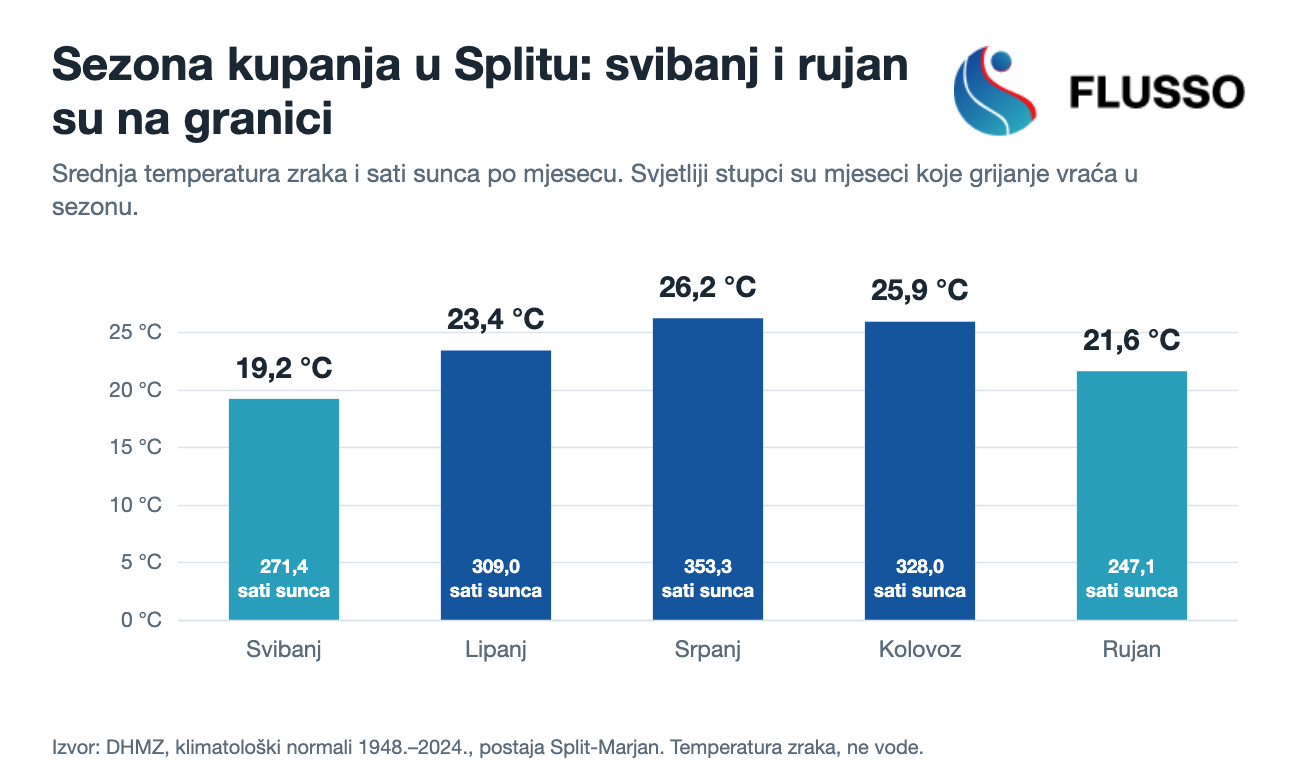
Why is heating an issue at all? Look at the climate normals of the Croatian Meteorological and Hydrological Service (DHMZ) for the Split-Marjan station (1948–2024):
| Month | Mean air temperature | Hours of sunshine |
|---|---|---|
| May | 19.2 °C | 271.4 |
| June | 23.4 °C | 309.0 |
| July | 26.2 °C | 353.3 |
| August | 25.9 °C | 328.0 |
| September | 21.6 °C | 247.1 |
These are air temperatures, not water temperatures – but the relationship is clear. July and August are pleasant without any heating. May (19.2 °C) and September (21.6 °C) are borderline: without heating, the pool mostly sits unused in those months, even though May has 271.4 hours of sunshine. That is exactly where a heat pump earns back the investment.
An Astralpool heat pump for an 8×4 pool costs ≈ €3,000 with us, and for a 10×4 pool ≈ €4,000. A solar cover (≈ €1,000) almost always pays off alongside it, because the biggest heat loss in a pool is through evaporation from the surface. See the options in the pool heating category.

What do they cost over five years?
The initial price is the least reliable indicator. An above-ground pool has a low entry price and a recurring cost of seasonal preparation; an in-ground pool has a high entry price and a predictable annual maintenance cost. Over a five-year horizon it looks like this.
- Above-ground metal (€1,000–1,800): on top of that come chemicals and filtration electricity during the season. We have no confirmed public figure for the annual running cost of an above-ground pool, so we do not quote one – but the cost profile is different: a smaller amount, a greater share of your own labour (setting up, filling, draining, storing).
- In-ground concrete, without a service contract: the market range is €600–1,400/year (bazenirijeka.com); the source does not say exactly what that range covers, but by scale it corresponds to basic maintenance without regular technician visits – that is, €3,000–7,000 over five years.
- In-ground concrete, full service: Flusso regular maintenance costs €300–400/month depending on size – that is €3,600–4,800 a year, or €18,000–24,000 over five years. The service includes checking the condition of the water, cleaning the shell and vacuuming, and servicing in the plant room, with a call-out within 24 hours.
With the lining, the difference in service life turns into money: PVC liner lasts 10–15 years, ceramic tiles 20–30 years. Over a 20-year horizon a liner is replaced once or twice, mosaic never. That is why we prefer glass mosaic – installation with a basic mosaic, all included, costs ≈ €160/m², while Renolit liner is ≈ €110/m². We have broken down the comparison of materials in the article concrete, fibreglass or overflow pool.
What about winter? Winterising an above-ground and an in-ground pool
Above-ground and in-ground pools are wintered in completely different ways. Simpler above-ground pools are emptied and dismantled – an advantage if you use the garden differently in winter, a burden if you have to do it every year. An in-ground pool stays full of water; the water protects the shell and prevents the structure from shifting. Winterising an in-ground pool means lowering the water level below the skimmers, preparing the plant room, adjusting the chemistry and covering the pool. A winter cover costs ≈ €1,500 with us, and a roller cover, which also reduces evaporation and warms the water during the season, €8,000–20,000 depending on the model.
When an above-ground pool makes sense and when it does not
Let us be open about it: Flusso builds only concrete pools. That is exactly why it is fair to say when a concrete pool is not the right choice – across 800 to 1,000 completed projects we have also seen situations in which something simpler would have served the client better.
An above-ground pool makes sense if:
- You do not live in your own property or you are not sure whether you will stay at that location for the next five to ten years. An in-ground pool stays where it is; an above-ground one goes with you.
- The space is too small or site access is impossible. An in-ground pool needs an excavator to get in, and a shell needs a crane as well – on narrow Dalmatian plots this can be decisive.
- The budget has no room for an investment of several tens of thousands of euros.
- You need the pool for the children, for a few seasons.
An above-ground pool does not make sense if:
- You want to swim, not just cool off – above-ground pools rarely have the depth and length for swimming.
- You want heating and a season from May to September.
- The plot is elevated with a sea view. This is where an overflow or infinity design pays off, and it can only be built in concrete. In a more urban setting we most often suggest a skimmer pool or an overflow pool on all sides.
- The pool has to be visually in harmony with the house and its surroundings. The most common mistake we find on other people’s pools is exactly this: the height of the pool ends up not matching the level of the house and terrace, and that cannot be fixed afterwards.
A decision in four questions
- How long will you stay at this location? Less than five years, or the property is not yours → above-ground. Longer, and your own property → in-ground.
- Do you rent out the property? If the pool is to be a permanent part of what the property offers and look like part of the house, go for in-ground.
- How much space is there, and what is the access like? Can an excavator reach the pool location? If it cannot, an in-ground pool becomes substantially more expensive or impossible, and an above-ground pool remains the only option.
- What is the budget – including maintenance, not just construction? Add the initial price and five years of maintenance. If that amount exceeds what you are prepared to spend, an above-ground pool is not a compromise but the right decision.
Next step
The decision comes down to two questions: will you stay here long enough, and do you want a season longer than two months? If the answer to both is ‘yes’, the next step is to check the spatial plan for your plot – before you even choose a material or lining.
If you are at that stage, send us the plot dimensions and the position of the house via the enquiry form – we typically reply within 24 hours, and we cover the area from Makarska to Zadar. What exactly we do and do not build is set out on the pool construction and maintenance page.
Frequently asked questions
An above-ground prefabricated pool is not a structure ‘sunk into the ground’, so Art. 4 of the Ordinance on Simple and Other Structures and Works does not cover it. For a garden pool up to 1 m deep measured from the level of the surrounding ground, Art. 3, point 4 provides that it is built without a building permit and without a main design. Regardless of the type, Art. 1, para. 2 prohibits building contrary to the spatial plan – always check the plan with the competent planning department.
Yes. Under Art. 4, point 1(c) of the Ordinance, a pool with a footprint of up to 100 m² sunk into the ground is built without a building permit but in accordance with a main design, on the building plot of an existing building and for the needs of that building. In addition, Art. 6, para. 3 obliges the investor to submit a construction start notification. At Flusso we help with the main design and work with an authorised designer.
According to market ranges from Trebam.hr, a metal above-ground pool runs at €1,000–1,800, an in-ground fibreglass pool at €13,800–20,000 and a concrete one at €25,000–58,800. Our concrete skimmer pool of 8×4 costs ≈ €35,000 (excluding the concrete shell) indicatively, and an overflow version of the same size about 30% more. The final price depends on the finish, the equipment and the conditions on the plot.
Technically yes, but with poorer performance. The above-ground wall loses heat to the air on all sides, whereas an in-ground pool is surrounded by soil. A heat pump also needs a permanent electrical connection and a fixed place next to the pool, which folding models usually do not have. With us, an Astralpool heat pump for an 8×4 pool costs ≈ €3,000, and we recommend adding a solar cover (≈ €1,000).
It depends on the model: simpler above-ground pools are emptied, dismantled and stored until the next season, whereas sturdier designs are wintered in place, with a cover. An in-ground pool stays full of water because the water protects the shell; it is wintered by lowering the level below the skimmers, preparing the plant room and covering the pool.

