Robotic pool cleaner or pool vacuum: which to choose
Choose a robot if you want the pool to clean itself, a battery vacuum if you clean occasionally and in specific spots. The difference is not only the price but also what uses the energy.

Short answer: a robot if you want the pool to clean itself, a battery vacuum if you clean occasionally and in specific spots. The difference is not only the price but also what uses the energy – a robot has its own motor of 150–200 W and runs independently of the filtration, whereas a pump-driven vacuum makes the main pump run extra hours. In our range this covers €335 to €2,200, and the deciding factor is usually the size of the pool rather than the budget.
Below is a closer look at the three types of cleaner that adverts keep mixing up, why the filtration inside a cleaner does not replace the filter in the plant room, and what you actually get at each price step. If you are putting together a whole plant room, start with the guide to pool systems and equipment.
Three types of cleaner, and why they get mixed up
In Croatian adverts, the words ‘vacuum’, ‘cleaner’ and ‘robot’ are used interchangeably for three technically different things:
- Manual vacuum run off the pump – a brush head on a telescopic pole, connected by hose to the skimmer or a dedicated suction point. It has no motor of its own; the main pump creates the suction. It is the cheapest option, and the one that needs someone standing at the pool.
- Battery vacuum – a self-contained unit with its own small pump and a basket for debris. It needs neither a hose nor mains power. It does what the manual one does, but without being tied to the skimmer.
- Robot (automatic cleaner) – drives itself along the floor and walls, with its own motor, brushes and filter. It runs a cycle unattended and regardless of whether the filtration is running.
The key difference: it is not which one vacuums better but which one uses the energy and which one uses your time. A manual vacuum is the cheapest to buy and the most expensive to use, because you pay with running time on the main pump and with your own time standing at the pool. A robot is the opposite. A battery vacuum sits in between: cheap and easy on the pump, but you still guide it by hand.
Why a robot does not burden the filtration
This is an argument that few people ever work out. A robot runs on its own low-voltage motor – according to figures published by Poolbots, a typical robot draws 150–200 W and uses 0.4–0.5 kWh over a 2.5-hour cycle. The same source states that pressure-side cleaners need a booster pump of over 1,000 W, while suction-side cleaners require the main pump to run longer.
Now let us apply that to a real system. If an 8 × 4 m pool has a Victoria Plus Silent 100M pump rated at 0.78 kW, two extra hours of running for vacuuming use 1.56 kWh. A robot doing the same job uses 0.45 kWh.
How this was calculated: the robot’s consumption comes from published figures (150–200 W, 0.4–0.5 kWh per cycle). The pump’s consumption is our own calculation from its rated power: 0.78 kW × 2 hours = 1.56 kWh. The ratio comes out at roughly 3.5 : 1 in the robot’s favour for each clean. With two cleans a week over a 22-week season, the difference is about 49 kWh – in money, roughly ten to twenty euros a year. The point is not the amount but that it turns the ‘a robot uses electricity’ argument upside down: a robot uses less than the way you would clean without one.
There is a second, more important effect. Vacuuming through the skimmer means all the dirt from the bottom passes through the pump’s strainer basket and the filter – so the filter clogs faster and has to be backwashed more often. Each backwash uses close to a tonne of water, as we explained in the article on the pool filter. A robot keeps that dirt in its own basket and takes it out of the system.
Filtration inside a cleaner is not a substitute for the filter
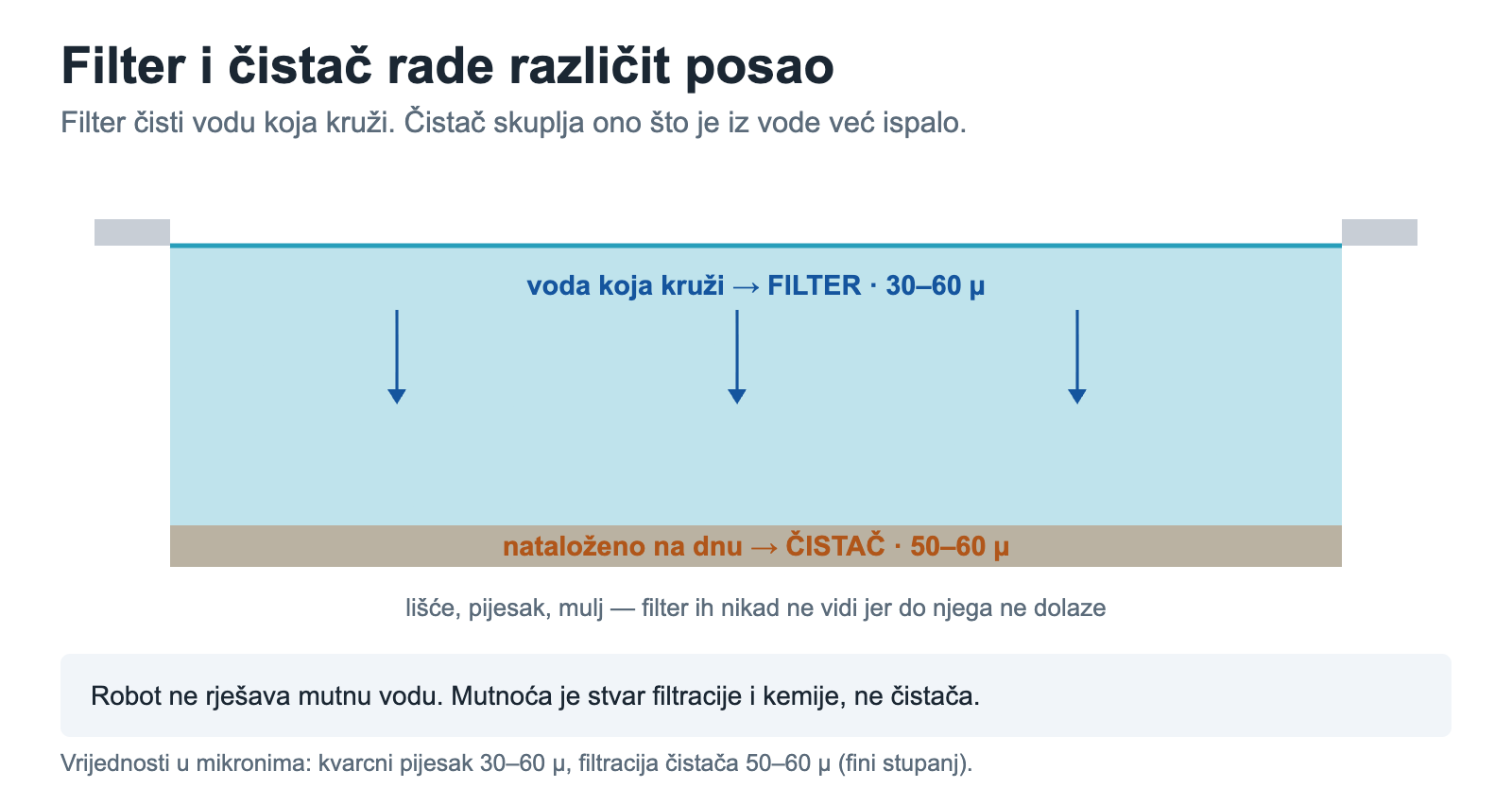
Cleaner marketing likes to highlight microns, which gives the impression that a robot replaces the filtration. It does not – it does a different job.
| Device | Filtration fineness | What it catches |
|---|---|---|
| Voltera 75 battery vacuum | 250 + 50 µ | what has already settled on the bottom |
| Zodiac RE 4300 Voyager | 150 / 60 µ (two-stage) | what has already settled on the bottom and the walls |
| Sand filter, quartz sand | 30–60 µ | what is circulating in the water |
| Sand filter, activated glass | down to 5 µ (declared value) | what is circulating in the water |
The numbers are comparable, but the jobs are not. A filter cleans the water that passes through it; a cleaner collects what has already dropped out of the water. The filter never sees the leaves, sand and silt lying on the bottom, because they never reach it – and that is exactly what bothers you most when you get into the pool.
Price ladder: what you get at each step
From our range, ordered by price – and by how much of the work they take off your hands:
| Device | Type | For pools up to | Price |
|---|---|---|---|
| Voltera 75 | battery vacuum, guided by hand · 75 min runtime · 3 kg debris | smaller pools and spot cleaning | €335 |
| GRE Action Vac | battery vacuum | smaller pools | €385 |
| Zodiac OP 32 Pixel | automatic, cordless · floor and walls | — | €750 |
| Zodiac RE 4300 Voyager | corded robot · cyclonic suction · 150/60 µ filtration · gyroscope and accelerometer | 10 × 5 m | €1,250 |
| Zodiac RF 5200 iQ Freerider | cordless robot · lithium-ion battery | 10 × 5 m | €1,475 |
| Zodiac RF 5400 iQ Freerider | cordless robot | 12 × 6 m | €1,675 |
| Zodiac RF 5600 iQ Freerider | cordless robot · remote control | 12 × 6 m | €1,813 |
| Zodiac RA 6800 iQ Alpha iQ | robot · Nav System · two-stage filtration · Wi-Fi | 15 × 7 m | €2,200 |
Prices are taken from our range and may change; the size and filtration data come from the manufacturers. The full range is in the Automatic cleaners category.
Pay attention to the ‘for pools up to’ column. It is the most important criterion when choosing, more important than the price. A robot rated for 10 × 5 m in a 12 × 6 m pool will not cover the whole surface in one cycle – not because it is weak, but because its cycle, cable length or battery life are not designed for that area.
Corded or cordless?
For mid-range robots this is now the first decision, and the difference is not in power but in handling.
A corded robot (Voyager) is not limited by runtime – it can run long cycles and repeat them. The drawback is the cable: it twists, has to be unrolled before and coiled afterwards, and in an irregularly shaped pool it can limit the reach.
A cordless robot (Freerider series) solves exactly that – there is nothing to tangle; you lower it into the pool, lift it out and charge it on its base. The drawback is that a cycle lasts only as long as the battery does, and the battery has a limited life.
Recommendation: if the pool has straight sides and a regular shape, a cable is perfectly fine and you get more robot for the same money – the Voyager at €1,250 offers cyclonic suction and two-stage filtration that cordless models in that class do not have. If the pool is irregular, has curves, or has an edge that makes the cable a nuisance, take a cordless one. The price difference of around two hundred euros is repaid by how much you actually use it.
How to choose in three questions
- How big is the pool? This narrows the choice first. Up to 10 × 5 m, every option is open; above that you are looking at the 5400, 5600 or Alpha iQ. An 8 × 4 m pool – the most common size here – is covered by every robot on the list.
- Who will use the pool, and how often? If the pool is used by a family that is there every day, a robot pays for itself because it takes the job over. If it is a house used at weekends or rented out, a battery vacuum with regular maintenance is often enough.
- What surrounds the pool? Pines, cypresses and Mediterranean scrub mean leaves and needles every day – here a robot is not a luxury but a condition for keeping the pool usable. A pool on an open terrace with no greenery collects far less dirt.
A note on scope: we do the waterproofing, the lining and the pool equipment; the concrete shell is built by the client's own building contractor to our design. Cleaners are equipment that we sell and recommend, but they are not part of the structure – you can add one at any time, unlike pipe diameters or the overflow type, which have to be decided before the concrete is poured.
Next step
Measure the pool and look at what surrounds it. Those two pieces of information settle the choice faster than any comparison table: the size decides which models are in the running at all, and the surroundings decide how hard the cleaner will have to work. If you use the pool at weekends and there is no greenery nearby, you do not need a two-thousand-euro robot.
You can browse robots and vacuums in the Automatic cleaners category. If you are unsure, send us the pool dimensions and a photo of its surroundings – we typically answer enquiries within 24 hours, and we will tell you if the answer is that a €335 vacuum is enough for you.
Frequently asked questions
A robot if you want the pool cleaned without you and it is surrounded by greenery that keeps dropping into the water. A manual or battery vacuum if you clean occasionally and in specific spots, or if the pool is small. In economic terms, a robot uses less energy than cleaning through the main pump: a robot draws 150–200 W and uses 0.4–0.5 kWh per cycle, whereas two extra hours of running a 0.78 kW pump use 1.56 kWh.
It depends on the model – it cannot be taken for granted. The Zodiac OP 32 Pixel is rated for cleaning the floor and walls, and the Voyager has tracks plus a gyroscope and accelerometer to find its way around pools of any shape. Cheaper battery vacuums as a rule work on the floor only. If it matters to you that the walls and the waterline are cleaned too, check this explicitly in the specification, because that is where the price difference lies.
In our range, robots start at €750 for a cordless automatic cleaner, and a proper robot with cyclonic suction and two-stage filtration starts at €1,250. For pools up to 12 × 6 m the range is €1,675–1,813, and the top of the range, with Wi-Fi control and coverage up to 15 × 7 m, is €2,200. The deciding criterion is not the price but the rated pool size – a robot rated for a smaller pool than yours will not cover the surface in a single cycle.