

A bio pool (natural pool) is a chlorine-free pool in which the water is purified by a planted regeneration zone. Croatian regulation for public biological pools (NN 59/2020) requires that this zone be at least 50 % surface, depth at least 0.8 meters and water temperature up to 26 °C; does not apply to private pools (Art. 2), but is the only domestic reference framework. This means approximately twice the water surface and different maintenance — not less maintenance.
Immediately, what you should know about the author of the text: Flusso builds only concrete pools and pool equipment. We do not build natural pools. and this is not an offer for their construction. The text exists because people regularly ask us "is it possible without chlorine", and Croatian content on this topic is mostly romantic and almost never numerical. Below are the facts — Croatian regulations, German guidelines and three published studies on water quality — on the basis of which you can decide for yourself. If you are just choosing the type of pool, start with a complete guide to building a swimming pool in Croatia.
What was a pool and how does it work?
The bio pool has two zones: swimming area and regeneration zone planted with aquatic and marsh plants. Water circulates between them, purified by microorganisms on the roots and substrate — the same process that works in a healthy lake, compressed into a yard-sized container. There is no chlorine because it would kill the very organisms that clean the water.
Croatian legislation explicitly defines this type of pool. The Ordinance on Sanitary, Technical and Hygienic Conditions of Swimming Pools (Official Gazette 59/2020), Art. 3, states: "a biological pool is an outdoor pool in which the preparation of pool water is carried out by natural biological processes in an ecosystem of microorganisms, plants and indigenous small animals".
The key word in that definition is ecosystem. A classic pool is a tank where you control the chemistry and flow — if something goes wrong, you add chlorine and the problem is solved in a few hours. A bio pool is a living system with biological inertia: it reacts for days and weeks, and your regulators are nutrients, temperature and light. The technology in it (pump, skimmer, bottom filter through the substrate) does not disinfect the water but helps the biology work.
Key: According to Article 2 of the same Ordinance, the regulation is does not apply to swimming pools owned by citizens that are not intended for public use. So you don't have these obligations for a private bio-pool — but NN 59/2020 is the only Croatian document that even sets figures for a biological pool, so it's the best reference framework you have.
How much space does a bio pool require?
Much more than people expect. The regeneration zone is not a decoration on the edge — it is filtration and takes up from approximately 30 % of surface area in the most technically equipped systems to 50–60 % for classic designs without pumpThe German FLL guidelines divide natural pools into five types based on this proportion.
| Type (FLL) | Regeneration zone | Min. size | Technique |
|---|---|---|---|
| Type 1 | ≥ 60 % | ~120 m² | without pump |
| Type 2 | ≥ 50 % | ~100 m² | pump + skimmer |
| Type 3 | ≥ 40 % | ~80 m² | + floor filter through substrate |
| Type 4 | ≥ 40 % | ~60 m² | strong pump, full volume daily |
| Type 5 | ≥ 30 % | ~50 m² | two-chamber system, pressure filter |
Source: FLL classification of types of natural pools. For Type 1, sources differ (50 % or 60 %), so take it as a range. Croatian regulation is stricter than most types: Art. 17. NN 59/2020 requires that the biological treatment part be at least 50 % surfaces, "completely planted with selected vegetation" and inaccessible to swimmers.

Let's translate that into a number that decides whether the pool will fit in the yard. Let's take as a benchmark the most requested dimension of a concrete pool in our country, 8 × 4 m — so 32 m² of swimming areaWith a regeneration zone of 40 %, a total of about 53 m² of water surface is needed, with 50 % about 64 m², and with 60 % full 80 m²If you adhere to the Croatian criteria of at least 50 %, count on 64–80 m².
This is the real obstacle: In a typical urban yard in Dalmatia, there is simply no water surface of 64–80 m². Measure the plot before discussing the price. Reducing the regeneration zone “because there is no room” does not result in a smaller bio-pool, but a pool that fails to purify itself.
What should the water in a biological pool be like?
Different than in a classic pool and measured by other quantities: instead of chlorine and redox potential, the key phosphorus, transparency and temperature. NN 59/2020, Annex I, Table 2 prescribes these limit values for public biological pools:
| Parameter | Limit value |
|---|---|
| Water temperature | max 26 °C |
| Total phosphorus | max 20 µg/L |
| Transparency | ≥ 2m |
| Escherichia coli | max 100 cfu/100 ml |
| Enterococci | maximum 50 |
| Pseudomonas aeruginosa | maximum 10 |
| Oxygen saturation | ≥ 80 % |
| Minimum depth (Art. 21) | 0.8 m; waterfowl and fish prohibited |
| Sampling (Art. 26) | at least once a week |

The Austrian guideline IOB / ÖNORM L 1128 goes even lower: for Swimming pool allows up to 35 µg/l of phosphorus, and for Nature pool — more technically equipped version — maximum 10 µg/lThe same guideline also states the intake: each bather injects into the water about 100 mg of phosphorus per day.
A comparison of orders of magnitude explains the sensitivity of the system. In a classic pool, free chlorine is measured in milligrams per liter (0.2–1.0 mg/l according to Table 1 of the same Ordinance); in biological phosphorus is measured in micrograms, a thousand times smaller unit. A calculation on a napkin: 100 mg of phosphorus in 100 m³ of water is exactly 1 µg/L, so four bathers a day for a week ingest about 28 µg/L — more than the Croatian limit of 20 µg/L, if the system doesn't take anything out.
Other reference numbers: FLL lists a capacity of 10 m³ of water per visitor, optimal pH 7.6–8.5 and carbonate hardness 5–14 °dH, and IOB warns that concrete can raise pH to 12, while nitrification is inhibited above pH 8.8.
Does a bio pool work in the Dalmatian climate?
This is the most important question for this region and one that Croatian texts do not answer. Temperature is the greatest limitation of a natural pool, and Dalmatia is the most demanding. The FLL guideline states that water temperature 30 cm below the surface should not exceed 23 °C, because higher temperatures favor pathogens; exceeding them is tolerated up to five consecutive daysCroatian legislation is more lenient and allows 26 °C.
Now check out the DHMZ climatological norms for the station Split-Marjan (1948–2024): average air temperature in June 23.4 °C, in July 26.2 °C with 353.3 hours of sunshine, in August 25.9 °C with 328.0 hours. The July average in Split reaches the Croatian upper limit for the biological pool, and the June average already exceeds the FLL threshold of 23 °C.
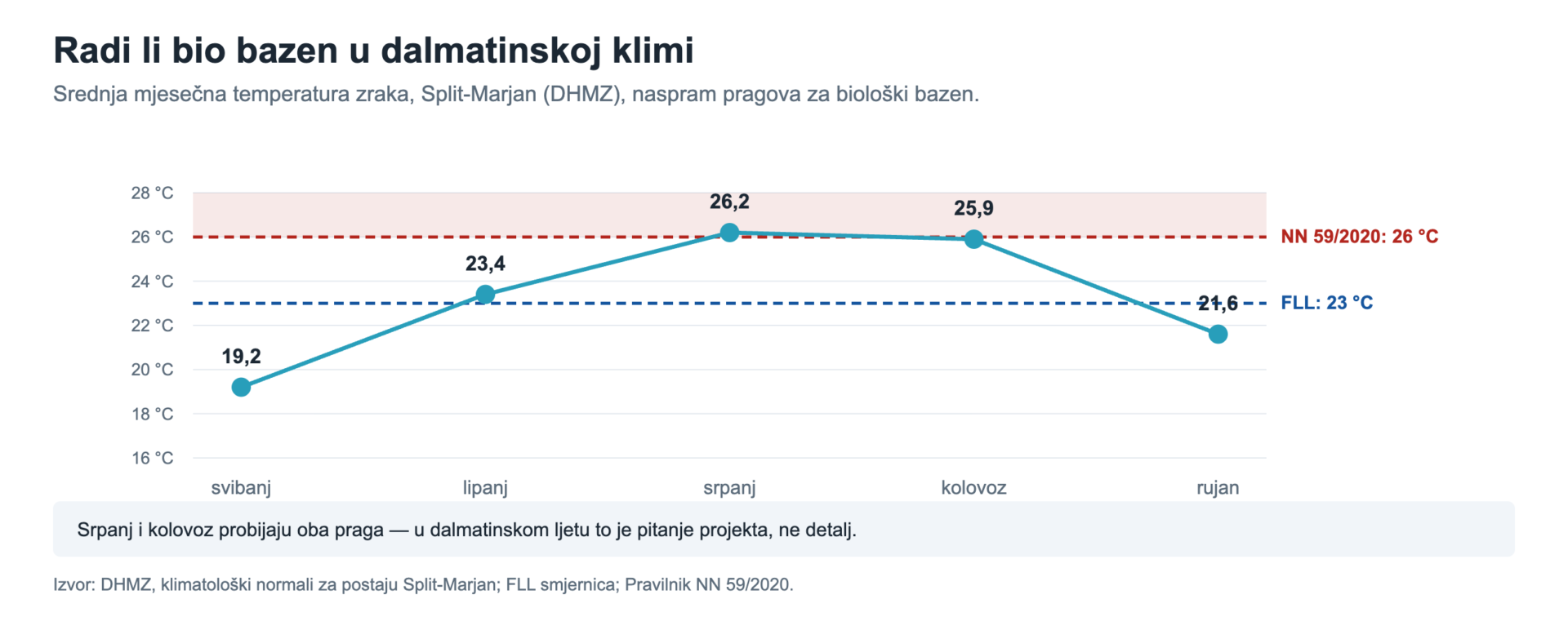
Fair about the limits of this data: air temperature is not water temperature and we do not equalize it. There are no water temperature measurements in natural pools in Dalmatia in the available sources, so it is above comparison of the climate context with prescribed thresholds, not proof that the pool will not work.
What follows from this? Not that a natural pool in Dalmatia is impossible — we have no source for such a claim. It follows that three design levers are mandatory here, not optional: shading (the regeneration zone on the southern exposure without shade is heated all day), depth (larger volume changes temperature more slowly; the prescribed 0.8 m is an absolute minimum, not a goal) and flow (stronger circulation equalizes temperature and prevents stratification of shallow zones.) In addition, a larger regeneration zone provides a greater reserve — the closer the system is to types 1 and 2, the more stable it is in summer.
Was the pool really maintenance-free?
It is not, and that is the most persistent myth on this topic. A bio pool does not have chemistry, but it does have seasonal works that a classic pool does not have at all: algae removal, sludge suction from the bottom, mowing of aquatic and marsh plants and phosphate removal.
Mowing is the most important item and the one that most people skip. Plants don't destroy nutrients — they do bind to their biomassIf you don't take the cut grass outside, it will die, decompose and return phosphorus to the water. Mowing and removal of biomass are the main routes through which nutrients leave the system.without it, phosphorus accumulates year after year.
Algae are therefore not bad luck with the weather — they are nutrient excess indicatorAlgal blooms mean that phosphorus intake (bathers, leaves, dust, birds) is greater than excretion, and the solution is not a preparation but a reduction in intake and an increase in excretion.
Realistic comparison: with a classic pool, maintenance is predictable and can be left to us — with us €300–400/month depending on the size, along with water testing, shell cleaning, vacuuming and engine room servicing. With bio pools, the work is seasonal and gardening-like, difficult to describe as a flat rate because it does not depend on the volume of water but on how much the plant zone has grown.
Is the water in the natural pool safe?
Published measurements give a mixed picture. Three studies worth knowing before making a decision:
- Catalonia (Casanovas-Massana & Blanch, 2013): of the four natural pools tested three exceeded the limits for E. coli and enterococci. The authors cite wild animals as a source of contamination, "especially birds".
- Netherlands (Schets et al., 2020, 13 public natural pools): 93–95 % samples met the criteria for E. coli and enterococci, but only 68 % for Staphylococcus aureusThe concentrations were significantly dependent on turbidity water.
- Canada (Shoults et al., 2021, Canada's first public natural swimming pool): the recommendation is load less than 45 bathers per day.
Two conclusions. First, birds are a documented source of pollution — that is why the Croatian regulation in Art. 21 explicitly prohibits the presence of waterfowl and fish, and this provision in an open courtyard is harder to enforce than to write. Secondly, transparency is not an aesthetic issue: Dutch data shows that turbidity follows microbial load, which explains why NN 59/2020 requires a transparency of at least 2 m.
No study says that a natural pool is dangerous. They say that variable and that the result depends on the project, load and maintenance discipline — while with disinfected water, this range is significantly reduced by chemistry.
How much does a swimming pool cost?
More expensive per square meter and with approximately twice as many square meters — that's the whole calculation. Croatian orientation range and German data by FLL types:
| Item | Indicative price |
|---|---|
| Natural / biological pool (HR market) | €1,100–1,500/m² |
| Concrete + ceramics (Croatian market, for comparison) | ~950 €/m² |
| Germany, Type 1 | 250–400 €/m² |
| Germany, Type 2 | 500–850 €/m² |
| Germany, Type 3–4 | 900–1,300 €/m² |
| Germany, design | €8,000–12,000 |
Sources: emajstor.hr for Croatian ranges and frischer-windt.de for German (2023, excluding VAT and without design). All amounts are indicative ranges, not a binding offer.
The German data show a logic that is often overlooked: The more technology, the more expensive the square footage, but the smaller the area required. Type 1 is the cheapest per m² and the most expensive per yard — it requires about 120 m². Type 5 fits in about 50 m², but its price per square meter increases.
The “price per m²” trap: if the Croatian 1,100–1,500 €/m² refers to total water surface, then 64 m² (8 × 4 swimming pool with a regeneration zone of 50 %) means an order of magnitude of €70,000 to €96,000. The source does not specify which area the price refers to, so take this calculation as an illustration of the order of magnitude, not as an estimate. A more detailed elaboration of the cost structure is in the text about it How much does it cost to build a swimming pool by type and size?.
Bio pool or concrete pool with salt electrolysis?
If it's the smell of chlorine that puts you off a classic pool, rather than the concept of the technique itself, there's a third option that's rarely mentioned. Salt electrolysis produces chlorine from salts dissolved in water, without dosing chemicals from canisters. In our practice, swimming pools up to about 100 m³ We are running on salt electrolysis; above that, we are going to have automatic control for liquid chlorine and pH.
| Criterion | Bio pool | Concrete + salt electrolysis |
|---|---|---|
| Area required for 32 m² of swimming | 64–80 m² of water surface | 32 m² + engine room |
| Key water parameter | phosphorus (µg/L), transparency, temperature | free chlorine (mg/l), pH, redox |
| Speed of reaction to the problem | days to weeks (biological inertia) | hours |
| Maintenance | mowing plants, sludge, nutrient control — seasonal | predictable, negotiable |
| Temperature limit | FLL 23 °C / HR regulation 26 °C | none — warmer water is preferred |
| The smell of chlorine | there is no | chlorine is produced from salt, without canisters |
This is not a table that declares a winner. A bio pool provides something that a concrete pool cannot — a biologically alive, cooler space that fits into the garden. A concrete pool provides predictability, a smaller surface area, and water quality that doesn't depend on whether you cut the reeds this September. If you're choosing between a concrete pool and other shell designs, the comparison is in the text concrete, polyester or overflow pool, and the practical path from the permit to the first bath in the text of swimming pool in the yard.
Frequently asked questions
Do I need a permit for a bio pool?
The same rules apply as for any other in-ground pool — permits depend on the floor plan area and whether the pool is buried in the ground on the building plot of an existing building, not on the method of water preparation. Check with the designer whether the regeneration zone is included in the floor plan area of the project — the Regulations do not explicitly regulate this. Details on permits in swimming pool construction guide.
Does the Ordinance NN 59/2020 apply to my private bio pool?
No. Art. 2 states that the Ordinance does not apply to swimming pools owned by citizens that are not intended for public use, so you are not obligated to do weekly sampling or comply with limit values. However, these are the only Croatian figures for a biological pool and a useful framework for assessing whether the system is well-dimensioned.
Are there mosquitoes in the bio pool?
The regulation responds indirectly: Art. 21. NN 59/2020 prescribes a minimum depth of 0.8 m and prohibits fish and waterfowl. The depth and constant movement of water via a pump and skimmer are the design response to stagnant water. We have no measurements of the number of mosquitoes in natural pools in our conditions and would not speculate.
How many people can use a natural pool?
The FLL guideline states a capacity of 10 m³ of water per visitor, and a 2021 Canadian study by Shoults et al. recommends less than 45 bathers per day for a public natural pool. For a private pool, the Austrian figure is more practical: each bather ingests about 100 mg of phosphorus per day, and the limit is 20 µg/L of total phosphorus according to Croatian regulations, or 10 µg/L for Naturpool according to the IOB.
Can an existing concrete pool be converted into a bio pool?
This is not a modification but a new intervention. You would need to add a regeneration zone that is the same size as the pool or larger, change the entire hydraulics, and address the chemical problem: IOB states that concrete can raise pH to 12, and nitrification is inhibited above pH 8.8. Concrete shell and biology do not cooperate without special surface treatment.
What to do next
Make your decision in order from the most restrictive to the most restrictive. First, measure the available area — if there isn’t 64–80 m² for a 32 m² swimming pool, the discussion is over. Second, be honest about seasonal work: mowing the plants and vacuuming the sludge are not options but a requirement for the system to work. Only third comes the price, and only then talk to the contractor who actually builds the natural pools.
If you've come to this article to escape chlorine, and not to wish for a lake in your backyard, it's worth discussing the concrete pool with salt electrolysis — in 800 to 1,000 completed projects, this is the solution we most often use to solve this very need. Contact us for a consultation. and we will tell you which way your plot is pulling, including the case where the answer is that a pool like the one we build is not the right choice for you.
 English
  Hrvatski
  Deutsch
  Español
  Русский
  Italiano
  Nederlands
  Svenska
  Dansk
Dansk  Čeština
  Українська
  Português
  العربية
  Suomi
Suomi  简体中文
简体中文