

A backyard pool measuring 8 × 4 × 1.5 m holds 48 m³ of waterThe first filling according to the price list of ViK Split (2.01 €/m³) costs about €96, and in the summer it loses approximately 307 liters per day — nearly 19 % of its own volume per month. The cover reduces this loss by more than 93 %. The construction of the concrete shell takes 6–12 weeks.
This text covers what Croatian guides about swimming pools don't cover: how much water a swimming pool actually uses in numbers, what the water utility's calls for savings in the summer of 2026 mean, how to ensure access to water when there are small children in the house, and how to plan the sequence of work so that the height of your pool doesn't end up clashing with your house. For a broader picture of the entire project, start with our a complete guide to building a swimming pool in Croatia.
Will a swimming pool fit in your yard?
The pool area is not just the pool's floor plan. In addition to the water surface, you need to consider a bypass path, a place for the engine room, a passage for machines during excavation, and a dump for excavated material. The 8 × 4 m water surface of the pool itself takes up 32 m², but with the bypass path, engine room, and manipulation space, the actual footprint is many times larger — the question is whether anything will remain of the yard.
Three things decide before the first line is drawn:
- Access to the construction site. Excavators, mixers and trucks for removing the excavated material need access. In Dalmatian yards with a narrow entrance, retaining walls or a neighbor's house next to the border, access can dictate both the location of the pool and the cost of the excavation.
- The elevation of the pool in relation to the house and the surroundings. This is the most common mistake we see on other people's pools: the height of the pool ends up not matching the house and the surroundings. The edge ends up too high so you have to climb stairs from nowhere, or too low so the surroundings have to be filled in.
- Engine room. The filter, pump and heating need a dry, airy and accessible space. If it is not planned in time, it ends up in an improvised niche that the repairman can hardly enter.
Pro advice from practice: determine the elevation of the edge of the pool together with the environmental project, not after it. In 800–1,000 completed projects, this is the decision that is the most expensive to correct — after concreting the shell, the height of the edge no longer changes, everything around it changes.

Do I need a permit for a backyard pool?
For a swimming pool with a floor area of up to 100 m², buried in the ground, on the building plot of an existing building and for the needs of that building, a building permit is not required — but the main project is, and the construction is starting must report (Regulations on simple and other buildings and works, Art. 4, item 1, c) and Art. 6, paragraph 3.) All typical house dimensions, from 6 × 3 to 12 × 6 m, remain below this threshold.
The key trap is not the area but the spatial plan: buildings from the Ordinance may not be built if this is contrary to the spatial plan (Art. 1, paragraph 2). The entire legal part, with citations and the difference with garden pools up to 1 m deep from Art. 3, is elaborated in swimming pool construction guide; the original text of the regulation is available at law.hr.
What type of pool for the backyard?
Three groups come into consideration for the yard: concrete buried swimming pools, polyester shells and prefabricated backyard pools (metal, wooden, inflatable). The decision comes down to how long the pool needs to last, how much freedom in shape is needed, and how accessible the yard is for delivering the finished shell.
We have to be honest here: Flusso builds exclusively concrete pools, with classic concrete construction of a reinforced concrete shell. We do not manufacture polyester shells and prefabricated pools. If your budget or deadline is such that a prefabricated pool makes more sense — it is a legitimate choice and there is no reason for someone who builds concrete to disparage it. A prefabricated pool is installed in one day, does not require excavation and can be removed; it cannot be shaped into an arbitrary shape and is not a permanent part of the property.
We have a detailed comparison in two separate texts: Built-in or prefabricated pool — what to choose and why and comparison of concrete, polyester and overflow pools. Note for polyester: the finished shell has to arrive by truck and be placed by crane, so this guy knows how to eliminate narrow access in the old parts of Split or Trogir before the price is even discussed.
How much water does a backyard pool use?
Part of the consumption is also spent on washing filters — exactly how much and how to reduce it, the text says about filter.
A swimming pool uses water in two ways: one-time charge and by constant evaporationFilling a pool 8 × 4 × 1.5 m means 48 m³, which is according to the price list Split Waterworks for a household connected to water supply and sewage (2.01 €/m³) approx. 96 €Evaporation is less visible, but accumulates a significantly larger amount throughout the season.
| Dimension | Ground plan | Volume | First filling (2.01 €/m³) | Evaporation at 30 °C without wind |
|---|---|---|---|---|
| 6 × 3 × 1.4 m | 18 m² | 25.2 m³ | ≈ €51 | ≈ 173 l/day · 5.2 m³/month |
| 7 × 3.5 × 1.4 m | 24.5 m² | 34.3 m³ | ≈ €69 | ≈ 235 l/day · 7.1 m³/month |
| 8 × 4 × 1.5 m | 32 m² | 48 m³ | ≈ €96 | ≈ 307 l/day · 9.2 m³/month |
| 10 × 5 × 1.5 m | 50 m² | 75 m³ | ≈ €151 | ≈ 480 l/day · 14.4 m³/month |
| 12 × 6 × 1.5 m | 72 m² | 108 m³ | ≈ €217 | ≈ 691 l/day · 20.7 m³/month |
For an 8 × 4 m pool, this means that in a month of full summer, about 9.2 m³ of water, or close to 19 % of total volumeIn money terms, that's about €18.5 per month of refills, which isn't dramatic — but in a year when the water utility is calling for savings, quantity is more important than amount.
How it is calculated: the numbers are estimate based on published evaporation coefficients (euro-matic), not measured data from your pool. The water surface (m²) is multiplied by the coefficient for the given temperature and wind (l/m²·h) and by the hours. The German DGfdB for an outdoor pool in operation states a seasonal average of ≈145 g/m²·h, or about 3.5 l/m² per day, which for 8 × 4 m gives ≈112 l/day — this is the average throughout the season, while 307 l/day is the value for the peak of summer. Bathers also bring 4–5 liters per person on the body and towels. Source: DGfdB.
Wind triples evaporation
Temperature is not the main culprit — wind is. At the same water temperature of 30 °C, evaporation increases from 0.40 to 1.00 l/m²·h as soon as a wind of 5–8 m/s appears. For an 8 × 4 m pool, this is a jump from 307 to 768 liters per dayOn an open plot of land above the sea, where the mistral blows every afternoon, this is not an extreme scenario but the rule.
| Conditions | Evaporation | Swimming pool 8 × 4 m (32 m²) | Monthly |
|---|---|---|---|
| 10 °C, no wind | 0.15 l/m²·h | ≈ 115 l/day | ≈ 3.5 m³ |
| 30 °C, no wind | 0.40 l/m²·h | ≈ 307 l/day | ≈ 9.2 m³ (19 % volume) |
| 30 °C, wind 5–8 m/s | 1.00 l/m²·h | ≈ 768 l/day | ≈ 23 m³ (48 % volume) |
Source of coefficients: euro-matic. Practical consequence: shelter from the wind — hedge, wall, pergola, positioning of the pool next to the house — is not just a matter of comfort but a water-saving measure.

The blanket is the only measure that really works
Reviewed measurement on 12 identical pools (Muleta, Cal Poly, for the National Plasterers Council) showed that the blanket reduces evaporation by 93.9 % (solid), 94.9 % (air/bubble) and 95.9 % (foam). Solar discs stop 50.1 %, liquid suppressors only 14.4–16.7 %. The authors note that these are of maximum efficiency, with a cover that is always on the pool.
| Decision | Reducing evaporation | Remaining for 8 × 4 m (30 °C, no wind) | Indicative price |
|---|---|---|---|
| Foam blanket | 95,9 % | ≈ 0.4 m³/month | — |
| Air (solar) cover | 94,9 % | ≈ 0.5 m³/month | ≈ €1,000 |
| Solid cover on the guides | 93,9 % | ≈ 0.6 m³/month | ≈ €1,500 |
| Roller blind (motorized) | depending on the cover design | — | €8,000–20,000 |
| Solar disks | 50,1 % | ≈ 4.6 m³/month | — |
| Liquid suppressants | 14.4–16.7 % | ≈ 7.7–7.9 m³/month | — |
Prices are indicative ranges, not a binding offer. Full measurement is available in NPC report.
Quick win: A cover worth ≈1,000 € reduces the monthly loss of an 8 × 4 pool from ≈9.2 m³ to less than 0.5 m³. It is the only measure in the entire pool system that changes the order of magnitude of consumption in one go — and at the same time reduces heat loss and the amount of dirt that gets into the water.
Are you even allowed to fill a swimming pool from the water supply?
In principle, yes, but in the summer of 2026, it's no longer just a technical issue. Two Croatian water supply companies have publicly urged citizens not to fill swimming pools: Zadar Waterworks August 2, 2026 introduced urgent water-saving measures and called for avoiding frequent filling of swimming pools, and ViK Rijeka August 14, 2026 he requested that the water not be used to fill the pool. These are invitations, not prohibitions — but they show where it's going.
Risk that is avoided through planning: If the pool is filled in mid-August in a dry year, at best you wait, at worst you fill it with a tanker at an additional cost. Plan the filling date off-peak season — in late spring or early fall — and check with your utility company to see if there are any savings measures in effect. Sources: Zadar Waterworks, Waterworks Rijeka.
Three practical rules that follow from this. First, the pool is not emptied for no reason — well-managed chemistry means that the same water remains in the pool for years, and only the evaporated amount is replenished. Else, the cover ceases to be an option; it is the difference between 9.2 and 0.5 m³ per month. Third, check the conditions for discharging pool water with the competent utility company (for the Split area, ViK Split) before discharging anything into the drainage system or into the environment.
How to secure a pool if you have children?
Let's be clear right away: In Croatia, there is no legal requirement for a fence or cover around a private swimming pool. The Ordinance NN 59/2020, which regulates swimming pools, in Article 2, explicitly states: does not apply to swimming pools owned by citizens that are not intended for public useThe decision about the barrier is yours — which doesn't mean it's unimportant.
The numbers are unambiguous. World Health Organization indicates about 300,000 deaths from drowning per year, of which it is finished a quarter of children under five years old; drowning is the fourth leading cause of death for children aged 1–4, and pool enclosures are explicitly included among the recommended measures. Croatian National Institute of Public Health states that in the period 2014–2023, 1,000 people died from drowning in Croatia 769 people, from that 47 children and young people under 19 years of age, and in 2023 alone, 68 of them. The recommendation is literal: free access to swimming pools and water tanks should be prevented. The HZJZ also warns that small children can drown in just a few centimeters of water.
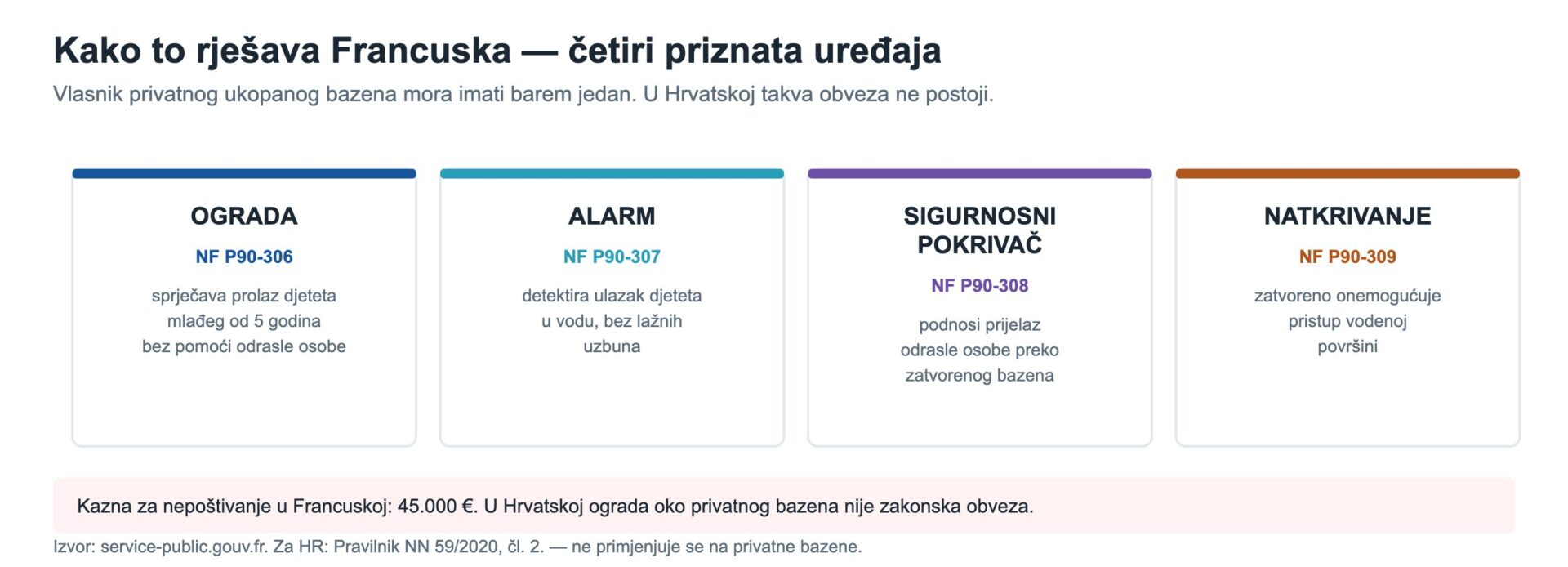
How do they solve this where there is a regulation: France is asking owners of private in-ground outdoor pools to at least one of four devices — a fence (NF P90-306) which must prevent the passage of a child under five years of age without the assistance of an adult, an alarm (NF P90-307) which detects the passage of a child without false alarms, a safety cover (NF P90-308) which withstands the passage of an adult, or a cover (NF P90-309) which, when closed, prevents access. The penalty for non-compliance is 45.000 €Source: service-public.gouv.fr.
The entrance to the pool is also connected to the barrier. The European standard for domestic swimming pools EN 16582 has an entire clause 5 dedicated to access (means of access) — anti-slip, crushing and entrapment hazards, ladders, submerged steps and handrails. Annex C specifies the test methods for entrapment head and neck, fingers and feet and handsThese are the details that are most easily overlooked in backyard pools, and they are elaborated on in the text about pool steps and ladders.
How long does it take from the decision to the first bath?
The construction of the concrete pool itself is ongoing 6–12 weeks, depending on the size and complexity. To this should be added the preparation before the start of the works — drawing up the main project with a licensed designer, collecting bids and notifying the start of construction — and landscaping after the pool is finished, as these are separate works with their own deadlines.
The order that makes sense in Dalmatian conditions starts from the swimming calendar backwards. According to the DHMZ climatological norms for the Split-Marjan station, the average air temperature in May is 19.2 °C, in June 23.4 °C, in July 26.2 °C, and in September it returns to 21.6 °C with 247 hours of sunshine. If you want your first bath in June, work should start in March or earlier, and the design and permits should be in place even before that. Winter and early spring are also the periods when the pressure on the water supply is the lowest, so filling is easier to arrange.
We note in fairness: Flusso does not work "turnkey"We carry out the pool shell, liner and pool technology, we help with the main project and permits and we cooperate with a licensed designer, but landscaping is not our job - plan it with a garden contractor in parallel, precisely to coordinate the elevation. We provide construction and waterproofing 5 year warranty. Read more about the scope of works and prices in the text How much does it cost to build a swimming pool?, or in development prices for swimming pools 8 × 4 m, and you can request a quote via contact page — we typically respond to inquiries within 24 hours.
Frequently asked questions
How much water does a backyard pool use per year?
An 8 × 4 × 1.5 m pool is filled with 48 m³ and then loses water through evaporation. According to published evaporation coefficients, at 30 °C without wind this is about 307 liters per day, or 9.2 m³ per month; the DGfdB states that the seasonal average for an outdoor pool is ≈3.5 l/m² per day, which is about 112 l/day. With a cover that reduces evaporation by more than 93 %, the annual replenishment is reduced to small amounts.
Do I need a permit for a backyard pool?
For a swimming pool with a floor area of up to 100 m², buried in the ground, on the building plot of an existing building and for the needs of that building, a building permit is not required, but a master plan is required and notification of the start of construction is mandatory (Article 4, point 1, c) and Article 6, paragraph 3 of the Ordinance on Simple and Other Buildings and Works). The construction must not be contrary to the spatial plan.
Is a fence around a swimming pool mandatory in Croatia?
No. There is no Croatian regulation that requires a private owner to have a fence or cover, and the Ordinance NN 59/2020 explicitly does not apply to citizens' swimming pools that are not intended for public use. However, there are recommendations: the WHO lists fencing of swimming pools among the measures, and the Croatian Institute of Public Health recommends that free access to swimming pools be prevented.
Are prefabricated backyard pools a good alternative to concrete ones?
For a limited budget and a temporary solution, they are — they are installed quickly, do not require excavation and can be removed. They do not offer freedom of form, do not last as long as a concrete shell and do not solve the issue of permanent integration with the environment. Flusso does not manufacture prefabricated pools; we build exclusively concrete ones. We have elaborated on the comparison with built-in pools in a separate text.
Can the pool be filled during a drought?
There is no ban, but in August 2026, both Vodovod Zadar and ViK Rijeka publicly invited citizens to avoid filling the swimming pool. Plan the charging outside the peak season, check the current measures with your utility company and count on the fact that the cover, which keeps the loss below 0.5 m³ per month, will be decisive for the rest of the season.
Next step
Before you ask for a quote, measure two things: the available floor space including the driveway and space for the engine room, and the height difference between the terrain and the threshold of the house. With these two pieces of information, the discussion about the pool ceases to be a principled one. If the plot is exposed to wind, immediately include a cover in the budget — not as an add-on, but as part of the system.
We work in the area from Makarska to Zadar, with an emphasis on Split, Kaštela, Trogir, Marina, Omiš and Podstrana. Send dimensions and a photo of your yard via pages about pool construction and maintenance and we will contact you with an approximate range and realistic work schedule.
 English
  Hrvatski
  Deutsch
  Español
  Русский
  Italiano
  Nederlands
  Svenska
  Dansk
Dansk  Čeština
  Українська
  Português
  العربية
  Suomi
Suomi  简体中文
简体中文