
Category
Pool pumps and sand filters.
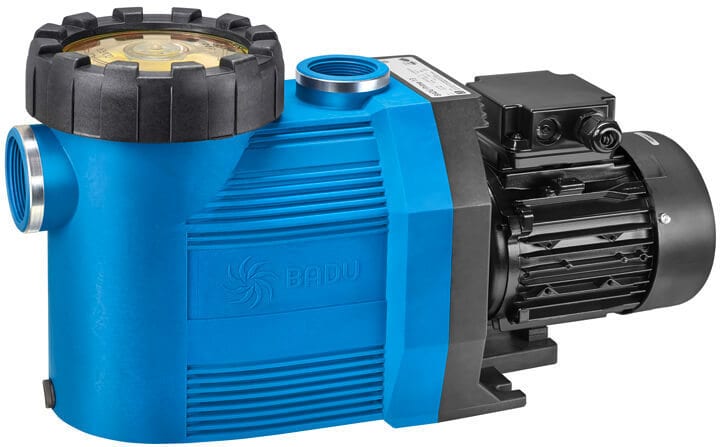
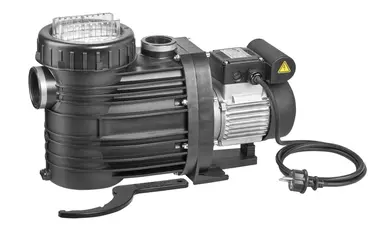
The heart of the plant room. Pump and filter are chosen together, by flow rate: (volume × 2) ÷ 8 hours of running. For an 8 × 4 × 1.5 m pool (48 m³) that is 12 m³/h — a D600 filter and a separate pump; up to 7 × 3.5 m a monobloc unit is enough.
How to choose
Pool pumps and sand filters: what to check before you buy.
Flow rate = (volume × 2) ÷ 8. A 6 × 3 × 1.4 m pool (25.2 m³) → 6.3 m³/h → Galactic D500 monobloc; 7 × 3.5 × 1.4 m (34.3 m³) → 8.6 m³/h → Aster D500 (9 m³/h); 8 × 4 × 1.5 m (48 m³) → 12 m³/h → Aster D600 (14 m³/h) with a separate pump.
A D400 takes 50 kg, a D500 90–100 kg, a D600 125 kg, a D750 300 kg in two layers (75 kg coarse + 225 kg fine). The exact quantity is printed on the tank — do not add more “just in case”.
A “sand” filter and a “quartz” filter are the same thing; what you choose is the filter medium. Quartz sand retains particles of 30–60 µm, activated glass down to 5 µm according to the manufacturer, and lasts longer; sand is cheaper (€15.50 against €35).
Advice
Pool pumps and sand filters: advice from our service team.
Pool pump: how to choose the right one (filter pump)
A pump is chosen by flow, not motor power: about 12 m³/h for 8 × 4 × 1.5 m – and the upper limit is set by the filter and the pipes.

Sand vs quartz pool filter – which one filters better
‘Sand’ and ‘quartz’ filters are the same thing; the real choice is quartz sand (30–60 µm) or activated glass (down to 5 µm).
Sand filter pump for a pool: sizing and installation
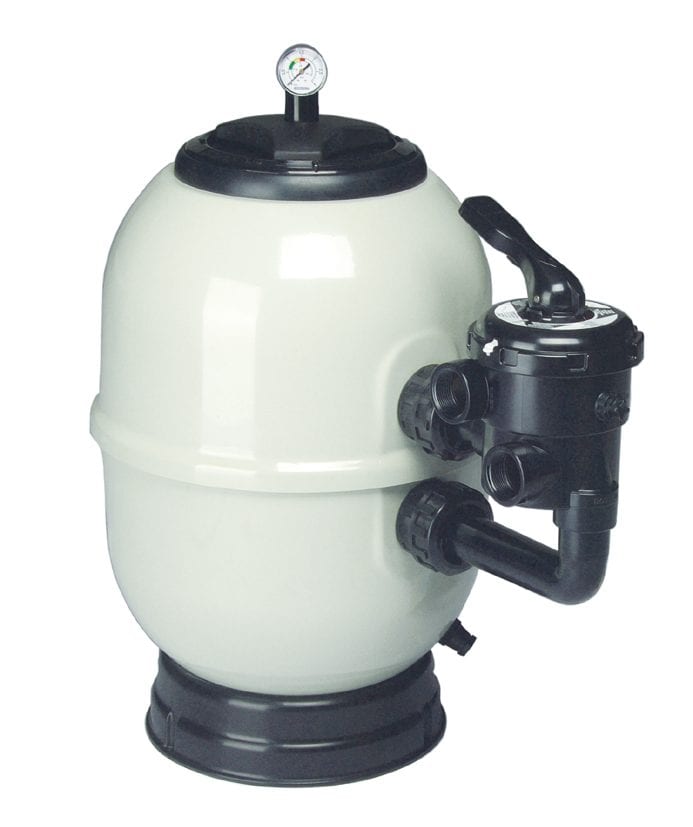
A monobloc of pump, filter and valve: flow (volume × 2) ÷ 8, how much sand goes into the D400–D750 and where the unit may be installed.