

Short answer: A prefabricated above-ground pool is chosen by those who need water this summer, have a limited budget, or are not sure whether they will stay in that location. An in-ground concrete pool is chosen by those who are building a permanent solution next to the house, want heating and a season longer than two months, and accept the main project and a higher initial investment.
Before comparing, it is necessary to clarify the terms, as the market confuses them. There are three products with similar names: prefabricated above-ground pool, built-in prefabricated pool (shell) and built-in concrete poolThey differ in whether they require a main project, whether they can be heated, and what happens to them in the winter.
What is an in-ground pool and what is a prefabricated pool?
An in-ground pool is buried in the ground — either as a finished shell lowered into an excavation, or as a reinforced concrete structure cast on site. A prefabricated pool is an above-ground pool that is assembled on a prepared base, without excavation. The problem is that the word “prefabricated” is used in offers for both things.
1. Prefabricated above-ground pool
A structure made of metal walls, wooden panels or composites with a foil coating, placed on a flat surface, without any penetration into the ground. The water is most often drained at the end of the season, and in simpler models, the pool itself is dismantled and stored. According to the portal Trebam.hr, prefabricated metal pools on the market range from €1,000 to €1,800, wooden ones from €5,000 to €8,400, and composite ones from €6,800 to €10,900.
2. Built-in prefabricated pool — shell
A finished polyester or steel shell manufactured in a factory and lowered into a prepared excavation. It is called “prefabricated” because it is not built on site, but the result is an in-ground pool — with excavation, foundation slab, backfilling and connections. According to Trebam.hr, polyester in-ground pools cost €13,800–20,000, and eMajstor.hr states 780–1,080 €/m² with excavation.
3. Built-in concrete pool
Reinforced concrete shell cast on site, waterproofed and lined with PVC foil, ceramics or glass mosaic. There are no restrictions on shape, depth or design — skimmer, overflow or infinity. This is the type that we build exclusively at Fluss, using classic concrete construction, with a 5-year warranty on the structure and waterproofing.
Key: When requesting quotes, ask specifically, “is the pool in-ground?” This is the only difference that changes the legal status of the project—not the material, the price, or the name in the catalog.
Built-in or prefabricated pool: large comparison table
The matrix compares the three types on criteria that really change the decision. Where we don't have a confirmed public source, we write that — instead of an assessment that sounds convincing but is not verifiable.
| Criterion | Prefabricated overhead | Built-in mounting (shell) | Built-in concrete |
|---|---|---|---|
| Starting price | metal €1,000–1,800; wooden €5,000–8,400; composite €6,800–10,900 | polyester built-in €13,800–20,000 | market €25,000–€58,800; Flusso skimmer 8×4 ≈ €35,000 |
| Installation/construction duration | without excavation and concreting; installed on a prepared surface | requires excavation, foundation slab, transport and crane to lower the shell | 6–12 weeks, depending on size and complexity (Flusso) |
| Shelf life | we do not have confirmed public information — ask for the manufacturer's warranty period in the offer | we do not have confirmed public information — ask for the manufacturer's warranty period | covering: PVC film 10–15 years, ceramics 20–30 years; Flusso warranty 5 years. on construction and waterproofing |
| Permit and main project | is not a structure buried in the ground as per Art. 4 of the Ordinance; the spatial plan restriction always applies | buried in the ground → up to 100 m² without a building permit, but in accordance with the main project | same: up to 100 m² without a permit, with a master project and notification of the start of construction |
| Heating option | difficult: wall exposed to air from all sides, often no fixed engine room or connection | good: fixed engine room, heat pump is installed as standard | best: heat pump, solar or roller cover, all sized by water volume |
| Annual cost | chemistry + filtration electricity only in season; we do not have a confirmed public amount | market 600–1,400 €/year for regular maintenance | market 600–1,400 €/year; Flusso full service 300–400 €/month depending on size |
| Wintering | water is most often drained; simpler models are disassembled and stored | remains full, winters with a blanket and engine room preparation | remains full; winter cover ≈ €1,500, roller cover €8,000–20,000 |
| Possibility of relocation | yes — can be disassembled and moved | not in practice (buried, excavated, connected) | no — permanent construction |
| Real estate and rentals | seasonal equipment in the yard, does not permanently change the appearance of the yard | permanent element of the garden, shape limited by the manufacturer's catalog | permanent element of the garden, shape and design (overflow, infinity) adapted to the plot |
One line deserves special attention, as it is almost never mentioned in Croatian content about swimming pools: permit and main project.
Do I need a permit for a prefabricated pool or for an in-ground pool?
The key word in the Croatian regulation is "buried in the ground“. Regulations on simple and other buildings and works (NN 112/17, 34/18, 36/19, 98/19, 31/20, 74/22, 155/23) in Art. 4, item 1. c) stipulates that without a building permit, and in accordance with the main project, can build a "swimming pool with a floor area of up to 100 m² buried in the ground" — as an auxiliary structure on the building plot of an existing building, for the needs of that building.
The three conditions are cumulative. Practically: an 8 × 4 m pool has a 32 m² floor area, and a 12 × 6 m pool has 72 m² — both are well below the threshold.
In addition, Art. 6, paragraph 3. of the same Ordinance states: "The investor is obliged to report the start of construction of the structures referred to in Article 4 of this Ordinance." Therefore, for an in-ground pool, the report of the start of construction is mandatory, although a building permit is not.
An above-ground prefab pool is not a structure buried in the ground, so it is Article 4. does not describe. For swimming pools that are constructed as a development of a building plot of an existing building, Art. 3, item 4. states that without a building permit i without main project can create a "garden pool or pond up to 1 m deep from the surrounding ground level".
The risk everyone skips: Art. 1, para. 2 of the Ordinance states that these structures “may not be designed, built, or executed if this is prohibited by the spatial plan or otherwise contrary to the spatial plan”. The spatial plan is above all else — for both prefabricated and built-in pools. Before placing any order, check the plan with the competent administrative department of your municipality or city. This text is not legal advice.
Two things that are often wrongly attributed to this Rulebook: depth limit for a pool up to 100 m² there is no such restriction (the 1 m restriction applies exclusively to the garden pool referred to in Article 3), nor volume limit in m³ nor the prescribed distance from the border. The distance from the border determines the spatial plan. If you are building on the coast, Law on Physical Planning (Official Gazette 155/25, in force from 1.1.2026) does not affect the basin directly, but through the spatial plan: in the restricted area — a part of the mainland and islands 1,000 m wide from the coastline and a sea belt 300 m wide (Art. 19, item 48 and Art. 58) — plans can be stricter.
A detailed overview of the entire process — from project to handover — can be found in our a complete guide to building a swimming pool in Croatia.
How much do built-in and prefabricated pools cost?
The range is huge: from around €1,000 for a metal above-ground pool to over €50,000 for a concrete one with mosaic. Prices are not comparable one-to-one, because you are not buying the same thing. With an above-ground pool, you pay for the product; with an in-ground pool, you pay for the work on the plot — excavation, foundation, machine room, connections and lining.
| Pool type | Price range | Source |
|---|---|---|
| Prefabricated metal | €1,000–1,800 | Trebam.hr |
| Prefabricated wooden | €5,000–8,400 | Trebam.hr |
| Composite | €6,800–10,900 | Trebam.hr |
| Polyester built-in | €13,800–20,000 | Trebam.hr |
| Concrete (market range) | €25,000–€58,800 | Trebam.hr |
| Concrete 8×4×1.5 with PVC foil | €23,000–42,000 | bazenirijeka.com |
| Concrete 8×4×1.5 with ceramic / mosaic | €32,000–60,000 | bazenirijeka.com |
| Flusso: concrete skimmer 8×4 | ≈ €35,000 | Flusso Group |
| Flusso: concrete overflow (same size) | ≈ 30 % more expensive than skimmer | Flusso Group |
All amounts are indicative ranges, not a binding offer. Two practical notes. First, Flusso does not do turnkey projects — we install the pool, pool equipment and liner, but not the landscaping; plan that part of the budget separately. That is why we tell owners to expect a minimum budget of EUR 100,000 for a fully landscaped yard with a pool. 50.000 €. Second, the calculation goes by project, not by m²: the equipment is dimensioned per cubic meter of water, so two pools with the same floor plan area can have different technical costs. A more detailed elaboration can be found in the text of cost of building a swimming pool by type and size.
Benchmark: An 8 × 4 × 1.5 m pool contains 48 m³, or 48,000 liters of water. Use this figure, not the floor area, when comparing offers for filtration, pump, and disinfection. In practice, for pools up to ~100 m³, we choose salt electrolysis, and above that, automatic liquid chlorine and pH.
Can a prefabricated pool be heated?
It is possible, but more expensive and with worse results than an in-ground pool. The above-ground wall is exposed to air from all sides and loses heat, while an in-ground pool is surrounded by soil, which acts as an insulator. Above-ground pools also often do not have a fixed engine room or a permanent electrical connection of the required power, and a heat pump requires both.
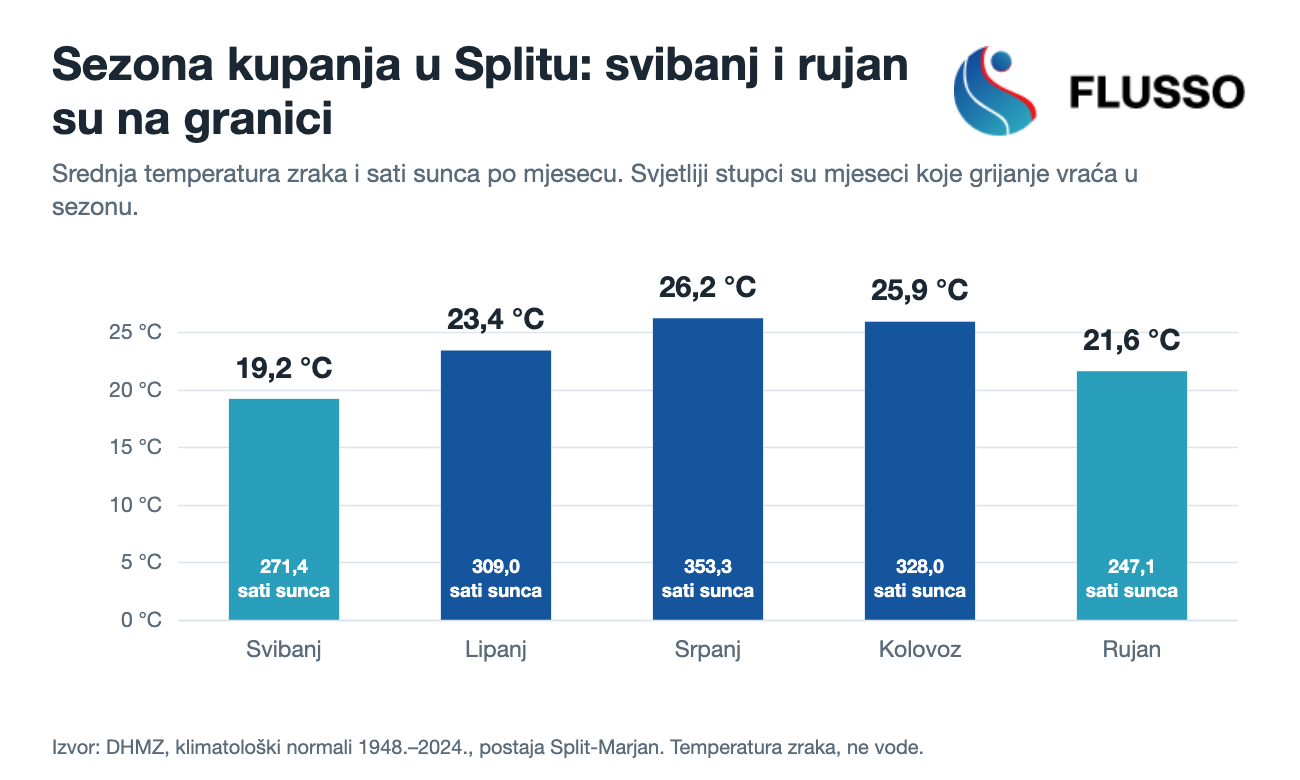
Why is heating even an issue? Look at the climatological normals DHMZ for the Split-Marjan station (1948–2024):
| Month | Average air temperature | Hours of sunshine |
|---|---|---|
| May | 19.2 °C | 271,4 |
| June | 23.4 °C | 309,0 |
| July | 26.2 °C | 353,3 |
| August | 25.9 °C | 328,0 |
| September | 21.6 °C | 247,1 |
It's the air temperature, not the water temperature — but the relationship is clear. July and August are comfortable without any heating. May (19.2 °C) and September (21.6 °C) are borderline: without heating, the pool is mostly idle during these months, even though May has 271.4 hours of sunshine. This is where the heat pump pays for itself.
The Astralpool heat pump for the 8×4 pool is located with us. ≈ €3,000, and for 10×4 ≈ €4,000It is almost always worth adding a solar cover (≈ €1,000), because the largest heat loss in a pool is through evaporation from the surface. See the solution option in the category pool heating.
Pro tip for your electricity bill: according to HEP's terms and conditions from 1.1.2026., in the period 1.4.–30.9.2026. consumption above 3,000 kWh in a six-month period is charged 35 % more expensive. This is exactly the pool season. Before buying a heat pump, calculate the expected consumption in kWh and multiply it by your own tariff — the network fee for the white model is 0.065702 €/kWh (VT) and 0.028689 €/kWh (NT), plus the RES incentive fee of 0.013239 €/kWh.

How much will they cost in five years?
The starting price is the least reliable indicator. A prefab pool has a low entry price and recurring seasonal preparation cost; an inground pool has a high entry price and a predictable annual maintenance cost. On a five-year horizon, it looks like this.
- Prefabricated metal (€1,000–€1,800): There is also the chemistry and electricity for filtration during the season. We do not have any confirmed public data on the annual cost of maintaining a prefabricated pool, so we are not stating it — but the cost profile is different: a smaller amount, a larger share of our own work (installation, filling, emptying, storage).
- Built-in concrete, without service contract: the market range is €600–1,400/year. (bazenirijeka.com); the source does not specify what exactly this range covers, but the scope corresponds to basic maintenance without regular service calls, i.e. €3,000–7,000 over five years.
- Built-in concrete, full service: Flusso regular maintenance costs €300–400/month depending on size — that's €3,600–4,800 per year, or €18,000–24,000 over five years. This service includes water condition checks, bowl cleaning and vacuuming, and engine room service, with a 24-hour response time.
With cladding, the difference in lifespan translates into money: PVC foil lasts 10–15 years, ceramics 20–30 years. Over a 20-year horizon, foil is replaced once or twice, mosaic not once. That's why we prefer glass mosaic — installation with basic mosaic, all included, costs ≈ €160/m², while Renolit foil is ≈ €110/m². We have explained the material comparison in the text concrete, polyester or overflow pool.
What to do in winter? Winterizing a prefabricated and built-in pool
Prefabricated and in-ground pools winterize in completely different ways. Simpler prefabricated pools are emptied and disassembled — an advantage if you use your yard differently in the winter, a burden if you have to do it every year. An in-ground pool remains full of water; the water protects the shell and prevents the structure from shifting. Winterizing an in-ground pool means lowering the water level below the skimmer, preparing the engine room, adjusting the chemistry, and covering it. We have a winter cover ≈ €1,500, and a roll cover, which also reduces evaporation and heats the water during the season, €8,000–20,000 depending on the model.
Quick win: If you're hesitating between a prefab and an in-ground pool because of the price, first calculate how many months of swimming you need. If the answer is "July and August," a prefab pool with quality filtration is worth considering. If the answer is "May to September," you need heating — and heating requires a fixed engine room, which leads you to an in-ground pool.
When a prefabricated pool makes sense and when it doesn't
Let's be honest: Flusso builds concrete pools exclusively. That's why it's fair to say that when a concrete pool it is not the right choice — through 800 to 1,000 executed projects, we have also seen situations in which the client would be better served by something simpler.
A prefabricated pool makes sense if:
- You don't live in your own property or you're not sure if you'll be staying in that location for the next five to ten years. An in-ground pool stays where it is; a prefab goes with you.
- The space is too small or access to the construction site is impossible. An excavation machine is needed for an in-ground pool, and a crane for a shell - this can be crucial on narrow Dalmatian plots.
- The budget does not have room for an investment of several tens of thousands of euros.
- You need a pool for your children, for several seasons.
A prefabricated pool does not make sense if:
- You want to swim, not just cool off — above-ground pools rarely have the depth and length for swimming.
- You want heating and a season from May to September.
- The plot is on a hill with a view of the sea. Here, an overflow or infinity design is worthwhile, which can only be done with concrete construction. In a more urban environment, we most often recommend a skimmer pool or an overflow pool on all sides.
- The pool should be visually coordinated with the house and the environment. The most common mistake we find in other people's pools is exactly this: the height of the pool does not match the level of the house and the terrace at the end, and this is not corrected later.
Decision in four questions
- How long are you staying at this location? Less than five years or the property is not yours → prefabricated. Longer and your property is yours → buried.
- Are you renting out the property? If the pool is to be a permanent part of the property's offering and look like part of the house, it should be in-ground.
- How big is the space and what is the access like? Can the excavator reach the pool site? If it cannot, an inground pool becomes significantly more expensive or unfeasible, and a prefabricated one remains the only option.
- What is the budget — with maintenance, not just construction? Add up the initial cost and five years of maintenance. If that amount exceeds what you are willing to spend, a prefabricated pool is not a compromise but the right decision.
Frequently asked questions
Do you need a building permit for a prefabricated pool?
An above-ground prefabricated swimming pool is not a structure "buried in the ground", so it is not covered by Art. 4 of the Ordinance on Simple and Other Buildings and Works. For a garden pool up to 1 m deep from the surrounding ground level, Art. 3, paragraph 4, stipulates that it can be built without a building permit and without a main project. Regardless of the type, Art. 1, paragraph 2, prohibits construction contrary to the spatial plan - always check the plan with the competent administrative department.
Does an in-ground pool need a master plan?
Yes. According to Art. 4, pt. 1. c) of the Regulations, a swimming pool with a floor area of up to 100 m² buried in the ground can be built without a building permit, but in accordance with the main project, on the construction part of the existing building and for the needs of that building. In addition, Art. 6, paragraph 3 obliges the investor to report the start of construction. At Fluss, we help with the main project and cooperate with an authorized designer.
How much more expensive is an in-ground pool than a prefabricated one?
According to market ranges from Trebam.hr, a prefabricated metal pool costs €1,000–1,800, a polyester built-in pool costs €13,800–20,000, and a concrete pool costs €25,000–58,800. Our 8×4 concrete skimmer pool costs approximately €35,000, while an overflow version of the same size costs around €30,000 more. The final price depends on the finish, technique, and conditions on the plot.
Can a prefabricated pool be heated with a heat pump?
Technically yes, but with a lower efficiency. An above-ground wall loses heat to the air from all sides, while an in-ground pool surrounds the ground. The heat pump also requires a permanent electrical connection and a fixed location next to the pool, which is usually not the case with foldable models. In our country, an Astralpool heat pump for an 8×4 pool costs ≈ €3,000, with the recommendation of a solar cover (≈ €1,000).
What happens to a prefabricated pool in winter?
It depends on the model: simpler prefabricated pools are emptied, disassembled and stored until the next season, while more robust models are winterized in place, with a cover. An in-ground pool remains full of water because the water protects the shell; it is winterized by lowering the level below the skimmer, preparing the engine room and covering it.
Next step
The decision comes down to two questions: are you staying here long enough and do you want a season longer than two months? If the answer to both is “yes,” the next step is to check the spatial plan for your plot — before even choosing a material or covering.
If you are at that stage, send us the dimensions of the plot and the location of the house via inquiry form — we typically respond within 24 hours, and we cover the area from Makarska to Zadar. What exactly we do and what we don't do is written on the page construction and maintenance of swimming pools.
 English
  Hrvatski
  Deutsch
  Español
  Русский
  Italiano
  Nederlands
  Svenska
  Dansk
Dansk  Čeština
  Українська
  Português
  العربية
  Suomi
Suomi  简体中文
简体中文