

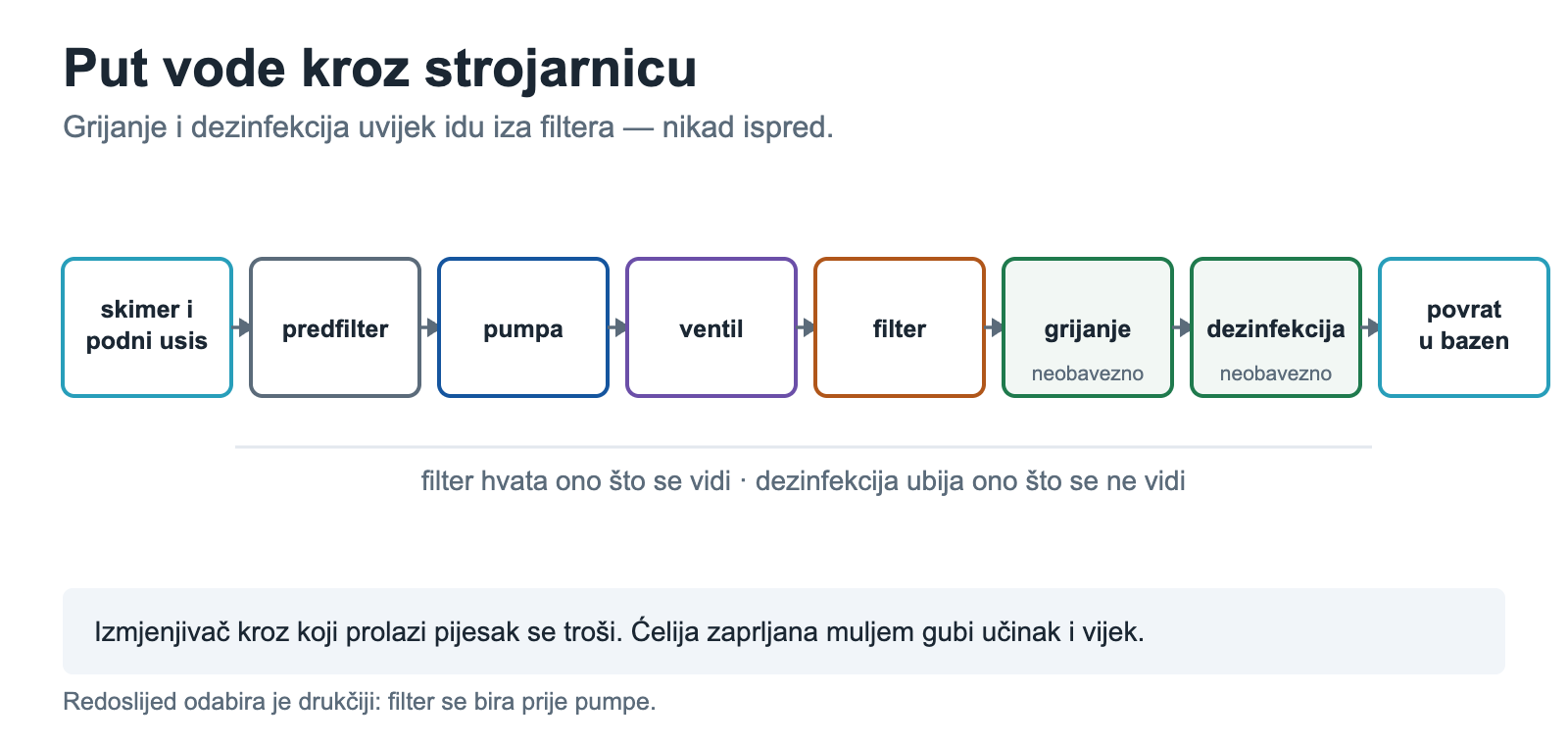
The pool engine room has four mandatory parts — pump, filter, multi-way valve and disinfectant — and a few optional ones that are added as needed. The order is not a matter of taste: water always goes skimmer → pump → filter → disinfection → return to the poolFor a pool 8 × 4 × 1.5 m the basic technique fits in the range of around €1,900, with automated disinfection and measurement in €4,500–5,000.
This guide lays out the entire engine room in the order in which decisions are actually made, with numbers instead of generalities: how much flow each pool requires, why a filter is chosen before a pump, when salt electrolysis makes sense and when it doesn't, and how much space it all actually takes up. If you're just planning a build, start with a complete guide to building a swimming pool.
What makes a swimming pool engine room?
The engine room is the space where everything that moves, cleans, and treats the water is located. It is divided into what the pool cannot do without and what is added depending on ambition and budget.
| Part | Role | Required? |
|---|---|---|
| Pump | moves water through the entire system | that |
| Filter | retains mechanical dirt | that |
| Multi-way valve | determines the direction of water — filtration, washing, rinsing | that |
| Disinfection | destroys microorganisms that the filter does not catch | that |
| Measurement and dosing | automatically maintains pH and disinfectant levels | no, but it changes everyday life |
| Heating | extends the swimming season | not |
| UV sterilization | reduces the amount of chemistry needed | not |
A definition that solves half the misunderstandings: filtration and disinfection are not the same and are not interchangeable. The filter captures what is seen. — sand, leaves, silt, particles up to 30–60 microns. Disinfection kills what you can't see. — bacteria and algae. A pool with a flawless filter and no disinfection will turn green in a few days, while a pool with chlorine and no filter will remain cloudy. You need both.
The order in which water travels
The path of water is always the same and is worth remembering because it explains why the equipment is arranged in that order:
- Skimmer and floor suction — water is coming out of the pool. The skimmer takes it from the surface, the floor suction from the bottom.
- Pump pre-filter — the basket catches leaves, even large ones, before they reach the rotor.
- Pump — pushes the water further.
- Multi-way valve — directs it into the filter or, when washing, in the opposite direction.
- Filter — water passes through the medium from top to bottom.
- Heating (if any) — always after filter, so that no dirt passes through the exchanger.
- Disinfection — electrolytic cell or dosing point, at the end of the line.
- Return to the pool through the nozzles.
Two rules from that order always apply: heating and disinfection go behind the filter, never in front. The exchanger through which the sand passes wears out, and the electrolysis cell contaminated with sludge loses its efficiency and lifespan.
1. Pump — choose by flow rate, not power
The flow is calculated from the pool volume and the change time. The German practice for private pools is two changes in eight hours of operation, so the formula is (volume × 2) ÷ 8.
| Swimming pool | Volume | Requested flow | Minimum pipe diameter |
|---|---|---|---|
| 6 × 3 × 1.4 m | 25.2 m³ | 6.3 m³/h | d50 |
| 7 × 3.5 × 1.4 m | 34.3 m³ | 8.6 m³/h | d50 / d63 |
| 8 × 4 × 1.5 m | 48 m³ | 12.0 m³/h | d63 |
| 10 × 5 × 1.5 m | 75 m³ | 18.8 m³/h | d63 / d75 |
| 12 × 6 × 1.5 m | 108 m³ | 27.0 m³/h | d75 |
The pipe diameter is not a recommendation but a limit. According to a review by AQUA Magazine, the water velocity at the suction should not exceed 1.83 m/s according to the ANSI/PHTA/ICC-15 energy standard. A d50 pipe at this speed leaks about 10.6 m³/h — which is below what an 8 × 4 m pool needs. We have elaborated on a detailed model selection and comparison of single-speed and variable-speed pumps in the text pool pump. If you are building a smaller pool and are thinking about a ready-made pump, filter and valve assembly, take a look sand pump (monoblock) — where are its boundaries and how much sand goes inside.
Pro tip: Decide on the pipe diameter before concreting. It is the only item in the entire machine room that is not changed later without breaking the concrete. You can replace the pump, filter and disinfectant at any time over the next twenty years — the pipe cannot. For pools of 48 m³ and above, d63 is a reasonable default value, and the difference in material cost is negligible compared to the cost of the entire project.
2. Filter — actually the first one is selected
Although the water reaches it second, the filter is decided before the pump. The reason is that the filter has declared flow rate which is the upper limit, not the operating point — so it sets a ceiling that the pump must not break through.
The measure is the filtration rate in meters per hour. According to data provided by pool-magazin.com, the limit for private pools is 50 m/h, while DIN 19643 for public freshwater swimming pools requires the highest 30 m/h. The quality of the filtrate decreases as the speed increases.
What is rarely said: manufacturers declare filters practically exactly at the private maximum. Aster D500 is declared at 9 m³/h, which is 45.9 m/h; D900 at 32 m³/h, which is 50.3 m/h. The filter that says "9 m³/h" therefore works at the upper limit of what is allowed, without reserve. You can find the entire table with the calculation and comparison of quartz sand and active glass in the text about pool filter.
Practical consequence: take a filter one diameter larger than the calculator says. The filter is the only item in the engine room where oversizing works in your favor — lower speed, better water, less frequent washing, less pump resistance. The opposite is true for the pump.
3. Disinfection — three times and when
The filter doesn't kill anything. Disinfection is a separate system and is selected based on water volume, not floor area.
Salt electrolysis
The cell produces chlorine from salt dissolved in water, which is then returned to the salt after the action. No canisters, no smell of a chlorinated pool, the water is softer on the skin. In practice, we run pools up to approximately 100 m³ on salt electrolysis. — and the most popular dimension of 8 × 4 × 1.5 m has 48 m³ and falls neatly within that range.
From our offer, by volume: Astralpool E-Next 12 g/h (1.580 €), Hidrolife SAL16 for pools up to 65 m³ (1.995 €), Hidrolife SAL22 up to 110 m³ (2.250 €).
Automatic control for liquid chlorine and pH
Above 100 m³, we switch to dosing pumps with liquid agents. The system measures the redox potential and pH and doses exactly as needed. From the offer: Zodiac Chlor Expert dosing pump (1,150 €) and pH Expert (850 €), with pH and Rx sensors (120 and 130 €) — all in category of dosing devices.
Manual tablet dosing
The cheapest and most demanding. Tablets in the skimmer or float, measuring with test strips, correction by hand. Works quite well on smaller pools and with the owner who is there regularly. On a pool that is rented or used on weekends, this is the model that most often ends up with green water in August.
A number worth knowing: the equipment is being dimensioned by cubic meters of water, not by floor area. Two pools with the same floor plan area of 8 × 4 m can have significantly different technology if one is 1.2 m deep (38.4 m³) and the other 1.8 m (57.6 m³) — the difference is 19 m³, almost 50 %. In the case of an overflow pool, the contents of the compensation tank and pipes should also be added to this volume, which we wrote about in the text about infinity and overflow pools.
4. Measuring and dosing — what really makes a difference
This is the part that is not mandatory, but it makes the most difference to how much the owner deals with the pool. The pH sensor and the redox sensor measure the water constantly, and the dosing pump corrects before the deviation is visible to the naked eye.
Why pH is more important than it sounds: chlorine loses its disinfecting power at too high a pH, so you can have "enough chlorine" per test and a green pool at the same time. Automatic pH correction often solves problems that the owner tries to solve by adding more chlorine.
For pools with salt electrolysis, pH regulation is almost mandatory because electrolysis itself raises the pH.
Optional, but often requested
Heating
Three versions, in increasing installation cost and decreasing operating cost:
- Heat pump — the most common choice for an outdoor pool. It takes heat from the air, so it is cheap to operate. From the offer: Astralpool Eco Elyo from €1,760, Zodiac Z250iQ from €2,000. The entire range in heat pump category.
- Heat exchanger — connects to the existing boiler in the house. Cheap to buy (from €500), but it only makes sense if the boiler is running anyway.
- Electric heater — cheapest to install, most expensive to operate. For an outdoor pool in season, it is rarely worth it.
The heating is always on. after filter, and it almost always comes with a blanket — without a blanket, you heat the surrounding air.
UV sterilization
The UV-C lamp destroys microorganisms as the water passes through the chamber, reducing the amount of chemicals needed. It does not replace disinfection because it has no residual effect in the pool itself — the water is disinfected only while passing through the lamp. From the offer: Lyriox UV-C from €465.
Cleaning
Robots and vacuums are not part of the engine room — they work in the pool and do not burden the filtration. The robot draws 150–200 W and consumes 0.4–0.5 kWh per cycle, while the same job using the main pump would require two additional hours of work. You can find a comparison of models and prices in the text robot or pool vacuum cleaner.
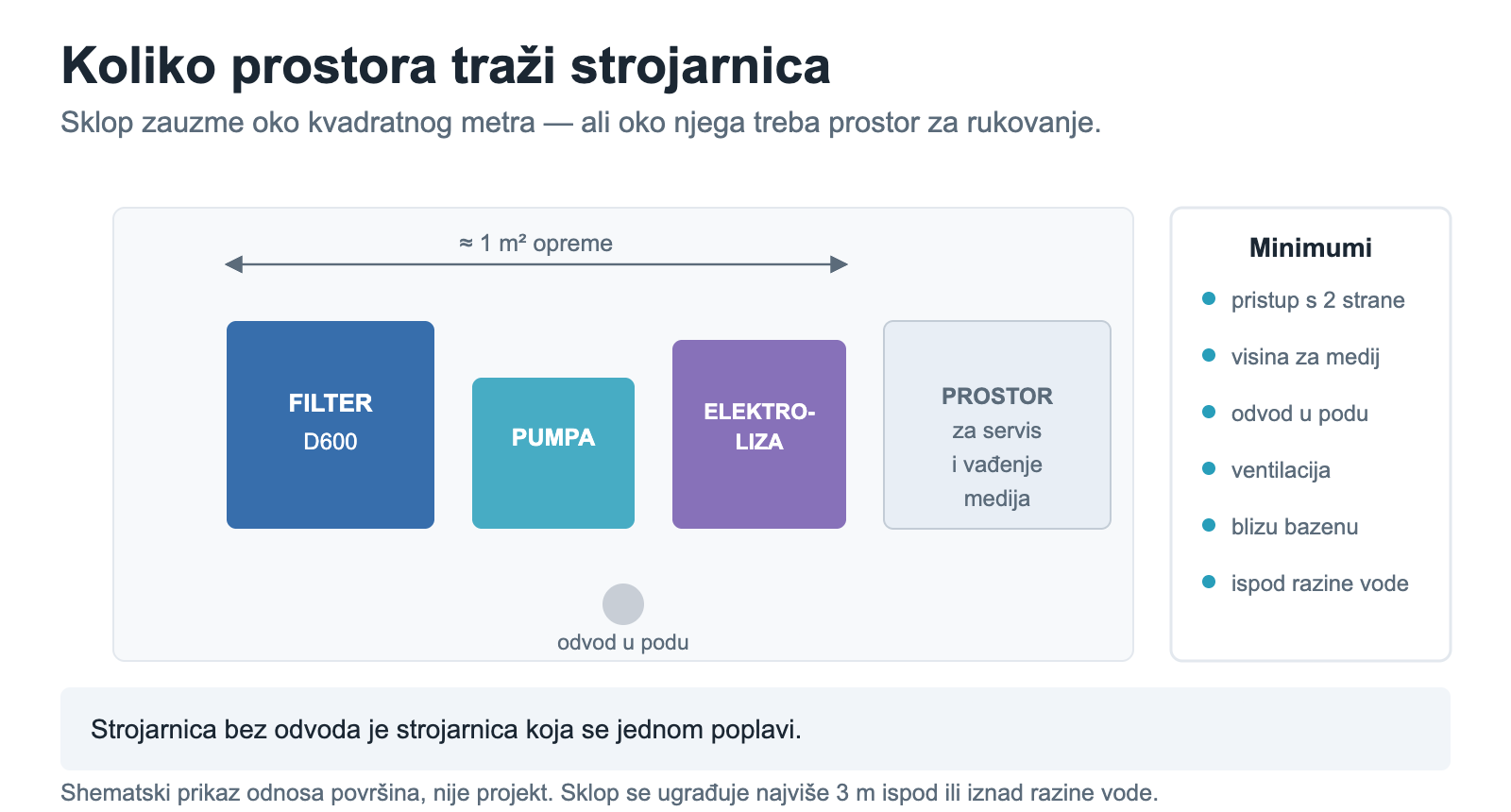
How much space does the engine room need?
More than people anticipate. A basic pump and filter assembly for an 8 × 4 m pool takes up about a square meter of floor space, but it needs room around it for handling.
Practical minimums from performance:
- Access from at least two sides. The pre-filter cover is opened weekly, the valve is turned by hand, and the filter is emptied and refilled once every ten years.
- Height sufficient for media removal. With the D600 filter, this means that there should be space above the bowl for a shovel and a bag.
- Floor drain. Washing the filter lets water in, seals leak at some point. An engine room without a drain is an engine room that floods at some point.
- Ventilation. The pump motor is cooled by air, and the heat pump requires air flow according to the manufacturer's specification.
- Close to the pool. Every meter of pipe and every elbow adds resistance.
- Elevation relative to water level. Below the water level it is always easier because the water reaches the pump on its own.
If the engine room is not planned in the project, it ends up in a niche that the repairman can hardly enter — and then the service is postponed until something breaks. This is one of the more common mistakes we find, and we described it in the text of Fr swimming pool in the yard.
How much does it all cost — example for an 8 × 4 m pool
Specifically, for 48 m³ of water and the required 12 m³/h flow rate, from our offer:
| Level | What does it include? | Approximate cost |
|---|---|---|
| Basic | Sena 75M pump (€610) · Aster D600 filter (€1,025) · 1½” multi-way valve (€145) · quartz sand (from €16/bag) | ≈ €1,900 |
| + salt electrolysis | basic + E-Next 12 g/h (€1,580) or Hidrolife SAL16 (€1,995) | ≈ €3,500–3,900 |
| + measurement and pH | previously + pH Expert dosing pump (850 €) + pH and Rx sensor (250 €) | ≈ €4,600–5,000 |
| + heating | Eco Elyo heat pump from €1,760 or exchanger from €500 | + €500–€2,600 |
| + automatic cleaning | robot from €750 to €2,200 | + €750–2,200 |
The amounts are approximate, from our offer, and do not include pipes, valves, assembly or electrical installation. They are not a binding offer. For comparison, the complete construction of a pool of this size is approximately €35,000, which we write about in detail in the text about price of a swimming pool 8 × 4 m — so the technique is of the order of 10–15 % of the total project.
Decision-making order
If we reduce everything above to a procedure, it goes like this:
- Calculate the volume — length × width × average depth.
- Calculate the required flow rate — (volume × 2) ÷ 8.
- Select a filter whose declared flow rate is equal to or greater, preferably one diameter larger.
- Choose the pipe diameter which can withstand this flow — and that before concreting.
- Choose a pump which provides the required flow rate and does not exceed the declared flow rate of the filter.
- Choose disinfection according to water volume — up to 100 m³ salt electrolysis, above automatic.
- Add measurement and dosing if you want the pool to maintain itself.
- Only at the end heating and cleaning — that can be added at any time.
Frequently asked questions
What constitutes a swimming pool engine room?
Four mandatory parts: a pump that moves the water, a filter that retains mechanical dirt, a multi-way valve that determines the direction of the water, and disinfection that destroys microorganisms. Optionally, measurement and automatic dosing of pH and disinfectant, heating, and UV sterilization are added. Robots and vacuum cleaners are not part of the engine room because they work in the pool and do not go through filtration.
In what order should the equipment be arranged?
The water always goes skimmer and floor suction → pump pre-filter → pump → multi-way valve → filter → heating → disinfection → return to the pool. Two rules always apply: heating and disinfection go after the filter, never before, because the exchanger and electrolysis cell must not receive impurities. When choosing, the order is different — the filter is chosen first because its declared flow rate sets a limit that the pump must not exceed.
How much space is needed for technology?
The pump and filter assembly for an 8 × 4 m pool takes up about a square meter, but the engine room requires significantly more: access from at least two sides, sufficient height for removing and refilling the filter media, a drain in the floor, ventilation for cooling the motor, and, preferably, a height below the water level in the pool. The assembly may be installed no more than 3 m below or 3 m above the water level; above this level, a self-priming pump and check valves are required.
Next step
Before requesting a quote for equipment, calculate the volume of the pool and decide where the machine room will physically be located in relation to the pool and the water level. These two pieces of information determine the rest of the list — flow rate, filter, pump, pipe diameter, and whether the installation will be simple or a construction project.
You can view the complete equipment for the engine room in category Engine roomWe carry out pool shell, lining and technology from Makarska to Zadar, and we provide a 5-year warranty on the construction and waterproofing. Send us the dimensions of the pool and the floor plan of the engine room. — we typically respond to inquiries within 24 hours and will compile a list of equipment with numbers, including what you don't need.
 English
  Hrvatski
  Deutsch
  Español
  Русский
  Italiano
  Nederlands
  Svenska
  Dansk
Dansk  Čeština
  Українська
  Português
  العربية
  Suomi
Suomi  简体中文
简体中文