

"Sand pump" in practice means monoblock — pump, filter and multi-way valve assembled on one plate. The size is not selected by the motor power but by flow: a pool 8 × 4 × 1.5 m (48 m³) needs approx. 12 m³/hThe amount of sand is not a matter of estimation — D400 holds 50 kg, D500 about 90–100 kg, D600 about 125 kg, and exceeding that number forces the sand back into the pool.
Below is the detail that the instructions for the device usually skip: where the monoblock can be placed in relation to the water level, in what order it is connected, what to do when putting it into operation for the first time and when a monoblock is not the right choice at all. If you are assembling an entire engine room, start with the guide through swimming pool technology and equipment.
What exactly is a "sand pump"?
The name is technically incorrect, but it has become common, so we use it. The pump does not filter anything — the sand container does. What is sold as a “sand pump” is a three-part assembly:
- Pump with a pre-filter (basket) that draws water from the pool.
- Filter bowl with quartz sand or activated glass.
- Multi-way valve which determines the direction of the water — filtration, washing, rinsing, circulation, discharge, closed.
Monobloc or separate components: A monoblock is the same system, only factory-assembled and with fewer joints that someone could make a mistake. The advantage is the speed of assembly and the price. The disadvantage is that you are tied to the combination chosen by the manufacturer — if you later need a larger filter, you change the entire assembly, not just the tank. For a concrete pool with a separate engine room, we usually perform separate pump and separate filter precisely because of that freedom.
Which size to choose?
Same calculation as for each filtration: flow = pool volume ÷ time of one change. German practice for private pools is two shifts per eight hours of operation, so the formula is (volume × 2) ÷ 8.
| Swimming pool | Volume | Requested flow | Monoblock from our offer | Price |
|---|---|---|---|---|
| 5 × 3 m | ≈ 20 m³ | 5.0 m³/h | Galactic D380 (5 m³/h) | 830 € |
| 6 × 3 × 1.4 m | 25.2 m³ | 6.3 m³/h | Galactic D500 (10 m³/h) | 935 € |
| 7 × 3.5 × 1.4 m | 34.3 m³ | 8.6 m³/h | Galactic D500 (10 m³/h) | 935 € |
| 8 × 4 × 1.5 m | 48 m³ | 12.0 m³/h | above the monoblock — separate pump and filter | — |
This is a point worth saying out loud: monobloc has an upper limit and the most requested dimension 8 × 4 m is already above it. Our monoblocs cover up to 10 m³/h, and a 48 m³ pool needs 12 m³/h. You can run it at 10 m³/h with longer hours of operation, but then you choose the compromise consciously, not by accident.
How much sand goes inside?
This is the number that people most often guess and most often miss. According to the instructions published by pooldoktor.at, the amounts per diameter of the container are:
| Diameter of the container | Amount of sand | Remark |
|---|---|---|
| D400 | 50 kg | one granulation |
| D500 | 90–100 kg | one granulation |
| D600 | 125 kg | one granulation |
| D750 | 300 kg | in layers: 75 kg coarse 2.0–3.0 mm + 225 kg fine 0.7–1.2 mm |
In larger containers, the sand goes in layers: coarser at the bottom, around the collecting branches, finer above it. That is why we also offer coarser granulation — it is no worse sand than the lower, supporting layer.
Common mistake: pour in “a little more, just in case”. The instructions are explicit — the filling amount is written on the container itself and must be followed, otherwise the sand washes into the pool. Above the prescribed level, there is not enough free space for the media to rise and dissolve during washing, so some of it is carried through the valve into the pool. Removing sand from the bottom of the pool is a half-day job and is perfectly avoidable.
Quick win when charging: Fill the container halfway with water before you start pouring in the sand, and cover the opening of the center pipe with your hand or a stopper. The water cushions the falling grains so they don't break the collection branches at the bottom, and the covered opening prevents sand from falling directly into the pipe. A broken branch isn't visible from the outside—you'll see it when sand leaks into your pool for months.

Where can the monoblock be placed?
There are two hard limits and a few practical rules.
Height difference according to water level. According to the same instructions, the assembly may be installed at most 3 m below or 3 m above the water level in the pool. If it is above the water level, it should self-priming pump and check valves — otherwise the pump loses water every time it stops and draws air the next time.
It's always easier below water level. The water then comes to the pump by itself and there is no question of filling. That is why the engine room for in-ground pools is almost always built in-ground, next to the pool.
Practical rules from performance:
- Dry and airy. The pump motor is cooled by air. A closed niche without ventilation shortens its life.
- Floor drain. Washing the filter lets water in, and the seals eventually leak. An engine room without a drain is an engine room that will eventually flood.
- Access from all sides. The pre-filter cover is opened every week and the valve is turned by hand. If the service technician can't get to it, neither can you.
- As close to the pool as possible. Every meter of pipe and every elbow adds resistance that the pump must overcome.
- The electrical connection is performed by an authorized electrician. The pool and engine room are areas with prescribed protection zones — it is not a place for an extension cord.
In what order does it connect?
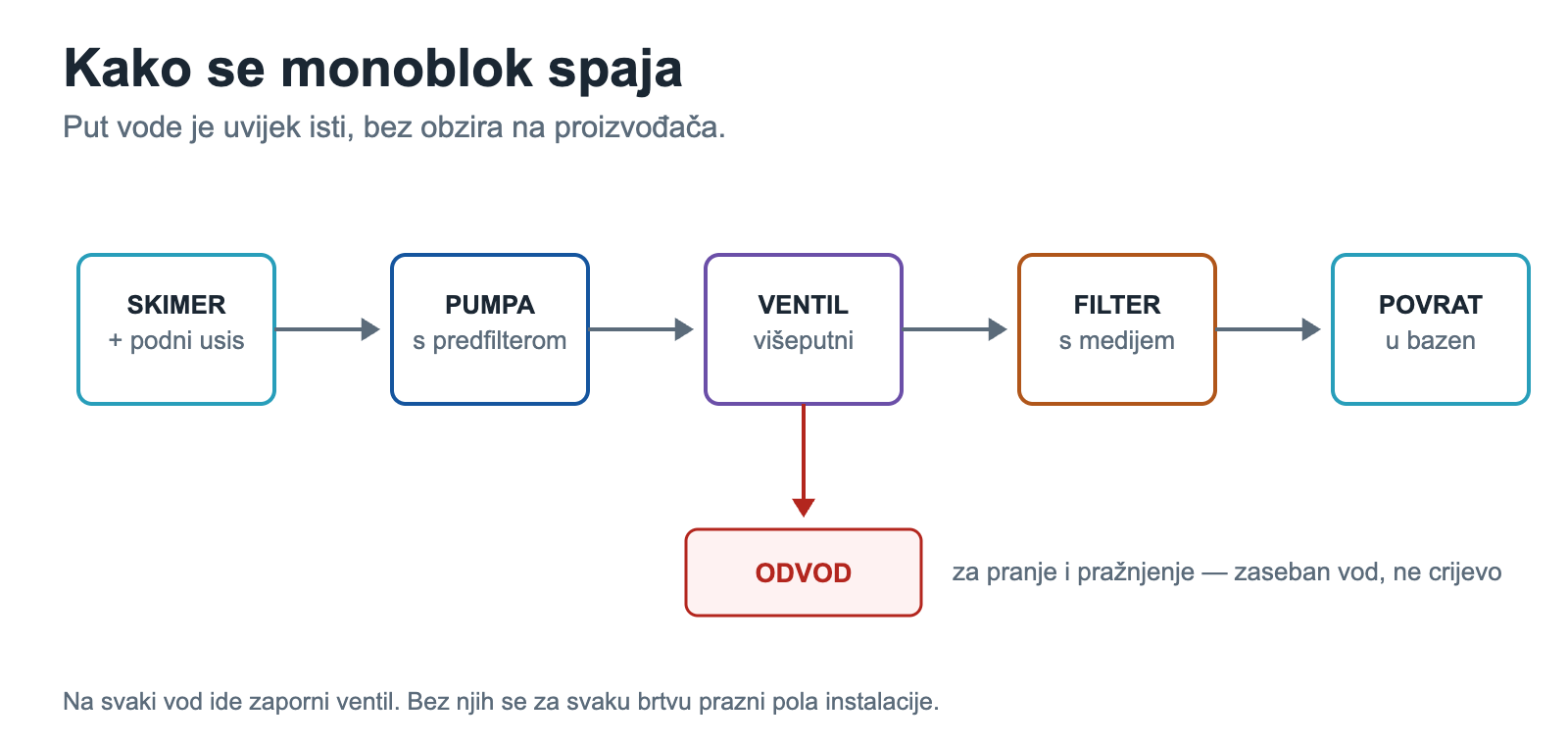
The path of water is always the same, regardless of the manufacturer:
- Skimmer and floor suction → suction line to the pump.
- Pump (with pre-filter basket) → pressure line to valve.
- Multi-way valve → filter bowl.
- From the filter → return to the pool jets.
- From the valve → separate line according to drain (for washing and emptying).
The drain line is the one that is most often forgotten or improvised with a hose. Water flows through it every time the filter is washed — close to a ton per wash for medium-sized filters. Check with your local utility company for pool water discharge requirements before connecting anything to the drain.
It goes to every line shut-off valveWithout them, half of the installation must be emptied for each seal replacement or basket cleaning.
First commissioning
The sequence that prevents the three most common beginner problems:
- Set the valve to "backwash" and then turn on the pump. New sand has dust and small particles that would otherwise go straight into the pool. Wash until the water in the sight glass runs clear.
- Then "rinse" for 20–30 seconds. This settles the media and expels the cloudy water from the collection branches.
- Only then to "filtration". Record the pressure the pressure gauge then shows — that is your zero point with clean media, a reference for the next ten years.
Pro tip: the valve turns only when the pump is off. Turning under pressure destroys the valve seal, a failure that only appears months later as a constant leak of water into the drain — so the owner spends months refilling the pool and looking for a crack that doesn't exist.
Maintenance throughout the season
Filter washing starts manometer, not calendar. The source states that washing is necessary when the pressure reaches approx 1.0 bar; in practice, a more reliable indicator is an increase of 0.3–0.5 bar above your zero point, because the absolute value varies from system to system.
In addition, weekly:
- Empty the pre-filter basket. A full basket chokes the pump just as effectively as a clogged filter.
- Check the water level. Below the middle of the skimmer, the pump starts to draw air.
- Listen to the pump. A change in sound to a “pebble” sound means air in the system or cavitation — shut down and investigate the cause before continuing.
For winter: drain the water from the pump and filter, leave the valve in an intermediate position so that the seal is not constantly pressed in the same place, and if the engine room is outdoors, disassemble and store the assembly. The sand does not need to be removed.
Frequently asked questions
What size sand pump should I choose?
By flow, not by power. Calculate flow as (pool volume × 2) ÷ 8 if you are aiming for two changes in eight hours of operation. A 6 × 3 × 1.4 m (25.2 m³) pool needs 6.3 m³/h, and an 8 × 4 × 1.5 m (48 m³) pool needs 12 m³/h. The monoblocs in our offer go up to 10 m³/h, so for a pool 8 × 4 m and larger you go for a separate pump and filter.
How much sand goes into the pump?
It depends on the diameter of the container: D400 holds 50 kg, D500 about 90–100 kg, D600 about 125 kg, and D750 a total of 300 kg in two layers — 75 kg of coarse 2.0–3.0 mm at the bottom and 225 kg of fine 0.7–1.2 mm above. The exact amount is written on the container itself and must be respected; if you pour more than the prescribed amount, the sand will wash into the pool during washing.
How to install a sand pump?
The unit is installed no more than 3 m below or 3 m above the water level in the pool; if it is above the level, a self-priming pump and non-return valves are required. The location must be dry, ventilated, with a floor drain and access from all sides. The water goes skimmer → pump → multi-way valve → filter → return to the pool, with a separate line from the valve to the washing drain. The electrical connection is carried out by a certified electrician.
Next step
Before purchasing, calculate the required flow rate from the pool volume and check two things at the location where you plan to install the unit: the height difference to the water level and whether there is a drain. These two items determine whether the installation will be an afternoon job or a construction project.
Monoblocs, separate pumps, filters and media can be viewed in category Engine roomIf you are not sure if a monoblock is enough for your pool, Let us know the dimensions of the pool and where you plan to install the engine room. — we typically respond to inquiries within 24 hours and will tell you openly when a monoblock is too small a choice for what you are building.
 English
 Hrvatski
 Deutsch
 Español
 Русский
 Italiano
 Nederlands
 Svenska
 Dansk
 Čeština
 Українська
 Português
 العربية
 Suomi
 简体中文