

Short answer: a robot if you want the pool to be cleaned by itself, a battery-powered vacuum cleaner if you clean occasionally and in a targeted manner. The difference is not only in price but also in who consumes the energy — the robot has its own motor from 150–200 watts and works independently of filtration, while the pump-driven vacuum cleaner forces the main pump to work extra hours. In our offer, this ranges from €335 to €2,200, and the limit is usually not set by the budget but by the size of the pool.
Below is a breakdown explaining the three types of cleaners that are constantly mixed up in ads, why filtration in a cleaner doesn't replace a filter in the engine room, and what you really get at each price point. If you're putting together an entire engine room, start with the guide through swimming pool technology and equipment.
Three types of cleaners, and why they keep getting mixed up
The words "vacuum cleaner", "cleaner" and "robot" are used interchangeably in Croatian advertisements for three technically different things:
- Hand-held vacuum cleaner with pump — a brush on a telescopic pole connected by a hose to a skimmer or a special attachment. It does not have its own motor; the suction is created by the main pump. The cheapest solution and the one that requires someone to stand by the pool.
- Battery vacuum cleaner — a self-contained device with its own pump and dirt basket. It doesn't need a hose or mains power. It does what a manual one does, but without being tied to a skimmer.
- Robot (automatic cleaner) — drives on the bottom and walls on its own, has its own motor, brushes and filter. It runs a cycle without supervision and regardless of whether the filtration is working.
Key difference: It's not about who vacuums better than who wastes your energy and who wastes your time. A handheld vacuum is the cheapest to buy and the most expensive to use — because you pay for the main pump and your own standing by the pool. A robot is the other way around. A battery-powered vacuum is in between: cheap, doesn't strain the pump, but you still have to operate it by hand.
Why is the robot not loading the filtration?
This is an argument that hardly anyone calculates. The robot runs on its own low-voltage motor — according to data provided by Poolbots, a typical robot pulls 150–200 watts and per 2.5 hour cycle it consumes 0.4–0.5 kWh. The same source states that pressure cleaners are looking for a booster pump from over 1,000 W, and suction cleaners require the main pump to run longer.
Now let's translate this into your system. If an 8 × 4 m pool has pump Victoria Plus Silent 100M of 0.78 kW, two additional hours of work due to vacuuming cost 1.56 kWh. The robot uses 0.45 kWh for the same job.
How it is calculated: The robot consumption is from the published data (150–200 W, 0.4–0.5 kWh per cycle). The pump consumption is our calculation from the declared power: 0.78 kW × 2 hours = 1.56 kWh. The ratio comes out approximately 3.5:1 in favor of the robot per cleaning. With two cleanings per week over a 22-week season, the difference is about 49 kWh — in money terms, about ten to twenty euros per year. The point is not in the amount, but in the fact that the “robot consumes electricity” story is turned upside down: the robot uses less than the way you would clean without it.
There is another, more important effect. Suctioning through the skimmer means that all the dirt from the bottom passes through the pump's pre-filter and through the filter — so the filter fills up faster and is washed more often. Each filter wash takes away close to a ton of water, as we wrote about in the article about pool filterThe robot retains this dirt in its own basket and removes it from the system.
Filtration in a purifier is not a replacement for a filter
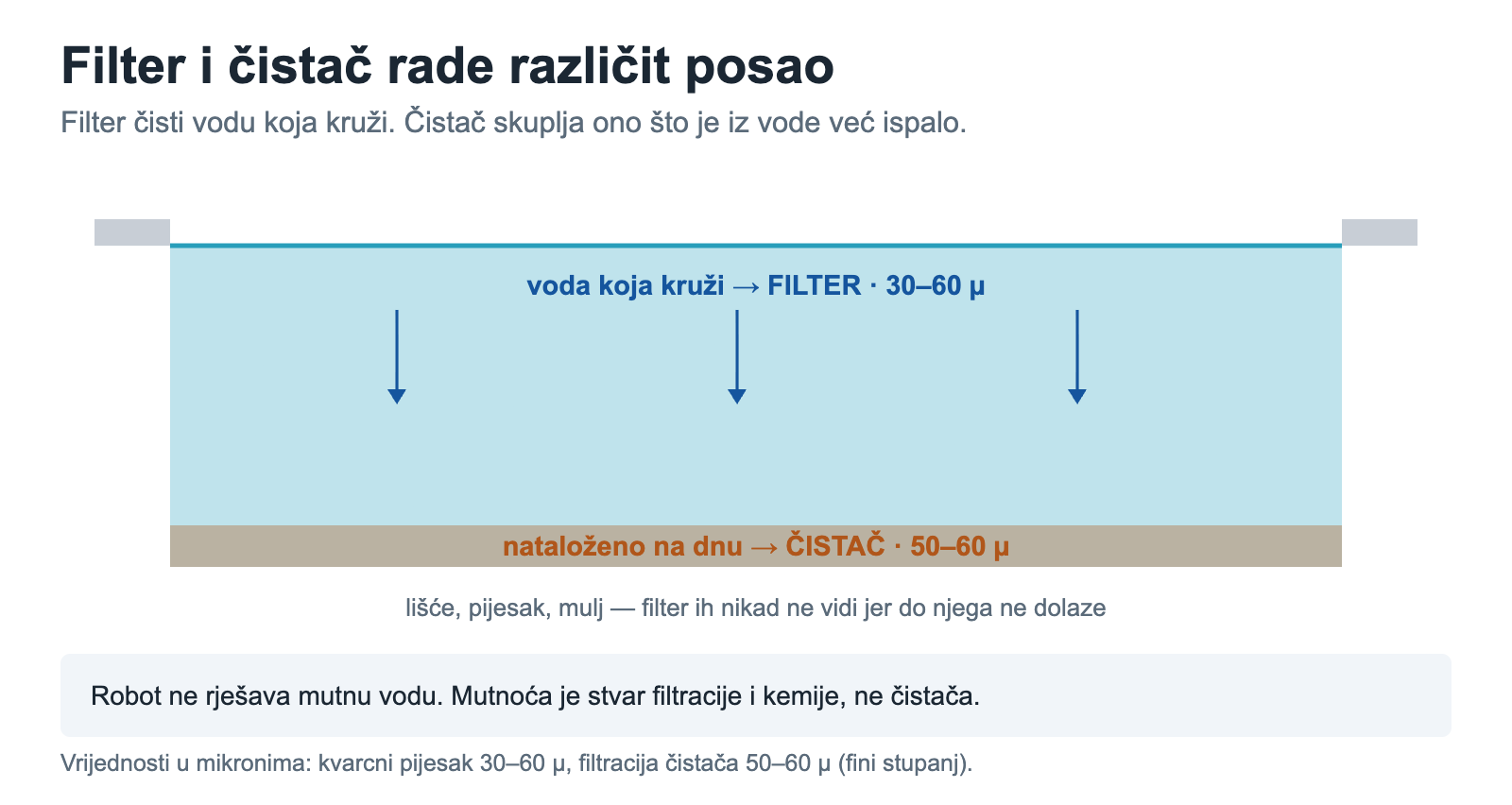
The marketing of cleaners likes to emphasize microns, so the impression is created that the robot replaces filtration. It does not replace — it does another job.
| Device | Fineness | What is catching? |
|---|---|---|
| Battery vacuum cleaner Voltera 75 | 250 + 50 µ | what has already fallen to the bottom |
| Zodiac RE 4300 Voyager | 150 / 60 µ (two-stage) | what has already fallen to the bottom and on the walls |
| Sand filter, quartz sand | 30–60 µ | what circulates in the water |
| Sand filter, active glass | up to 5 µ (declaration) | what circulates in the water |
The numbers are comparable, but the tasks are not. The filter cleans the water that passes through it; the purifier collects what has already fallen out of the water. Leaves, sand, and mud at the bottom will never see the filter because they can't reach it — and that's what bothers you the most when you get into the pool.
Common mistake: buy a robot to solve the cloudy water problem. Turbidity is a matter of filtration and chemistry, not the cleaner. If the water is cloudy, check the filtration rate, media condition and water treatment — the robot will pick up sludge from the bottom, but the water will still be cloudy. The robot solves the appearance of the bottom and walls, not the clarity.
Price ladder: what you get at each step
From our offer, sorted by price — and by how much work they take on from you:
| Device | Type | For pools up to | Price |
|---|---|---|---|
| Voltaire 75 | battery-powered vacuum cleaner, hand-operated · 75 min of operation · 3 kg of waste | smaller pools and spot cleaning | 335 € |
| GRE Action Vac | battery vacuum cleaner | smaller pools | 385 € |
| Zodiac OP 32 Pixel | automatic, wireless · floor and walls | — | 750 € |
| Zodiac RE 4300 Voyager | cable robot · cyclonic suction · filtration 150/60 µ · gyroscope and accelerometer | 10 × 5 m | 1.250 € |
| Zodiac RF 5200 iQ Freerider | cordless robot · lithium-ion battery | 10 × 5 m | 1.475 € |
| Zodiac RF 5400 iQ Freerider | cordless robot | 12 × 6 m | 1.675 € |
| Zodiac RF 5600 iQ Freerider | cordless robot · remote control | 12 × 6 m | 1.813 € |
| Zodiac RA 6800 iQ Alpha iQ | robot · Nav System · two-stage filtration · Wi-Fi | 15 × 7 m | 2.200 € |
Prices are from our offer and are subject to change; dimensions and filtration data are from the manufacturer. The entire assortment is in the category Automatic cleaners.
Pay attention to the column "for pools up to". This is the most important filter when choosing, more important than price. A robot declared for 10 × 5 m in a 12 × 6 m pool will not cover the entire surface in one cycle — not because it is weak, but because its cycle and cable length or battery life are not suitable for that surface.
Cable or battery?
With middle-class robots, this is the first decision today, and the difference is not in strength but in handling.
Cable robot (Voyager) has no duration limit — it can run long cycles and repeat them. The disadvantage is the cable: it twists, it needs to be unwound before and wound up afterwards, and it can limit the reach in the case of an irregularly shaped pool.
Cordless robot (The Freerider series) solves exactly that — there's nothing to twist, lower into the pool and take out, charge on the base. The downside is that the cycle lasts as long as the battery does, and the battery has a lifespan.
Recommendation: If your pool has straight sides and a regular shape, a cord is fine, and you get more robots for the same money — the Voyager for €1,250 offers cyclonic suction and two-stage filtration that cordless models in its class don't. If your pool is irregular, has curves, or the edge is such that you struggle with the cord, go for a cordless one. The difference in price of around €200 is repaid by how much you actually use it.
How to choose in three questions
- How big is the pool? This first narrows the choice. Up to 10 × 5 m, all options are open; above that you're looking at the 5400, 5600 or Alpha iQ. An 8 × 4 m pool — the most common dimension in our country — covers every robot on the list.
- Who will use it and how often? If the pool is used by a family who is there every day, a robot is worth it because it takes over the work. If it is a weekend house or a rental, a battery-powered vacuum with regular maintenance is often sufficient.
- What is the pool surrounded by? Pines, cypresses and scrubland mean leaves and needles every day — a robot is not a luxury here, but a requirement for the pool to be usable. A pool on an open terrace without greenery collects much less dirt.
Scope note: We do the pool shell, liner and engineering. Cleaners are equipment we sell and recommend, but they are not part of the structure — you can add them at any time, unlike pipe diameter or overflow type, which are decided before concreting.
Frequently asked questions
Robot or handheld vacuum cleaner — what to choose?
A robot if you want the pool to be cleaned without you and if it is surrounded by greenery that keeps falling into the water. A manual or battery-powered vacuum cleaner if you clean occasionally and specifically, or if the pool is small. Economically speaking, the robot consumes less energy than cleaning via the main pump: the robot draws 150–200 W and consumes 0.4–0.5 kWh per cycle, while two additional hours of operation of the 0.78 kW pump cost 1.56 kWh.
Does the robot clean walls too?
It depends on the model — it's not implied. The Zodiac OP 32 Pixel is declared for cleaning floors and walls, and the Voyager has tracks and gyroscopic sensors and an accelerometer for navigating pools of all shapes. As a rule, cheaper battery vacuum cleaners only work on the bottom. If it is important to you that both the walls and the water line are cleaned, check it explicitly in the specification, because the price difference is exactly there.
How much does a good robot cost?
In our offer, the robot starts at €750 for a wireless automatic cleaner, and a real robot with cyclonic suction and two-stage filtration starts at €1,250. For pools up to 12 × 6 m, the range is €1,675–1,813, and the top of the range with Wi-Fi control and coverage up to 15 × 7 m is €2,200. The decisive criterion is not the price but the declared size of the pool — a robot below that dimension will not cover the surface in one cycle.
Next step
Measure the pool and look at what surrounds it. These two pieces of information will help you make a choice faster than any comparison chart: the size determines which models are available, and the environment determines how long the cleaner will work. If you use your pool on weekends and there is no greenery nearby, you don't need a two-thousand-euro robot.
You can view robots and vacuum cleaners in the category Automatic cleanersIf you are not sure, send us the dimensions of the pool and a photo of the surroundings — we typically respond to inquiries within 24 hours and we will also tell you when the answer is that a €335 vacuum cleaner is enough for you.
 English
  Hrvatski
  Deutsch
  Español
  Русский
  Italiano
  Nederlands
  Svenska
  Dansk
Dansk  Čeština
  Українська
  Português
  العربية
  Suomi
Suomi  简体中文
简体中文