

Swimming pool construction is not just excavation and concreting the shell — it is a procedure that includes preparation of documentation, excavation, reinforced concrete structure, waterproofing, cladding, machine room with filtration, and water and electricity connections. For a family pool with a floor area of up to 100 m² buried in the ground, a building permit is not required, but the main design and application for the start of construction are. Construction typically takes 6 to 12 weeks.
This guide is written from the perspective of a team with 16 years of experience in the field, covering the territory from Makarska to Zadar through 800 to 1,000 completed projects. We go through what investors are interested in before the first contract: what paperwork is mandatory according to the regulations in force from January 1, 2026., what type of pool makes sense for your lot, how long it takes to build, how much it costs — and how much it costs each year after construction. Special emphasis is placed on what is different in Dalmatia, because this is where budgets and deadlines are most often missed.
Do I need a building permit for a swimming pool?
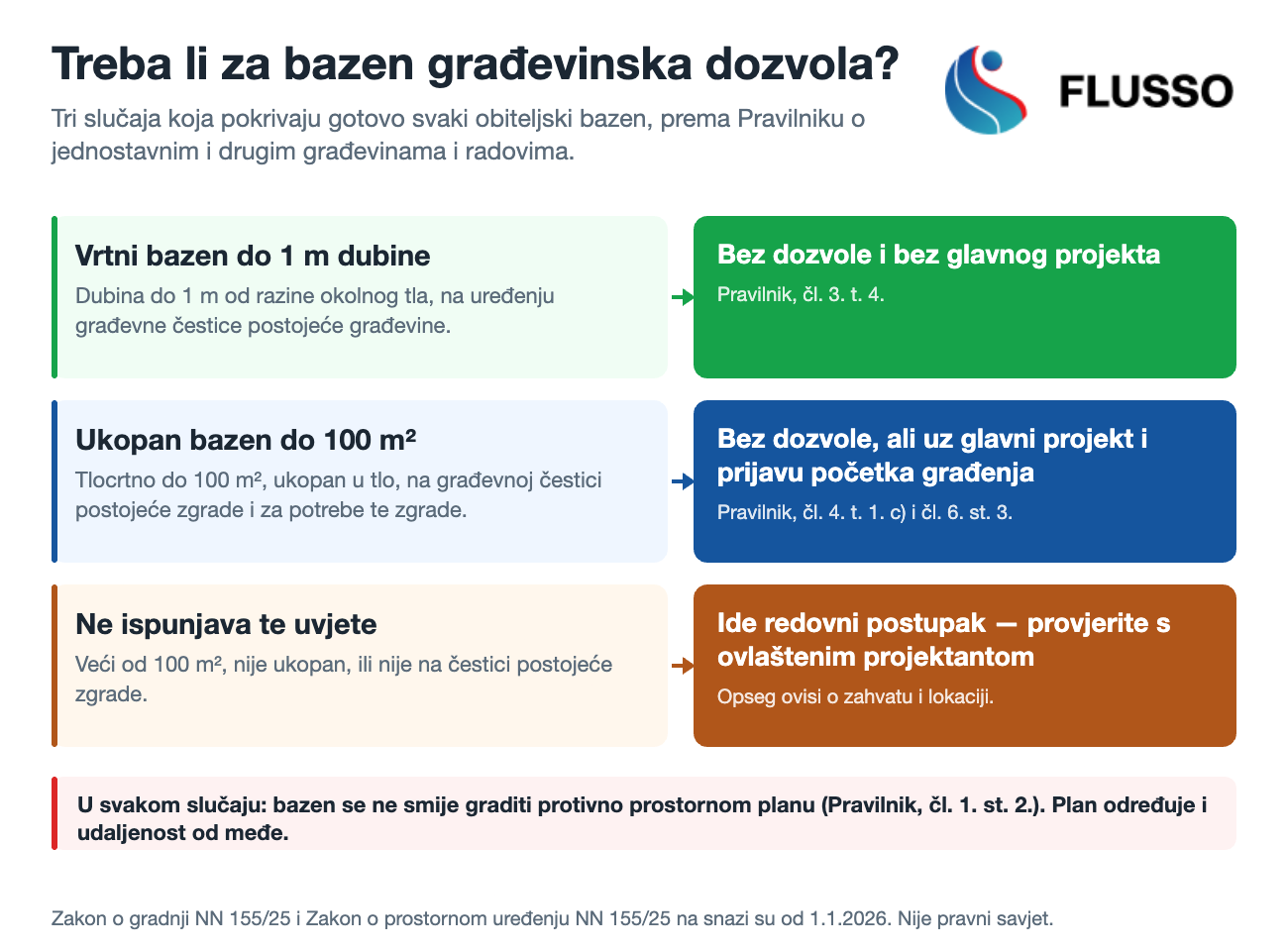
For the majority of family pools in Croatia building permit not requiredThe Regulation on Simple and Other Buildings and Works distinguishes between two regimes: a shallow garden pool can be built without documentation, while an in-ground pool up to 100 m² can be built without a permit, but in accordance with the main project and with mandatory notification of the start of construction. These two legal bases are often confused.
Garden pool up to 1 m deep — without a permit and without a master plan
According to article 3, point 4 of the Ordinance, without a building permit and without a main project, works can be carried out on the development of a building plot of an existing building, including the construction of "garden pool or pond up to 1 m deep from the surrounding ground level". Limitation depths up to 1 m refers exclusively to this category — shallow decorative pools and smaller water areas as part of garden landscaping.
A pool of up to 100 m² buried in the ground — without a permit, but with the main project
This is where almost every family pool comes in. Article 4, point 1. c) of the Regulations stipulates that without a building permit, and in accordance with the main project, an auxiliary building may be built on the building plot of an existing building, for the needs of that building, and "a swimming pool with a floor area of up to 100 m² buried in the ground".
The three conditions are cumulative — all three must be met simultaneously:
- Floor area up to 100 m². The floor plan is measured, not the circumference.
- The pool must be buried in the ground. Above-ground and prefabricated versions are not included in this point.
- It must be located on the building plot of an existing building and serve the needs of that building. If there is no existing building on the plot, this foundation is not valid.
There is also a related provision, Article 4, point 20., which treats in the same way "a swimming pool with a floor area of up to 100 m² buried in the ground within a building plot or within the scope of the intervention in the camp area".
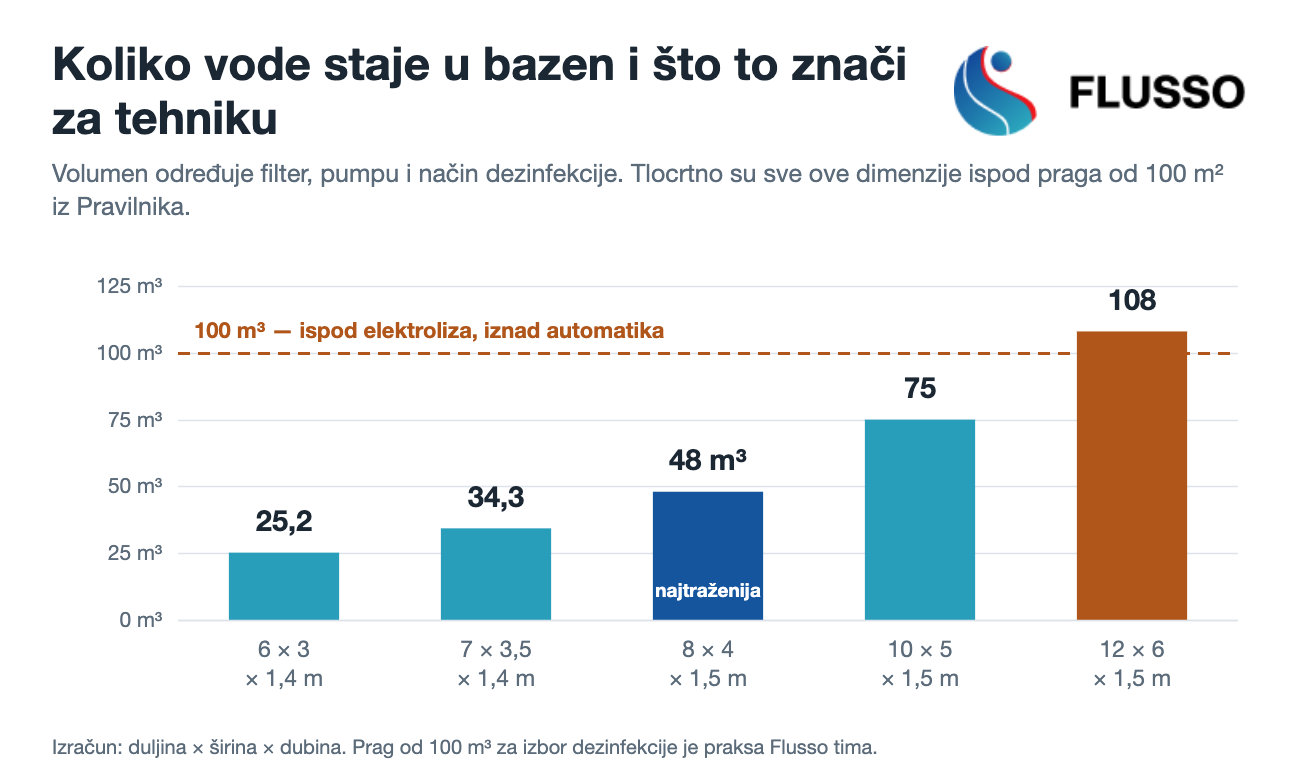
Practically: all the dimensions that are most often built are comfortably below the threshold. A 6 × 3 m pool has 18 m² of floor space, a 7 × 3.5 m has 24.5 m², the most popular 8 × 4 m has 32 m², a 10 × 5 m has 50 m², and even a large 12 × 6 m has 72 m² — still under 100 m².
Key: "without a building permit" does not mean "without a project". For a swimming pool up to 100 m² in-ground, a main project is mandatory because the Ordinance explicitly requires construction in accordance with the main projectThe main design is prepared by a certified designer.
Registration of the start of construction is mandatory
Article 6, paragraph 3 of the Regulations prescribes: "The investor is obliged to report the start of construction of buildings referred to in Article 4 of this Ordinance." Since a pool of up to 100 m² buried in the ground falls under Article 4, Registration of the start of construction is mandatory for him.. This is a step that investors often skip because they have only heard the first part of the story — "a swimming pool does not require a permit."
On the other hand, confirmations from public authorities in the main project and expert supervision are required according to Article 6, paragraphs 1 and 4. only for buildings for which a use permit is issued — those intended for the performance of activities or those recorded in the cadastre.
The spatial plan overrides the Ordinance.
This is the provision that thwarts the most projects, and is the one that is talked about the least. Article 1, paragraph 2 of the Regulations says that the buildings from the Regulations "they may not design, build or carry out work if this is prohibited by the spatial plan or otherwise contrary to the spatial plan".
The Ordinance, therefore, exempts you from the building permit, but not from the spatial plan. The distance from the boundary, the permitted development of the plot and the design conditions are determined by the valid spatial plan of your municipality or city, not the Ordinance. The first call is not to the contractor, but to the administrative department for spatial planning of the competent local government unit.
Beware of outdated sources: of January 1, 2026 new is in effect Construction Act (Official Gazette 155/25) and new Spatial Planning Act (Official Gazette 155/25). The old Construction Act (Official Gazette 153/13 and subsequent amendments) is no longer in force. Much of the pool text you'll find online still cites the old law — check the date before relying on it.
The new Construction Act stipulates that the contractor must meet the conditions for carrying out construction activities and appoint construction site engineer and/or construction manager who manages the construction and construction diary (Articles 21-23). Professional supervision is a general rule for buildings for which a building permit is issued (Art. 26, paragraph 1).
What you need depending on the type of pool
| Type of intervention | Building permit | Main project | Registration of the start of construction | Legal basis |
|---|---|---|---|---|
| Garden pool or pond up to 1 m deep from the surrounding ground level, on a plot of an existing building | Not | Not | Not prescribed by Article 6, paragraph 3 (refers to Article 4) | Regulations, Art. 3. item 4. |
| Swimming pool with a floor area of up to 100 m², buried in the ground, on the building plot of an existing building and for the needs of that building | Not | That — is being built in accordance with the main project | That — mandatory | Rulebook, Art. 4th t. 1. c) + Art. 6, paragraph 3. |
| Swimming pool up to 100 m², buried in the ground, within the building plot or within the scope of the intervention in the camp area | Not | That | That | Rulebook, Art. 4th t. 20. + Art. 6, paragraph 3. |
| Any of the above cases if the intervention is contrary to the spatial plan | It may not be designed, built or carried out — regardless of whether the project is listed in the Regulations. | Regulations, Article 1, Paragraph 2. | ||
Another good news for private investors: Ordinance on sanitary, technical and hygienic conditions of swimming pools (Official Gazette 59/2020) in Article 2 it explicitly states that does not apply to swimming pools owned by citizens that are not intended for public use. Your family pool does not have the same obligations as public swimming pools. The limit values from this regulation (pH 6.5–7.8, free chlorine 0.2–1.0 mg/l, turbidity up to 1.0 NTU, redox above 750 mV) are still a useful technical guide for water quality in private pools. Swimming pool water in public swimming pools is monitored by sanitary inspection of the State InspectorateCheck the conditions for discharging pool water with the competent utility company (in Split, ViK Split).
What type of pool to choose?
In Croatia, three technologies are realistically being chosen: concrete (reinforced concrete shell cast on site), polyester (finished shell that is delivered and lowered into the prepared excavation) and prefabricated (overhead structures made of metal, wood or panels). The difference is not only in the price but in how limited you are by the shape, depth and position of the pool.
Concrete pool There is no limit to the shape or depth. It is made to measure for the plot, it can have steps, a beach, a countercurrent, an overflow edge, integrated seats. We build exclusively concrete pools using classic concrete construction and this is the choice we recommend when the pool is part of the permanent decoration of the house. Disadvantage: it takes the longest and is the most expensive to start with.
Polyester pool is faster because the shell is ready. You are limited by the catalog of shapes, and — which is often crucial in Dalmatia — the shell has to physically reach the plot and be lowered by crane. On a narrow street in the old part of Trogir or on a plot with access through someone else's land, this can be impossible. Let's be honest: if you have a straight approach, a simple rectangular shape and want a pool quickly, polyester is a legitimate choice and concrete is not automatically "better".
Prefabricated pool is the cheapest entrance. It is not buried in the ground, so it does not fall into the category from Article 4. pt. 1. c) of the Ordinance and is treated differently. The solution is for temporary use and for budgets where an inground pool is not an option.
We have elaborated a detailed comparison of performances, advantages and disadvantages in separate texts: read built-in vs prefabricated pool — what to choose and why and comparison of concrete, polyester and overflow pools.
Skimmer or overflow pool?
The difference is in the water level and the way the water goes to the filtration. With skimmer The pool level is a few centimeters below the edge, and the water enters through skimmers in the wall. At overflow The water is flush with the edge and overflows over the entire circumference (or one side) into the overflow channel, then into the compensation tank.
An overflow basin has better hydraulics because the surface layer of water — the one with the most impurities — is removed along the entire length of the edge, not just at two or three points. In return, it requires a compensation tank, a larger engine room, and more precisely designed elevations, which is why it is more expensive.
Our recommendation from the field: if the plot is on a hill and has an open view of the sea — go to overflow or infinity design. The effect of joining the water surface with the sea works only when the edge of the pool is in the water plane and when the pool is placed at a height from which the sea can be seen. If the plot is in an urban area, surrounded by neighboring buildings and walls, there is nothing to do with that effect — then it is skimmer A pool is a more rational choice, or one that overflows on all sides if you want a peaceful surface without a view as an argument.
Infinity design is a subset of overflow: only the side facing the view overflows. We have built such pools in Trogir and Okrug Donji — where the elevation of the plot is good, the result justifies the difference in price. Where it is not, it does not.
What are the stages of pool construction and how long do they last?
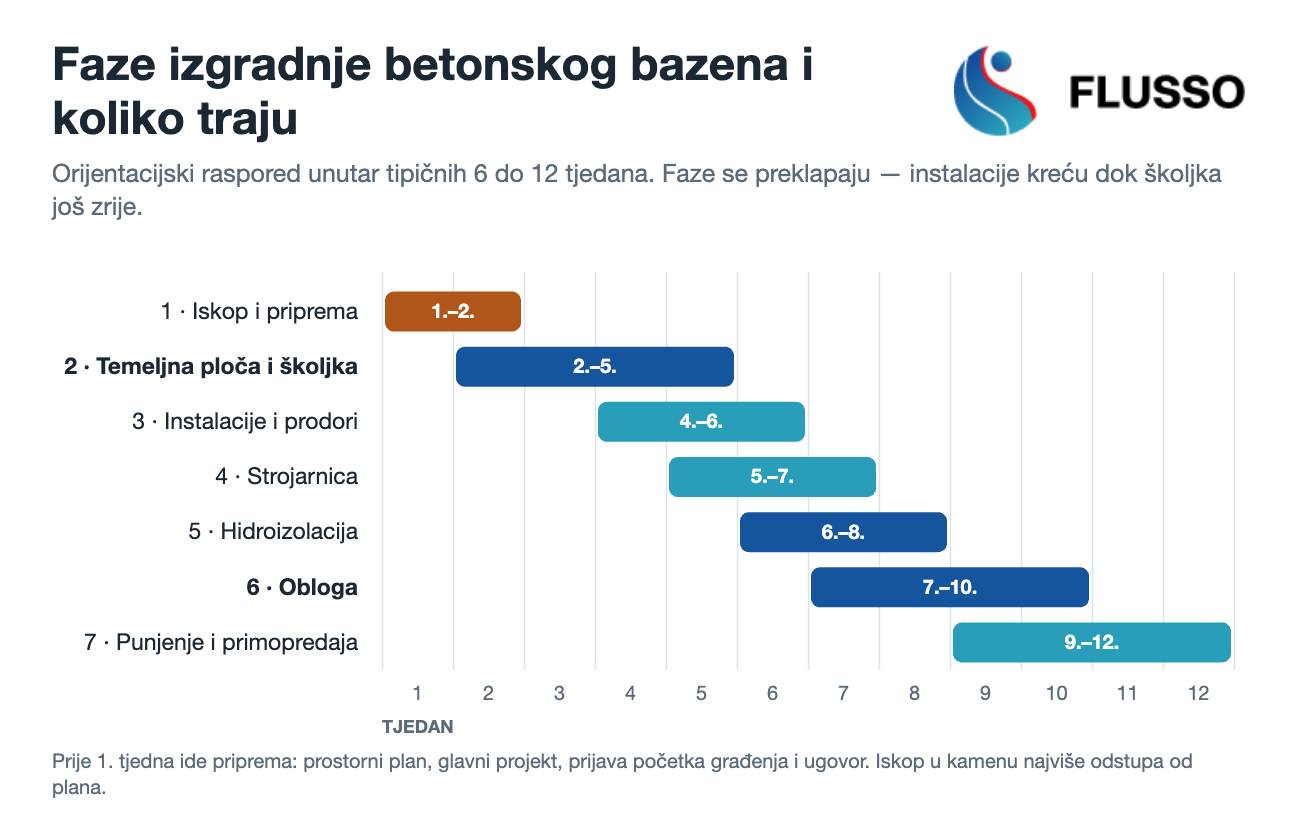
The construction of a concrete pool here typically takes time 6 to 12 weeks, depending on size and complexity. The lower limit applies to a simple skimmer pool in earthen soil with good access; the upper limit applies to an overflow pool with a rock excavation, demanding lining and additional equipment. The range does not include the development of the main design and preparation of documentation before the start of work.
| Phase | Orientation weeks | What exactly is being done? |
|---|---|---|
| Preparation (before start) | — | Checking the spatial plan, main project, notification of the start of construction, contract and deadline |
| 1. Excavation and site preparation | 1.–2. | Marking, excavation, removal of material, buffer layer. In stone, this phase lasts the longest and deviates the most from the plan |
| 2. Foundation slab and reinforced concrete shell | 2.–5. | Reinforcement, formwork, concreting of slabs and walls, care of concrete and removal of formwork |
| 3. Installations and penetrations | 4.–6. | Pipework, skimmers or overflow channel, nozzles, underwater lighting, grounding, cable routing |
| 4. Engine room | 5.–7. | Filter, pump, valves, automation, disinfection, heat pump if necessary |
| 5. Waterproofing and substrate preparation | 6.–8. | Leveling, waterproofing system, watertightness check |
| 6. Coating | 7–10. | PVC film, ceramic or glass mosaic. The mosaic lasts the longest because it is handmade |
| 7. Charging, commissioning, handover | 9.–12. | Water filling, chemistry balancing, filtration trial run, user training, documentation and warranty |
The phases overlap, so the sum of the individual spans is not the total duration. The order is firm: until the concrete has set, the lining does not go; until the lining is finished, the filling does not work.
When to book an appointment to have your pool ready for summer
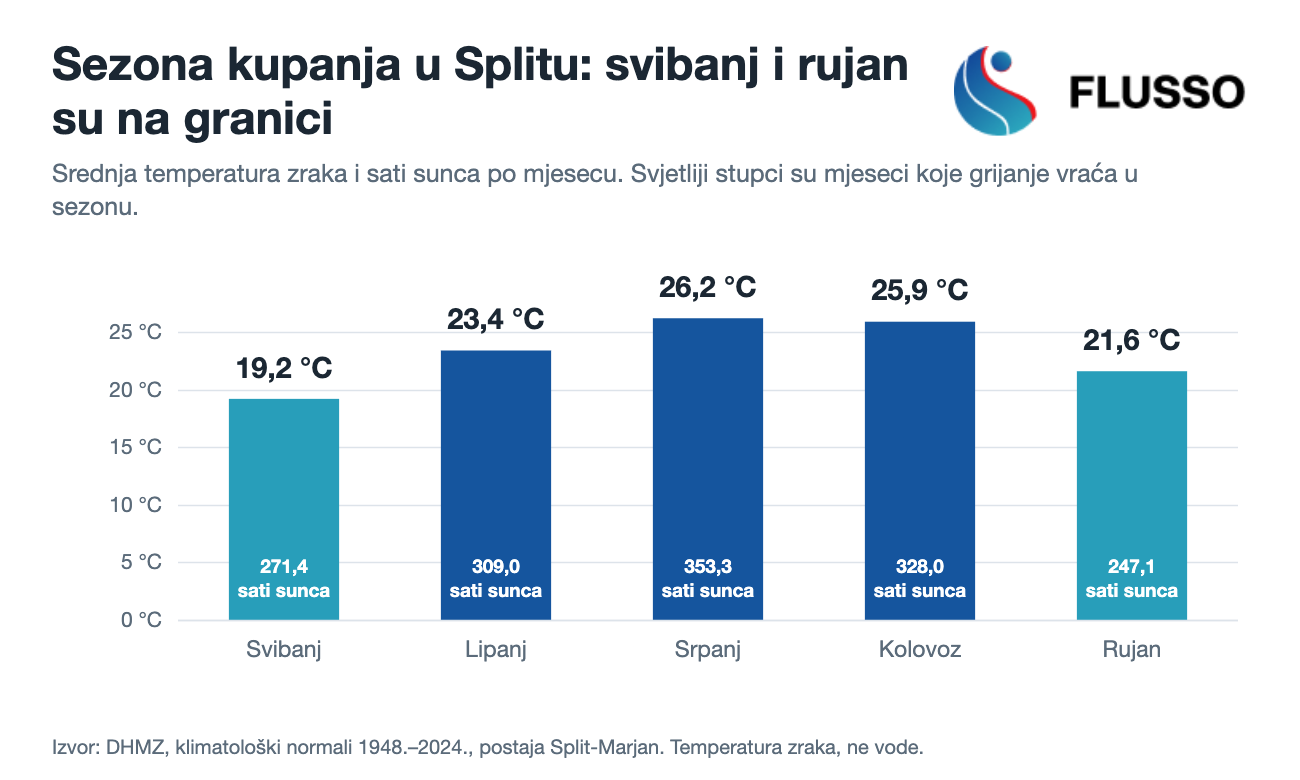
According to DHMZ climatological norms for the Split-Marjan station, the average monthly air temperature in May is 19.2 °C, in June 23.4 °C, in July 26.2 °C. If you want the pool to be operational at the beginning of the season, construction must be completed by the end of May. With a duration of 6 to 12 weeks, this means start of work no later than March — and since the main project and the notification of the start of construction precede the works, the conversation with the contractor really belongs in autumn or early winter of the previous year.
Quick win: Whoever sends the request in September gets to choose the date. Whoever sends it in April gets to wait. The construction season on the coast is short and dates are filled in advance — and the winter months are the best for excavation anyway because the terrain is not drained and the construction site does not interfere with the use of the yard.
How much does it cost to build a swimming pool?
Concrete skimmer a swimming pool measuring 8 × 4 m is usually around 35.000 €. Overflow the same size version is about 30 % is more expensive. A realistic minimum budget with which to enter a concrete pool project is 50.000 €, because the pool itself also includes landscaping, a terrace, a fence, lighting and connections — and that is not in our scope. These are all indicative ranges, not a binding offer.
What Flusso doesn't do: me we do not do turnkey work. We carry out pool shell, pool technology and lining — not landscaping around the pool (paving, terraces, fences, garden lighting, horticulture). This is the work of other contractors and you have to account for their cost separately. When comparing quotes, first check where with each contractor stops Scope of work — this is the most common cause of the difference between two offers that look comparable on paper.
Why the price per m² is misleading
The excavation, engine room, pipework and connections have a large fixed part that does not grow proportionally with the pool area. An 18 m² pool needs the same water connection and engine room as a 32 m² one. That is why the price per square meter decreases as the pool grows, and that is why with us The calculation is per project, not per m²..
Second reason: equipment is dimensioned by cubic meters of water, not by floor plan. A pool measuring 8 × 4 × 1.5 m has 48 m³, or 48,000 liters; the same floor plan with a smaller depth requires a second filter and a second pump. Two pools with identical floor plan areas can therefore have significantly different technical costs.
Flusso ranges and market ranges
| Item | Indicative amount | Source |
|---|---|---|
| Concrete skimmer pool 8 × 4 | ≈ €35,000 | Flusso |
| Concrete overflow pool (same size) | ≈ 30 % more expensive than skimmer | Flusso |
| Minimum budget for a concrete pool project | 50.000 € | Flusso |
| Vidrepur glass mosaic — material | €30–250/m² | Flusso |
| Mosaic — installation with basic mosaic, everything included | ≈ €160/m² | Flusso |
| Renolit foil | ≈ €110/m² | Flusso |
| Concrete pool — market range per m² | 900–1,250 €/m² | eMajstor.hr |
| Polyester in-ground pool — market range per m² | 780–1,080 €/m² | eMajstor.hr |
| Concrete pool — total market range | €25,000–€58,800 | Trebam.hr |
| Polyester inground pool — market scope | €13,800–20,000 | Trebam.hr |
| 8 × 4 × 1.5 pool with PVC liner — market range | €23,000–42,000 | bazenirijeka.com |
| Pool 8 × 4 × 1.5 with ceramic or mosaic — market range | €32,000–60,000 | bazenirijeka.com |
Read the complete breakdown of prices by item in the text. How much does it cost to build a swimming pool — prices by type and size, and if you are interested in the exact most requested dimension, take a look the price of the pool 8 × 4 m by dimensions.
What is being built differently in Dalmatia?
Four things change the design of a swimming pool on the Dalmatian coast compared to the continent: the soil is often rocky, The access to the construction site is narrow., the air carries salt and storm is a construction and operational factorEach of them has a direct impact on the price, deadline, or choice of materials — and none of them are visible in the photo of the finished pool.
Excavation in stone
Excavation in earthen soil is a predictable job. Excavation in hard rock is not: it requires different machinery, takes longer and produces material that must be removed. In offers, this item is most often stated as “according to the actual condition on the ground” and is the most common reason why the final bill deviates from the estimate. Ask the contractor how excavation in rock is calculated ago signatures, not after the first day of digging.
Access to the construction site
The finished polyester shell must reach the plot and be lowered by crane. In old cores, on steep approaches and on plots accessed via someone else's land, this can be impossible. A concrete pool is more tolerant because the material is delivered in parts, but even then the access determines which machinery can reach the excavation. Checking access is the first thing we do when going out into the field.
Salt, climate and season
Proximity to the sea means salt in the air and greater load on metal parts, lighting and cladding. This is an argument for quality components and for a coating that withstands UV and chemistry — in practice, we prefer glass mosaic, which has a longer life than foil, although it is more expensive and requires manual installation.
The climate, on the other hand, is the biggest asset. According to DHMZ data for Split-Marjan, there are 271.4 hours of sunshine in May, 309.0 in June, 353.3 in July, 328.0 in August and 247.1 in September. The average air temperature in September is 21.6 °C — higher than in May. September, which many write off, remains a full month of swimming with heating.
Information: In Split, from May to September, according to the climatological norms of the Croatian Meteorological Service, 1,508.8 hours of sunshine accumulate (271.4 + 309.0 + 353.3 + 328.0 + 247.1). According to these norms, May and September carry 271.4 and 247.1 hours of sunshine, respectively — these are the months that the solar blanket and heat pump bring back into the season.
Storm and buoyancy
The storm means that blankets, awnings and everything by the pool must be anchored and that light solutions do not survive. It also means more deposition of leaves and dust in the water, so more frequent cleaning and a higher filtration load than in the leeward direction.
Buoyancy is a structural issue: an empty pool in the ground with a high water table is exposed to hydrostatic pressure from below. That is why the pool is not emptied for no reason, and drainage and winterization are agreed upon during the project phase.
Market context: according to CBS data on issued building permits in 2025., in Split-Dalmatia County, the value of the works is estimated at €640,082 thousand, of which €395,447 thousand for residential buildings, with 2,481 apartments. Nationally, 11,733 permits worth €7.86 billion were issued, for 21,809 apartments (+6.9 % vs. 2024). Translated into contractor deadlines: demand on the coast is growing and this is reflected in the construction schedule.
Which technique to predict?
Pool equipment is dimensioned per cubic meter of water, not by floor plan. The volume determines the size of the filter and pump, and thus the price of the machine room. A pool measuring 8 × 4 × 1.5 m has 48 m³ of water — that is the number used to calculate the equipment, not the 32 m² floor plan.
Filtration and pump
Here we provide an overview; a full explanation — in what order the equipment is placed, how it is dimensioned, and where the limits are — can be found in the guide on swimming pool technology and equipment.
The filter and pump are the only equipment that runs every day, all season long. An undersized pump means that the water is not passing through the filter enough times a day and that the chemistry is failing to maintain quality — a mistake that is not visible in the first year, but in the third. Oversized means unnecessary electricity consumption. That's why we size by volume, with brands we have experience with: Speck for pumps, Astralpool and Zodiac for the rest of the system. These components make up swimming pool engine room.
Disinfection: salt electrolysis or automatic for liquid chlorine
The practice we apply is related to volume: up to approximately 100 m³ of water we go to salt electrolysis, above 100 m³ on automatic control for liquid chlorine and pH. Electrolysis is more user-friendly and there is no handling of canisters, but for large volumes, automatic liquid chlorine provides more stable regulation. For orientation: the 8 × 4 × 1.5 m (48 m³) and 10 × 5 × 1.5 m (75 m³) pools are in the electrolysis zone, while the 12 × 6 × 1.5 m with 108 m³ exceeds the threshold.
Heating and blankets
Astralpool heat pump for 8 × 4 swimming pool approximate cost about €3,000, and for 10 × 4 around €4,000. With the mentioned climate, this is the equipment that brings you back to May and September. This is equipment from the category pool heating.
Blankets simultaneously conserve heat and keep dirt out. Solar blanket is around 1.000 €, winter about 1.500 €, and roll cover depending on the model €8,000–20,000In Dalmatian conditions, with bora and drift, a cover is not a luxury but an item that directly reduces the cost of chemicals and hours of filtration work.
Pro tip: all penetrations, cable routes and connection points for the heat pump, countercurrent and lighting should be foreseen ago concreting. The subsequent installation of the equipment in the finished shell means savings, new waterproofing and repair of the lining. Decide on the entire technical package at the project stage, even if you buy some items later — pipes and cables can wait in the country.
What are the most common mistakes when building a swimming pool?
The number one mistake we find in other people's pools has nothing to do with technique: the height of the pool ultimately does not match the house and the surroundings. The pool is built correctly, but in relation to the elevation of the terrace, the entrance to the house or the slope of the garden it is placed incorrectly - so you have to go down three steps to get to it where there should be a level approach, or the edge of the pool cuts off the view from the living room. This cannot be fixed; it is solved exclusively at the design stage, by measuring the elevation and checking the views from the places where people are actually standing.
Other errors that logically follow from all of the above:
- Skipped notification of the start of construction. The investor heard that a permit is not required for a swimming pool up to 100 m² and concluded that nothing was needed. Article 6, paragraph 3, states otherwise.
- Unverified spatial plan. The Ordinance exempts permits, but Article 1, paragraph 2, prohibits construction contrary to the spatial plan. The inspection takes one call.
- Comparing offers of different scope. One includes the cladding and the technology, the other just the shell. The price difference then means nothing.
- Equipment dimensioned according to the floor plan. The filter and pump are selected according to the cubic meters of water; the same floor plan with different depths is not the same system.
- A budget without the environment. Paving, patio, fencing, and garden lighting are not part of pool work with most contractors — including us.
- Subsequent addition of equipment. Heating, countercurrent flow or lighting that are not planned before concreting will cost many times more later.
- A contract with no deadline and no description of the cost of rock excavation. On the Dalmatian terrain, this is the item that changes the final amount the most.
How much does it cost to maintain a swimming pool after construction?
Regular pool maintenance at our place is moving €300–400 per month, depending on the size of the pool. This includes checking the water condition, cleaning the pool shell and vacuuming, and any service required in the engine room. For comparison, publicly available market ranges for basic maintenance are from €50 to €120 per month, or €600 to €1,400 per year — the difference is in the scope of the service and whether it is a field service or self-maintenance with purchased chemicals.
If you maintain the pool all year with service, €300–400/month gives you €3,600–4,800 per year. In ten years, this is €36,000–48,000 — often more than the construction itself. That's why the cost of ownership, not just the cost of construction, must be part of the decision.
The hidden cost that no one counts: The coating has a lifespan. According to publicly available data, PVC foil lasts 10–15 years, and ceramics 20–30 years.. In the case of foil, therefore, within the first 15 years, the renewal of the covering comes as a separate investment. When choosing a covering, don't look at the price per m² today — look at it divided by the years of life.
Electricity: calculate in kWh, then multiply by your tariff
You can calculate the filtration consumption yourself and accurately, before you even build your pool. The formula is simple:
pump power (kW) × operating hours per day × number of days in the season = consumption in kWh
Read the pump power from the nameplate or from the technical data sheet of the offered model, then multiply the consumption by with his/her at a rate per kWh from the electricity bill. Arithmetic for a 180-day season:
| Pump power | 6 hours per day × 180 days | 8 hours a day × 180 days | 12 hours a day × 180 days |
|---|---|---|---|
| 0.5 kW | 540 kWh | 720 kWh | 1,080 kWh |
| 0.75 kW | 810 kWh | 1,080 kWh | 1,620 kWh |
| 1.1 kW | 1,188 kWh | 1,584 kWh | 2,376 kWh |
| 1.5 kW | 1,620 kWh | 2,160 kWh | 3,240 kWh |
The table is an arithmetic representation, not a recommendation for the operating mode — the hours of filtration operation are determined by the designer according to the volume of water and the load on the pool. The point is that you see an order of magnitude. ago pump selection.
Why is this calculation important in 2026? according to HEP's conditions for households from 1 January 2026., in the period from April 1 to September 30, 2026. consumption above 3,000 kWh in a six-month period it is charged 35 % more expensive — and that's the exact period the pool is operating. If a household is already close to the threshold, pool filtration can take it over it.
The energy part of the bill also includes regulated items: the use of the network in the white model amounts to 0.065702 €/kWh in higher and 0.028689 €/kWh in a lower tariff, in the blue model of unique 0.052324 €/kWh, with a fee for the metering point €1,983 per month and a fee for encouraging production from RES 0.013239 €/kWhThese items are subject to the price of the energy itself according to your supply contract, so read the total price per kWh from your own bill.
Practical consequence: operating the filtration at a lower tariff with the white model reduces the network cost per kWh to less than half. The setting is set once, automatically, and works every season.
How to choose a swimming pool contractor?
Choose a contractor based on three things: Does it meet the legal requirements?, Is the scope of work clearly defined in the offer? and Who will service the pool in five years?A swimming pool is a system that needs maintenance, so a contractor who disappears after the handover is more expensive than one who seemed more expensive at the start.
Questions to ask each bidder:
- Who is the appointed works manager and is he licensed? The new Construction Act (Official Gazette 155/25) requires the contractor to appoint a construction site engineer and/or works manager who manages the construction and keeps a construction diary.
- Do you cooperate with a certified designer for the main project? Without a master plan, a swimming pool up to 100 m² in-ground may not be built.
- Where exactly does your scope of work end? Looking for a list of what it is not included, not just what is.
- How is rock excavation calculated? Fixed, per cubic meter, per hour of mechanization — and who bears the risk of deviation.
- What is the warranty and what does it cover? Construction and waterproofing are things you can't fix yourself.
- What does the service look like after handover and in what time frame do you go out for intervention?
- What brands of equipment do you install and are you authorized for them? Serviceability and availability of spare parts depend on this.
- Can I see the completed project live? The photo is marketing, the constructed pool on the field is proof.
Our answers to the same questions: 16 years of experience in the profession, between 800 and 1,000 completed projects, a team of 12 people (pipe fitters, electricians, repairmen, engineering works manager, expert works manager / senior electrician), professional construction manager license, cooperation with the authorized designer for the main project, 5 year warranty on construction and waterproofing, authorized distributor of Avantopool and partner of Astralpool and Zodiac, response to inquiry typically within 24 hours and going out for intervention within 24 hoursWe cover the area from Makarska to Zadar.
Read more about how we work from the first outing to the handover on the page construction and maintenance of swimming pools.
Frequently asked questions
Do I need a building permit for a swimming pool in Croatia?
For a swimming pool with a floor area of up to 100 m², buried in the ground, on the building plot of an existing building and for the needs of that building, a building permit is not required — but the pool must be built in accordance with the main project and the start of construction must be reported (Regulations on Simple and Other Buildings and Works, Art. 4, item 1, c) and Art. 6, paragraph 3). A garden pool with a depth of up to 1 m from Art. 3, item 4 does not require either a permit or a main project. In both cases, the project must not be contrary to the spatial plan.
How long does it take to build a concrete pool?
A concrete pool typically takes 6 to 12 weeks to build, depending on the size and complexity of the project. This time does not include the preparation of the main design and the notification of the start of construction, which take place before the start of work. For a pool in operation at the beginning of the season, work should start no later than March, and the discussion with the contractor should take place in the autumn of the previous year.
How much does an 8 × 4 meter pool cost?
A concrete skimmer pool 8 × 4 m costs approximately €35,000, while an overflow version of the same size costs around €30,000. A realistic minimum budget for the entire concrete pool project is €50,000. These are approximate ranges, not binding offers — the final price depends on the processing, technique, excavation conditions and access to the construction site.
Skimmer or overflow pool — which is better?
It depends on the elevation and view from the plot, not on the budget. If the plot is on a hill with an open view of the sea, an overflow or infinity design justifies the difference in price because the water surface visually connects to the sea. In an urban environment, where this view is not available, a skimmer pool provides the same comfort at a lower price and a simpler machine room.
How much does it cost to maintain a swimming pool monthly?
Regular maintenance with a service technician costs €300–400 per month, depending on the size of the pool, including water testing, shell cleaning, vacuuming and engine room service. Publicly published market ranges for more basic maintenance are €50–120 per month. Calculate electricity separately: multiply the pump power in kW by the operating hours and days of the season, and then multiply the resulting kWh by your tariff.
Next step
If you are building a swimming pool in 2026, the order of actions is: check the spatial plan with the relevant administrative department, hire a licensed designer for the main project, register the start of construction, and only then choose a contractor and a date. If you do it in reverse order, you will lose months.
For a specific estimate, we need three pieces of information: the dimensions you want, the type of soil, and how to access the construction site. Send them via the contact form and we respond with an orientation range, typically within 24 hours.
Note: all amounts are indicative ranges and are not a binding offer. Legal provisions are listed according to regulations in force in July 2026; before proceeding, check the current edition of the regulations and the spatial plan for your plot.
 English
 Hrvatski
 Deutsch
 Español
 Русский
 Italiano
 Nederlands
 Svenska
 Dansk
 Čeština
 Українська
 Português
 العربية
 Suomi
 简体中文